
Machine Learning: Decision Trees
Decision Trees •One kind of classifier (supervised learning) •Outline: –The tree –Algorithm –Mutual information of questions –Overfitting and Pruning –Extensions: real-valued features, tree rules, pro/con . A Decision Tree • A decision tree has 2 kinds of nodes 1. Each leaf node has a class label, determined by
Download Machine Learning: Decision Trees

Information
Domain:
Source:
Link to this page:
Documents from same domain
REVIEW - University of Wisconsin–Madison
pages.cs.wisc.edulearning discovers intricate structure in large data sets by using the backpropagation algorithm to indicate how a machine ... NATURE | VOL 521 | 28 MAY 2015 REVIEW

The Adaptive Lasso and Its Oracle Properties
pages.cs.wisc.eduThe Adaptive Lasso and Its Oracle Properties Hui Z OU Thelassoisapopulartechniqueforsimultaneousestimationandvariableselection.Lassovariableselectionhasbeenshowntobeconsistent

Cookbook - University of Wisconsin–Madison
pages.cs.wisc.eduThis cookbook integrates a variety of topics in probability the-ory and statistics. It is based on literature [1,6,3] and in-class material from courses of the statistics …

Understanding Modern Device Drivers
pages.cs.wisc.eduUnderstanding Modern Device Drivers Asim Kadav and Michael M. Swift Computer Sciences Department, University of Wisconsin-Madison ... kernel code with over 5 million lines of code in the Linux kernel, and cause significant complexity, bugs and development costs. ... drivers. In addition, a better understanding of driver code can lead ...
Introduction to Database Systems Module 1, Lecture 1
pages.cs.wisc.eduDatabase Management Systems, R. Ramakrishnan 5 Data Models A data model is a collection of concepts for describing data. A schema is a description of a particular collection of data, using the a given data model. The relational model of data is the most widely used model today.
DATABASE MANAGEMENT SYSTEMS SOLUTIONS MANUAL THIRD EDITION
pages.cs.wisc.edu1 INTRODUCTION TO DATABASE SYSTEMS Exercise 1.1 Why would youchoosea databasesysteminstead ofsimply storingdata in operating system files? When would it make sense not to use a database system? Answer 1.1 A database is an integrated collection of data, usually so large that it has to be stored on secondary storage devices such as disks or tapes.
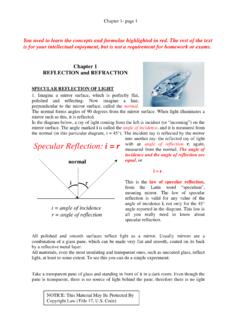
Specular Reflection: i = r
pages.cs.wisc.eduREFLECTION and REFRACTION SPECULAR REFLECTION OF LIGHT 1. Imagine a mirror surface, which is perfectly flat, polished and reflecting. Now imagine a line, perpendicular to the mirror surface, called the normal. The normal forms angles of 90 degrees from the mirror surface. When light illuminates a

CS 547 Lecture 34: Markov Chains
pages.cs.wisc.eduCS 547 Lecture 34: Markov Chains Daniel Myers State Transition Models A Markov chain is a model consisting of a group of states and specified transitions between the states. Older texts on queueing theory prefer to derive most of their results using Markov models, as opposed to the mean

CS 547 Lecture 35: Markov Chains and Queues
pages.cs.wisc.eduContinuous Time Markov Chains Our previous examples focused on discrete time Markov chains with a finite number of states. Queueing models, by contrast, may have an infinite number of states (because the buffer may contain any number of ... which are treated the same as any other transition in a Markov …

1 An Inside Look at Botnets
pages.cs.wisc.eduAn Inside Look at Botnets Paul Barford Vinod Yegneswaran {pb,vinod}@cs.wisc.edu Computer Sciences Department University of Wisconsin, Madison Abstract The continued growth and diversification of the Internet has been accompanied by an increasing prevalence of attacks and intrusions [40]. It can be argued, however,
Related documents

Decision Trees: Information Gain - University of Washington
courses.cs.washington.eduLast Time: Basic Algorithm for Top-DownLearning of Decision Trees [ID3, C4.5 by Quinlan] node= root of decision tree Main loop: 1. Aßthe “best” decision attribute for the next node. 2.Assign Aas decision attribute for node. 3.For each value of A, create a new descendant of node. 4.Sort training examples to leaf nodes.
Introduction to boosted decision trees - INDICO-FNAL (Indico)
indico.fnal.govDecision/regression trees Learning: Each split at a node is chosen to maximize information gain or minimize entropy Information gain is the difference in entropy before and after the potential split Entropy is max for a 50/50 split and min for a 1/0 split The splits are created recursively

Classification: Basic Concepts, Decision Trees, and Model ...
www-users.cse.umn.eduthe decision tree that is used to predict the class label of a flamingo. The path terminates at a leaf node labeled Non-mammals. 4.3.2 How to Build a Decision Tree In principle, there are exponentially many decision trees that can be con-

CSC 411: Lecture 06: Decision Trees
www.cs.toronto.eduI Decision trees can express any function of the input attributes I E.g., for Boolean functions, truth table row !path to leaf: Continuous-input, continuous-output case: I Can approximate any function arbitrarily closely Trivially, there is a consistent decision tree for any training set w/ one path

Decision Trees Another Example Problem
www.d.umn.eduTop-Down Induction of Decision Trees Main loop: 1. A = the “best” decision attribute for next node 2. Assign A as decision attribute for node 3. For each value of A, create descendant of node 4. Divide training examples among child nodes 5. If training examples perfectly classified, STOP Else iterate over new leaf nodes
Chapter 9 DECISION TREES
www.ise.bgu.ac.ilDecision Trees 167 In case of numeric attributes, decision trees can be geometrically interpreted as a collection of hyperplanes, each orthogonal to one of the axes. Naturally, decision-makers prefer less complex decision trees, since they may be consid-ered more comprehensible. Furthermore, according to Breiman et al. (1984)

MSJC COVID-19 Decision Trees
www.msjc.eduDecision Trees developed by San Diego County Office of Education and Health & Human Services Agency and modified by Mt. San Jacinto Community College District COVID-19 Team. Title: MSJC COVID-19 Decision Trees Author: Sherry …

EXTRA PROBLEM 6: SOLVING DECISION TREES p being …
www2.seas.gwu.eduSOLVING DECISION TREES Read the following decision problem and answer the questions below. A manufacturer produces items that have a probability of .p being defective These items are formed into . Past experience indicates thatbatches of 150 some are of and others are of (batches) good quality (i.e ...