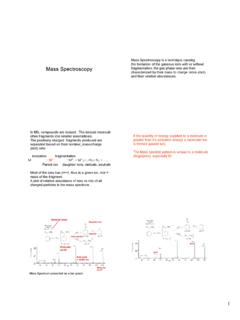
Mass Spectroscopy
1 Mass Spectroscopy Mass Spectroscopy is a technique causing the formation of the gaseous ions with or without fragmentation; the gas phase ions are then
Download Mass Spectroscopy

Information
Domain:
Source:
Link to this page:
Documents from same domain
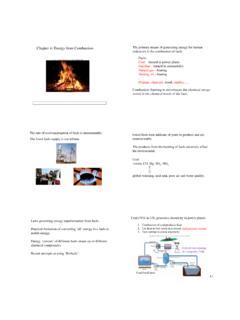
Chapter 4: Energy from Combustion The primary …
web.mnstate.eduChapter 4: Energy from Combustion The primary means of generating energy for human endeavors is the combustion of fuels. Fuels: Coal -burned in power plants Gasoline -burned in automobiles

African Environmental Issues - Minnesota State …
web.mnstate.eduAfrican Environmental Issues . Environment in Africa: continuity & change. •Important to consider geological age of Africa & its tropical location. •Both affect
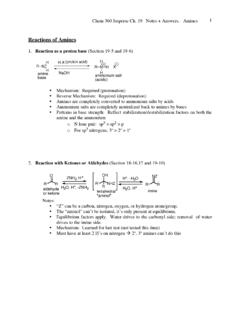
Reactions of Amines - Minnesota State University …
web.mnstate.eduChem 360 Jasperse Ch. 19 Notes + Answers. Amines 1 Reactions of Amines 1. Reaction as a proton base (Section 19-5 and 19-6) RN H H N H R H H X …

Test3 ch17b Buffer-Titration-Equilibrium Practice …
web.mnstate.edu4 Preparation and Recognition of Buffer Systems 14. Which of the following is not a buffer system? A solution containing roughly equal concentrations of _____ a.
Standardization of a Hydrochloric Acid Solution
web.mnstate.eduPage 1 Spring 2011 Standardization of a Hydrochloric Acid Solution The purpose of this experiment is to test your lab technique and examine potential sources of error in

Some Arrow-Pushing Guidelines (Section 1.14)
web.mnstate.eduOrganic Chemistry I Review: Highlights of Key Reactions, Mechanisms, and Principles 1 Some Arrow-Pushing Guidelines (Section 1.14) 1. Arrows follow electron movement.

Recrystallization I 9 Chem 355 Jasperse RECRYSTALLIZATION
web.mnstate.eduRecrystallization I 9 Chem 355 Jasperse RECRYSTALLIZATION Background: Impurities often contaminate organic compounds, whether they have been synthesized in

1. Given the relation R (1 1) (1 3) (1 4) (2 2) (3 1) (3 4 ...
web.mnstate.edu9. For each of the following collections of subsets of A= {1,2,3,4,5}, determine whether of not the collection is a partition. If it is, list the ordered pairs in the equivalence relation determined by the partition.
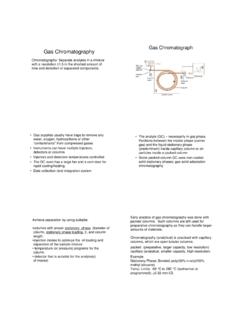
Gas Chromatograph Gas Chromatography
web.mnstate.eduColumn selection GC: Select a stationary phase that would retain (‘dissolve’) the analytes of interest. Stationary phase polarity ~ analyte polarity; (like dissolves like). Selectivity to individual analytes determines the quality of separation (ability to discern the

Acute Stress Response Spectrum Adaptationist Perspectives ...
web.mnstate.edurecent literature, freeze, flight, fight, fright, faint provides a more complete description of the human acute stress response sequence than current descriptions.
Related documents
Infrared Spectroscopy and Mass Spectrometry
crab.rutgers.eduInfrared Spectroscopy and Mass Spectrometry Introduction It is fundamental for an organic chemist to be able to identify, or characterize, the new compound that he/she has just made.
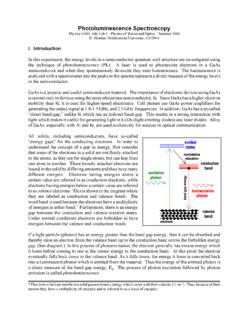
Photoluminescence Spectroscopy
tns.ndhu.edu.twvalence band excited states conduction band excitation photon luminescence photon nonradiative relaxation band gap energy electrons Photoluminescence Spectroscopy
INFRARED SPECTROSCOPY (IR)
utdallas.edu4 ELECTROMAGNETIC SPECTRUM Most organic spectroscopy uses electromagnetic energy, or radiation, as the physical stimulus. Electromagnetic energy (such as visible light) has no detectable mass
Determining the Structure of an Organic …
www.chemistry.sjsu.edu1 Determining the Structure of an Organic Compound The analysis of the outcome of a reaction requires that we know the full structure of the products as well as the reactants
ICP OPTICAL EMISSION SPECTROSCOPY …
www.horiba.com5 ICP OPTICAL EMISSION SPECTROSCOPY TECHNICAL NOTE 05 standards across the mass range of the analytes, will help to compensate for these effects, although
19.3 SPECTROSCOPY OF ALDEHYDES AND KETONES
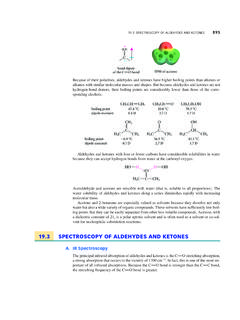
www.saplinglearning.com19.3 SPECTROSCOPY OF ALDEHYDES AND KETONES 895 Because of their polarities, aldehydes and ketones have higher boiling points than alkenes or alkanes with similar molecular masses and shapes.
Chemical Analysis of Polymeric Materials Using …
www.t-pot.euOutlines Basic Theory of Infrared Specrtrocopy Molecular vibrational energy, infrared spectroscopy and its selection rules Interpretation of Infrared spectra, group frequency and
Related search queries
Infrared Spectroscopy and Mass Spectrometry, Photoluminescence Spectroscopy, INFRARED SPECTROSCOPY IR, Spectroscopy, Mass, Determining the Structure of an Organic, Determining the Structure of an Organic Compound, ICP OPTICAL EMISSION SPECTROSCOPY, ICP OPTICAL EMISSION SPECTROSCOPY TECHNICAL NOTE, 19.3 SPECTROSCOPY OF ALDEHYDES AND KETONES, Chemical Analysis of Polymeric Materials Using