
Math 55: Discrete Mathematics
Math 55: Discrete Mathematics UC Berkeley, Fall 2011 Homework # 5, due Wednesday, February 22 5.1.4 Let P(n) be the statement that 13 + 23 + + n3 = (n(n+ 1)=2)2 for the positive integer n. a) What is the statement P(1)? b) Show that P(1) is true. c) What is the induction hypothesis? d) What do you need to prove in the inductive step?
Download Math 55: Discrete Mathematics

Information
Domain:
Source:
Link to this page:
Documents from same domain
The Foundations of Geometry - UCB Mathematics
math.berkeley.eduthe foundations of geometry by david hilbert, ph. d. professor of mathematics, university of gÖttingen authorized translation by e. j. townsend, ph. d.
Teaching Geometry in Grade 8 and High School …
math.berkeley.eduTeaching Geometry in Grade 8 and High School According to the Common Core Standards H. Wu c Hung-Hsi Wu 2013 October 16, 2013 Contents Grade 8 6 1.Basic rigid motions and congruence (page 8)

Math 54: Linear Algebra and Differential Equations Worksheets
math.berkeley.eduA linear system corresponds to an augmented matrix, and the operations we use on a linear system to solve it correspond to the elementary row operations we use to change a matrix into row echelon form.

Teaching Fractions According to the Common Core Standards
math.berkeley.eduTeaching Fractions According to the Common Core Standards H. Wu c Hung-Hsi Wu 2013 August 5, 2011 (revised February 8, 2014) Contents Preface 2 Grade 3 5 Grade 4 17 Grade 5 33 Grade 6 59 Grade 7 80 I am very grateful to David Collins and Larry Francis for very extensive corrections. 1. ... the fractions 1 3 or 5, much less 1 11. At some point ...

Galois Theory - math.berkeley.edu
math.berkeley.eduGalois Theory David Corwin August 19, 2009 0 Preliminaries Remark 0.1 (Notation). jGjdenotes the order of a nite group G. [E: F] denotes the degree of a eld extension E=F. We write H Gto mean that H is a subgroup of G, and NE Gto mean that N is a normal subgroup of G. If E=F and K=F are two eld extensions, then when we say that K=F is

SOLUTION: ASSIGNMENT 5 - UCB Mathematics | Department …
math.berkeley.eduObserve that T(c) = t0 = 0 where c is any constant polynomial, and hence T is not an isomorphism because ker T ,f0g(e.g. it contains constant polynomials). Remark.

Basic Analysis: Introduction to Real Analysis
math.berkeley.eduIntroduction 0.1 About this book This book is a one semester course in basic analysis. It started its life as my lecture notes for teaching Math 444 at the University of …
THE CATEGORICAL LANGUAGE OF QUANTUM PHYSICS …
math.berkeley.eduTHE CATEGORICAL LANGUAGE OF QUANTUM PHYSICS 3 Example 2.8. If is a directed graph, then we can construct a category C whose objects are the vertices of and whose morphisms are possible paths between pairs of points (the

Homework from Section 4.5 4.5.3. - UCB Mathematics
math.berkeley.eduHomework from Section 4.5 4.5.3. Find two positive numbers whose product is 100 and whose sum is a minimum. We want x and y so that xy = 100 and S = x + y is minimized.
An Introduction to String Theory - UCB Mathematics
math.berkeley.eduM-Theory (Becker, Becker and Schwarz), Introduction to String Theory (Polchinski), String Theory in a Nutshell (McMahon) and Superstring Theory (Green, Schwarz and Witten), along with the lecture notes of David Tong, sometimes word-for-word.
Related documents

Discrete-Time Signal Processing - Second Edition
entsphere.comDiscrete-Time Signal Processing - Second Edition Author: Alan V. Oppenheim Keywords: 1998 Prentice Hall ISBN: 0-13-754920-2 Created Date: 10/28/2005 5:12:18 AM ...

Introduction to Discrete-Event Simulation
personal.denison.eduDiscrete-event simulation is stochastic, dynamic, and discrete Stochastic = Probabilistic - Inter-arrival times and service times are random variables - Have cumulative distribution functions Discrete = Instantaneous events are separated by intervals of time - The state variables change instantaneously at separate points in time ...
Discrete Mathematics - NYU Courant
cims.nyu.edudiscrete mathematics. (“Discrete” here is used as the opposite of “continuous”; it is also often used in the more restrictive sense of “finite”.) The aim of this book is not to cover “discrete mathematics” in depth (it should be clear from the description above that such a task would be ill-defined and impossible anyway).

CONDITIONAL PROBABILITY Discrete random variables ...
ctools.ece.utah.eduDiscrete random variables DEFINITIONS, FORMULAS (CONT.) TOOL: Using the Law of Total Probability and the axiom that probabilities of all outcomes in the sample space sum to unity, we can derive additional equations for conditional probability.

Discrete and Continuous Random Variables
ocw.mit.edu15.063 Summer 2003 44 Discrete Random Variables A probability distribution for a discrete r.v. X consists of: – Possible values x 1, x 2, . . . , x n – Corresponding probabilities p
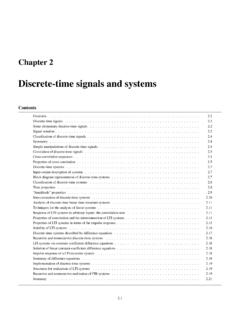
Discrete-time signals and systems
web.eecs.umich.eduA discrete-time system is a device or algorithm that, according to some well-dened rule, operates on a discrete-time signal called the input signal or excitation to produce another discrete-time signal called the output signal or response .

A Course in Discrete Structures - Cornell University
www.cs.cornell.eduDiscrete mathematics deals with objects that come in discrete bundles, e.g., 1 or 2 babies. In contrast, continuous mathematics deals with objects that vary continuously, e.g., 3.42 inches from a wall. Think of digital watches versus analog watches (ones where the second hand loops around continuously without stopping).
Discrete Mathematics Problems
www.unf.eduThis booklet consists of problem sets for a typical undergraduate discrete mathematics course aimed at computer science students. These problem may be used to supplement those in the course textbook. We felt that in order to become proficient, students need to solve many problems on their own, without the temptation of a solutions manual!