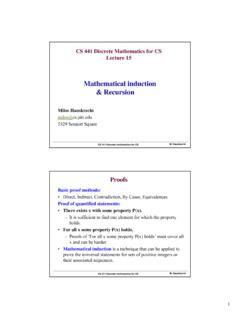
Mathematical induction & Recursion
Mathematical induction • Used to prove statements of the form x P(x) where x Z+ Mathematical induction proofs consists of two steps: 1) Basis: The proposition P(1) is true. 2) Inductive Step: The implication P(n) P(n+1), is true for all positive n. • Therefore we conclude x P(x).
Download Mathematical induction & Recursion

Information
Domain:
Source:
Link to this page:
Documents from same domain
CS 1652: Data Communication and Computer Networks …
people.cs.pitt.edufrom the application layer to the data-link layer. Concurrent with the lectures, you (in groups of two) will be building a functional TCP/IP stack and a small web server that will run on it.

Informal proofs - University of Pittsburgh
people.cs.pitt.eduInformal proofs Proving theorems in practice: • The steps of the proofs are not expressed in any formal language as e.g. propositional logic

MIPS Floating Point Instructions
people.cs.pitt.edu11/9/2011 1 MIPS Floating Point Instructions CS/COE 447 Why Floating Point? • Sometimes need very small, or very large numbers? Non-integers?
Foundations of Artificial Intelligence
people.cs.pitt.edu“The branch of computer science that is concerned with the automation of in-telligent behavior” (Luger+Stubblefield, 1993) Views of AI fall into four categories: Thinking humanly Thinking rationally Acting humanly Acting rationally Examining these, we will plump for acting rationally (sort of) AIMA Chapter 1 (after Russell and Norvig) 3

Propositional logic: Horn clauses
people.cs.pitt.edu• Horn form (Horn normal form) • Two inference rules that are sound and complete with respect to propositional symbols for KBs in the Horn normal form: – Resolution (positive unit resolution) – Modus ponens (A∨¬B) ∧(¬A∨¬C ∨D) Can be written also as: (B ⇒ A) ∧(( A ∧C) ⇒ D) CS 2740 Knowledge Representation M. Hauskrecht ...
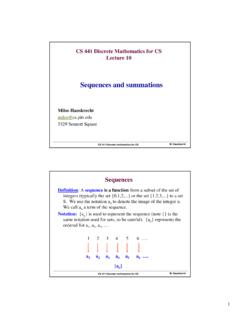
Sequences and summations
people.cs.pitt.eduSequences and summations CS 441 Discrete mathematics for CS M ... Arithmetic progression Definition: An arithmetic progression is a sequence of the ... -1, 3, 7, 11, … 3 CS 441 Discrete mathematics for CS M. Hauskrecht Geometric progression Definition A geometric progression is a sequence of the form: a, ar, ar2, ..., ark, where a is the ...

Time Series: Autoregressive models AR, MA, ARMA, ARIMA
people.cs.pitt.eduGaussian White Noise {A particular useful white noise is Gaussian white noise, wherein the w ... -20 0 20 40 60 80 12/77. Time Series Analysis The procedure of using known data values to t a time series ... Measures of Dependence A complete description of a time series, observed as a

Introduction to Kernel Methods
people.cs.pitt.edu1 Introduction to Kernel Methods Dave Krebs CS 3750 Fall 2007 ... Paradigm for Pattern Analysis. Kernel Methods in Bioengineering, Signal and Image Processing. 2007. ... 9 Mercer’s Condition (continued) if and only if, for any g(x) such that is finite, then It can be ...
Probabilities: Expected value
people.cs.pitt.eduExpected value Investment problem: • You have 100 dollars and can invest into a stock. The returns are volatile and you may get either $120 with probability of 0.4, or $90 with probability 0.6. • What is the expected value of your investment? • M. Hauskrecht Expected value Investment problem: • You have 100 dollars and can invest into a ...
Sets and set operations - University of Pittsburgh
people.cs.pitt.edu• Ordered-n tuples are used to represent an ordered collection. Definition: An ordered n-tuple (x1, x2, ..., xN) is the ordered collection that has x1 as its first element, x2 as its second element, ..., and xN as its N-th element, N 2. Example: • Coordinates of a point in the 2-D plane (12, 16) x y
Related documents
Abstract Algebra Theory and Applications
abstract.ups.eduAug 16, 2013 · A certain amount of mathematical maturity is necessary to nd and study applications of abstract algebra. A basic knowledge of set theory, mathe-matical induction, equivalence relations, and matrices is a must. Even more important is the ability to read and understand mathematical proofs. In
INTRODUCTION TO THE SPECIAL FUNCTIONS OF …
www.physics.wm.eduProof by mathematical induction 6 1.4Definition of an infinite series 7 Convergence of the chessboard problem 8 Distance traveled by A bouncing ball 9 1.5The remainder of a series 11 1.6Comments about series 12 1.7The Formal definition of convergence 13 1.8Alternating series 13 ...
Mathematical Methods for Physics and Engineering
ee.sharif.edu8.1 Vector spaces242 Basis vectors; inner product; some useful inequalities 8.2 Linear operators247 8.3 Matrices249 8.4 Basic matrix algebra250 Matrix addition; multiplication by a scalar; matrix multiplication 8.5 Functions of matrices255 8.6 The transpose of a matrix255 8.7 The complex and Hermitian conjugates of a matrix256 8.8 The trace of ...

Introduction to Mathematical Proof
monks.scranton.eduIntroduction to Mathematical Proof Lecture Notes 1 What is a proof? Simply stated A proof is an explanation of why a statement is objectively correct. Thus, we have two goals for our proofs. •Veracity - we want to verify that a statement is objectively correct. •Exposition - we want to be able to effectively and elegantly explain why it is correct. However, these two goals are …
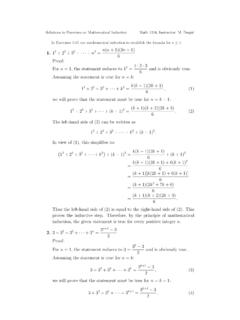
Solutions to Exercises on Mathematical Induction Math 1210 ...
home.cc.umanitoba.caThus the left-hand side of (8) is equal to the right-hand side of (8). This proves the inductive step. Therefore, by the principle of mathematical induction, the given statement is true for every positive integer n. 5. 1 + 4 + 7 + + (3n 2) = n(3n 1) 2 Proof: For n = 1, the statement reduces to 1 = 1 2 2 and is obviously true.

Question 1. Prove using mathematical induction that for ...
home.cc.umanitoba.caInduction Examples Question 7. Consider the famous Fibonacci sequence fxng1 n=1, de ned by the relations x1 = 1, x2 = 1, and xn = xn 1 +xn 2 for n 3: (a) Compute x20. (b) Use an extended Principle of Mathematical Induction in order to show that for n 1, xn = 1 p 5 [(1+ p 5 2)n (1 p 5 2)n]: (c) Use the result of part (b) to compute x20. Solution ...
Mathematical Reasoning FINAL 05.01 - NCERT
ncert.nic.in(iii) The sum of 5 and 7 is greater than 10. (iv) The square of a number is an even number. (v) The sides of a quadrilateral have equal length. (vi) Answer this question. (vii) The product of (–1) and 8 is 8. (viii) The sum of all interior angles of a triangle is 180 °. (ix) Today is a windy day . (x) All real numbers are complex numbers. 2.
Mathematical Induction - Stanford University
web.stanford.eduTheorem: The sum of the first n powers of two is 2n – 1. Proof: By induction.Let P(n) be “the sum of the first n powers of two is 2n – 1.” We will show P(n) is true for all n ∈ ℕ. For our base case, we need to show P(0) is true, meaning the sum of the first zero powers of two is 20 – 1. Since the sum of the first zero powers of two is 0 = 20 – 1, we see
Structural Induction - UMD
www.cs.umd.eduStructural induction is a proof methodology similar to mathematical induction, only instead of working in the domain of positive integers (N) it works in the domain of such recursively de ned structures! It is terri cally useful for proving properties of such structures. Its structure is sometimes \looser" than that of mathematical induction.
1.1 The Natural Numbers - University of Utah
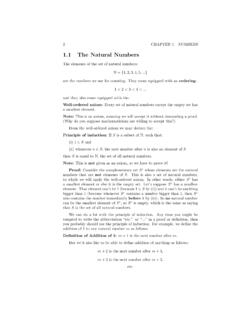
www.math.utah.eduNext we turn to proofs by induction. A mathematical sentence P is an (ordinary) sentence that is definitely either true or false. For example: • “There are 5 days in a week” is a false mathematical sentence, • “14 >13” is a true mathematical sentence, and • “5+2 = 8” is another false mathematical sentence, but