
Mathematics: Principles and practice
answers as opportunities to improve and deepen children’s understanding of mathematical concepts. The experiences and outcomes encourage learning and teaching approaches that challenge and stimulate children and young people and promote their enjoyment of mathematics. To achieve this, teachers will use a skilful mix of approaches, including:
Download Mathematics: Principles and practice

Information
Domain:
Source:
Link to this page:
Documents from same domain
Gaelic Education: Building on the successes, …
education.gov.scotGaelic Education: Building on the successes, addressing the barriers 1 Foreword The inspectorate has a strong and well-established commitment to promoting Gaelic
English for Speakers of Other Languages (ESOL)
education.gov.scotBackground . In 2015 – 16, £1,455,000 was allocated to Community Planning Partnerships to support the delivery of English for Speakers of Other Languages (ESOL) Programmes.
Learner Participation in Educational Settings (3-18)
education.gov.scotDefining Learner Participation Principles for Learner Participation: • equal opportunities for inclusive, voluntary participation • respect for children and young people’s …
How good is our school? (4th edition) - Education …
education.gov.scotHow good is our school? How good is our school? 4 5 Introduction This edition of How good is our school? aims to support the growth of a culture of self-improvement across Scottish education. It builds on previous editions
Rainbow Fish assembly resource - Education Scotland
education.gov.scotRainbow Fish assembly resource Stage Early stage (pre-school years and P1) Rationale Sometimes young children find sharing difficult. Using this story will help them see the benefits of doing this.
How good is OUR school? Part 1 - education.gov.scot
education.gov.scotHow good is OUR school? A toolkit to support learner participation in self-evaluation and school improvement. Part One 1 Contents Chief Executive Officer’s Foreword 2
Health and wellbeing - Education Scotland
education.gov.scotHealth and wellbeing: experiences and outcomes 2 Mental, emotional, social and physical wellbeing The mental, emotional, social and physical wellbeing of everyone within a learning community should be positively developed by fostering a safe, caring, supportive,
A professional development framework for Scotland's adult ...
education.gov.scot7 The Scottish Government, as part of the implementation of its ten-year strategy for raising the literacies levels of Scotland’s adults, has identified the need for a professional development
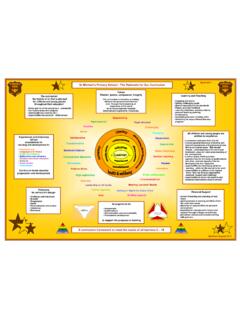
Evaluating and Improving our Curriculum – Primary ...
education.gov.scotEarly learning and Evaluating and Improving our Curriculum – Primary childcare The curriculum What is Curriculum for Excellence? What can learners expect? How is the curriculum organised? How is progress assessed? Building your curriculum Curriculum planning What is Building your Curriculum? Involving the school
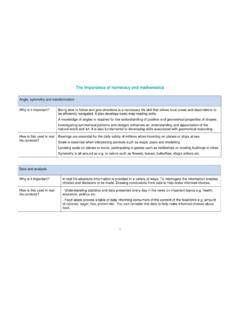
The importance of numeracy and mathematics
education.gov.scotThe importance of numeracy and mathematics 3 In order to make effects and digital images look so real in computer games, mathematicians and software developers make and use complicated equations of how human motion works.
Related documents
Mathematics in Early Childhood and Primary Education (3-8 ...
ncca.iethat the mathematics education of young children extends beyond the walls of the classroom: family and the wider community can make a significant contribution to children’s mathematical achievement (e.g., Sheldon & Epstein, 2005). Pedagogy It is impossible to think about good mathematics pedagogy for children aged 3–8 years without
A Resource for Teachers, A Tool for Young Children © 2010 ...
www.mathlearningcenter.orgmathematical models as a means to help children develop such number sense. These models – e.g., the number line, the rekenrek, the ratio table, etc. – are instrumental in helping children develop structures – or ways of seeing – mathematical concepts. This textbook series has been designed to introduce some of these models to teachers

What Is a Standards-Based Curriculum?
mcc.edc.org• Literacy involves understanding mathematical principles (such as change, function, and quantitative relationships), developing mathematical ways of thinking, and developing fluency with number, geometry, and data. • Students develop this literacy by actively doing mathematics—using their
Mathematics in the Primary Curriculum
uk.sagepub.com‘enhancing children’s mathematical understanding through making links to other areas of learning and wider issues of interest and importance’ (DCSF/QCDA, 2010b, Mathematical Understanding, Programme of Study, section 3). Cross-curricular stud-ies will inevitably draw on and develop mathematical skills, for example, in organ-
Developing Math Skills in Early Childhood - ed
files.eric.ed.govchild relationship but also stimulate children’s cognitive and linguistic development.24 Having books at home and reading and talking to children—even very young infants—influences children’s development of language and literacy skills.3, 26 Children whose parents talked to them frequently and used a variety of words when

Documenting children’s learning and development
www.aistearsiolta.ieabout height took place, showing young children’s growing mathematical awareness. The children helped choose the photo and decide the caption. Example 2: A webbing format This web type template means that you can jot down simple ideas as they happen. Later, you can reflect and discuss how to support this interest further, as well as adding a few
Intervention Strategies for Pre-School Students with ...
files.eric.ed.govThese mathematical concepts can easily be incorporated into any pre-k curriculum and fit easily into a science or social studies unit. Most children can apply these concepts easily and accurately if they are introduced to the practical applications at an early age. Science Young children have a natural curiosity about scientific information.
Children thinking mathematically: PSRN essential …
www.foundationyears.org.ukmathematical mark making and children’s mathematical development to be used to support Early Years practitioners’ professional development. The review emphasised that although ‘the EYFS provides guidance on developing mathematical understanding through imaginative play…opportunities in this area seem to be missed.’
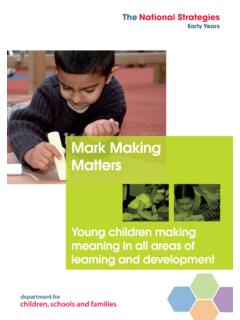
Mark Making Matters - From pregnancy to children aged 5
www.foundationyears.org.uksupporting children in making mathematical marks as part of developing their abilities to extend and organise their mathematical thinking.’ One of the recommendations of the Williams Review is to commission a set of professional development materials to support practitioners in their understanding of young children’s mathematical mark making