Example: bankruptcy
Documenting children’s learning and development
about height took place, showing young children’s growing mathematical awareness. The children helped choose the photo and decide the caption. Example 2: A webbing format This web type template means that you can jot down simple ideas as they happen. Later, you can reflect and discuss how to support this interest further, as well as adding a few
Tags:
Information
Domain:
Source:
Link to this page:
Documents from same domain
Information booklet: Planning and assessing for children’s ...
www.aistearsiolta.ieMagazines for Valentine’s Day are ready and we are also sending a note home asking for a family photo to be brought in or emailed. Laminate and cut photos into a few pieces to make ‘jig-saws’ – maybe 6 pieces for older children; 3 might be enough for younger children. One child mentioned love hearts in the shops for Valentine’s Day.

Learning and developing through play - Aistear Siolta
www.aistearsiolta.ieAistear: the Early Childhood Curriculum Framework Learning and developing through play Sometimes individual children like to play alone and sometimes they enjoy playing with others: Solitary play – The child plays alone. Spectator play – …
Developing an emergent and inquiry-based curriculum
www.aistearsiolta.ieTip sheet: Developing an emergent and inquiry-based curriculum 3 aistearsiolta.ie Building an emergent and inquiry-based curriculum While interests that emerge from the children help with planning, the inquiry-based approach is a way of enacting or progressing these interests. Put simply, an emergent curriculum is about WHAT children will be ...

Creating and Using the Learning Environment Pillar: Overview
www.aistearsiolta.ieAistear Síolta Practice Guide: Creating and Using the Learning Environment 2 www.aistearsiolta.ie Aistear’s principle on the learning environment states that, The learning environment (inside and outside) influences what and how children learn. An inviting environment encourages and helps children to explore and to

Self-evaluation Tool - Aistear Siolta
www.aistearsiolta.ie5 aistearsiolta.ie Self-evaluation Tool : Planning and Assessing using Aistear's Themes (Birth-6 years) Element 1: Observing, talking and gathering assessment information Prompts for Reflection • Think about what is working well in relation to planning for children’s learning and development using Aistear’s themes. • Think about the challenges you have experienced in planning for ...

Building Partnerships with Parents Pillar: Overview
www.aistearsiolta.iethe pillar, Building Partnerships with Parents. This pillar has a range of resources to help you build stronger partnerships with parents in your setting. Why focus on building partnerships with parents? Aistear and Síolta highlight the important role parents and families play in children’s lives. The Practice Guide uses the term ‘parent’ to

Supporting Transitions: Overview - Aistear Siolta
www.aistearsiolta.iesuggestions on how to facilitate transitions in a sensitive, responsive and thoughtful manner. Personal characteristics and dispositions, family and cultural background, and previous experience of early childhood settings or transitions, all impact on children’s adjustment to a new setting, a new room or to transitions in the daily routine.
Supporting learning and development through assessment
www.aistearsiolta.iedevelop rich portraits of children as learners in order to support and enhance their future learning. ... Uses many methods uses methods such as self-assessment, conversations, observations, tasks, ... . Primary School Curriculum. ...

Aistear Siolta Practice Guide
www.aistearsiolta.ieThis introduction to the Aistear Síolta Practice Guide explains the purpose of, and audience ... working in a support or mentoring role, for example, by County and City Childcare ... under the guidance of stiúrthóirí (pre-school practitioners) (Aistear, Principles and themes, 2009a, p.56).
Related documents
Mark Making Matters - From pregnancy to children aged 5
www.foundationyears.org.uksupporting children in making mathematical marks as part of developing their abilities to extend and organise their mathematical thinking.’ One of the recommendations of the Williams Review is to commission a set of professional development materials to support practitioners in their understanding of young children’s mathematical mark making
A Resource for Teachers, A Tool for Young Children © 2010 ...
www.mathlearningcenter.orgmathematical models as a means to help children develop such number sense. These models – e.g., the number line, the rekenrek, the ratio table, etc. – are instrumental in helping children develop structures – or ways of seeing – mathematical concepts. This textbook series has been designed to introduce some of these models to teachers
Mathematics in Early Childhood and Primary Education (3-8 ...
ncca.iethat the mathematics education of young children extends beyond the walls of the classroom: family and the wider community can make a significant contribution to children’s mathematical achievement (e.g., Sheldon & Epstein, 2005). Pedagogy It is impossible to think about good mathematics pedagogy for children aged 3–8 years without
Intervention Strategies for Pre-School Students with ...
files.eric.ed.govThese mathematical concepts can easily be incorporated into any pre-k curriculum and fit easily into a science or social studies unit. Most children can apply these concepts easily and accurately if they are introduced to the practical applications at an early age. Science Young children have a natural curiosity about scientific information.

Mathematics: Principles and practice
education.gov.scotanswers as opportunities to improve and deepen children’s understanding of mathematical concepts. The experiences and outcomes encourage learning and teaching approaches that challenge and stimulate children and young people and promote their enjoyment of mathematics. To achieve this, teachers will use a skilful mix of approaches, including:
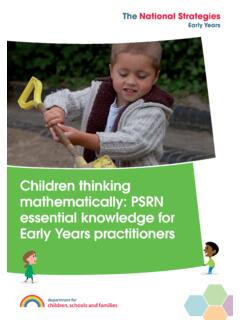
Children thinking mathematically: PSRN essential …
www.foundationyears.org.ukmathematical mark making and children’s mathematical development to be used to support Early Years practitioners’ professional development. The review emphasised that although ‘the EYFS provides guidance on developing mathematical understanding through imaginative play…opportunities in this area seem to be missed.’
Developing Math Skills in Early Childhood - ed
files.eric.ed.govchild relationship but also stimulate children’s cognitive and linguistic development.24 Having books at home and reading and talking to children—even very young infants—influences children’s development of language and literacy skills.3, 26 Children whose parents talked to them frequently and used a variety of words when

What Is a Standards-Based Curriculum?
mcc.edc.org• Literacy involves understanding mathematical principles (such as change, function, and quantitative relationships), developing mathematical ways of thinking, and developing fluency with number, geometry, and data. • Students develop this literacy by actively doing mathematics—using their
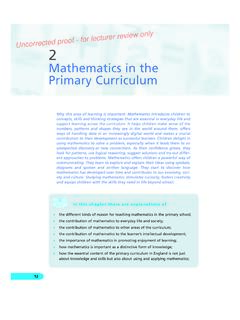
Mathematics in the Primary Curriculum
uk.sagepub.com‘enhancing children’s mathematical understanding through making links to other areas of learning and wider issues of interest and importance’ (DCSF/QCDA, 2010b, Mathematical Understanding, Programme of Study, section 3). Cross-curricular stud-ies will inevitably draw on and develop mathematical skills, for example, in organ-