
Maximum Classifier Discrepancy for Unsupervised Domain ...
Maximum Classifier Discrepancy for Unsupervised Domain Adaptation Kuniaki Saito1, Kohei Watanabe1, Yoshitaka Ushiku1, and Tatsuya Harada1,2 1The University of Tokyo, 2RIKEN {k-saito,watanabe,ushiku,harada}@mi.t.u-tokyo.ac.jp Abstract In this work, we present a method for unsupervised do-
Download Maximum Classifier Discrepancy for Unsupervised Domain ...

Information
Domain:
Source:
Link to this page:
Documents from same domain
What Have We Learned From Deep Representations for …
openaccess.thecvf.comwhat these powerful models actually have learned. In this paper we shed light on deep spatiotemporal net-works by visualizing what excites the learned models us-ing activation maximization by backpropagating on the in-put. We are the first to visualize the hierarchical features
Finding Tiny Faces in the Wild With Generative Adversarial ...
openaccess.thecvf.comfaces, which are unfriendly for the face classifier. Toward-s this end, we design a refinement sub-network to recover some detailed information. In the discriminator network, the basic GAN [17, 12, 8] is trained to distinguish the real and fake high resolution images. To classify faces or non-
Squeeze-and-Excitation Networks - openaccess.thecvf.com
openaccess.thecvf.comSqueeze-and-Excitation Networks Jie Hu1∗ Li Shen2∗ Gang Sun1 hujie@momenta.ai lishen@robots.ox.ac.uk sungang@momenta.ai 1 Momenta 2 Department of Engineering Science, University of Oxford Abstract Convolutional neural networks are built upon the con-
RegularFace: Deep Face Recognition via Exclusive ...
openaccess.thecvf.comRegularFace: Deep Face Recognition via Exclusive Regularization Kai Zhao Jingyi Xu Ming-Ming Cheng ∗ TKLNDST, CS, Nankai University kaiz.xyz@gmail.com cmm@nankai.edu.cn
Protecting World Leaders Against Deep Fakes
openaccess.thecvf.comProtecting World Leaders Against Deep Fakes Shruti Agarwal and Hany Farid University of California, Berkeley Berkeley CA, USA {shrutiagarwal, hfarid}@berkeley.edu
Auto-DeepLab: Hierarchical Neural Architecture Search for ...
openaccess.thecvf.comAuto-DeepLab: Hierarchical Neural Architecture Search for Semantic Image Segmentation Chenxi Liu1∗, Liang-Chieh Chen 2, Florian Schroff2, Hartwig Adam2, Wei Hua2, Alan Yuille1, Li Fei-Fei3 1Johns Hopkins University 2Google 3Stanford University Abstract Recently, NeuralArchitectureSearch(NAS)hassuccess-
PointNet: Deep Learning on Point Sets ... - CVF Open Access
openaccess.thecvf.comPointNet: Deep Learning on Point Sets for 3D Classification and Segmentation Charles R. Qi* Hao Su* Kaichun Mo Leonidas J. Guibas Stanford University
Frustum PointNets for 3D Object Detection From RGB-D Data
openaccess.thecvf.comFrustum PointNets for 3D Object Detection from RGB-D Data Charles R. Qi1∗ Wei Liu2 Chenxia Wu2 Hao Su3 Leonidas J. Guibas1 1Stanford University 2Nuro, Inc. 3UC San Diego Abstract In this work, we study 3D object detection from RGB-D data in both indoor and outdoor scenes.
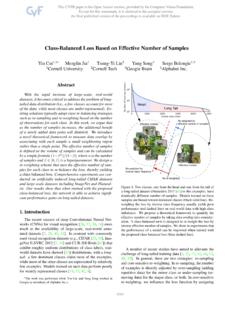
Class-Balanced Loss Based on Effective Number of Samples
openaccess.thecvf.comand large-scale datasets including ImageNet and iNatural-ist. Our results show that when trained with the proposed class-balanced loss, the network is able to achieve signifi-cant performance gains on long-tailed datasets. 1. Introduction The recent success of deep Convolutional Neural Net-works (CNNs) for visual recognition [26, 37, 38, 16] owes
ESRGAN: Enhanced Super-Resolution Generative Adversarial ...
openaccess.thecvf.comESRGAN: EnhancedSuper-Resolution Generative Adversarial Networks Xintao Wang 1, Ke Yu , Shixiang Wu2, Jinjin Gu3, Yihao Liu4, Chao Dong 2, Yu Qiao , and Chen Change Loy5 1 CUHK-SenseTime Joint Lab, The Chinese University of Hong Kong 2 Shenzhen Institutes of Advanced Technology, Chinese Academy of Sciences 3 The Chinese University of Hong Kong, …
Related documents
SVM &GA-CLUSTERING BASED FEATURE SELECTION …
aircconline.comirrespective of the classifier used. This procedure, however, lacks the classifier relationship; each feature is interpreted separately from functional dependence. Wrapper's approach depends on classification. Classifier results are used to assess …
Tutorial on Support Vector Machine (SVM)
course.ccs.neu.edumaximum margin classifier or hyper plane as an apparent solution. The next illustration gives the maximum margin classifier example which provides a solution to the above mentioned problem [8]. Figure 4: Illustration of Linear SVM. ( Taken from Andrew W. Moore slides 2003) [2]. Note the legend is not described as they are

Explainable Artificial Intelligence (XAI)
sites.cc.gatech.eduany classifier in a faithful way, by approximating it locally with an interpretable model. Electric Guitar . p = 0.32 . Acoustic Guitar . p = 0.24 • SP-LIME is . a method that selects a set of representative instances with explanations as a way to characterize the entire model. Example Explanation . 12 . Black-box Induction

Domain - 國立臺灣大學
speech.ee.ntu.edu.twTraining a classifier is ... Little but labeled • Idea: training a model by source data, then fine-tune the model by target data • Challenge: only limited target data, so be careful about overfitting. Domain Adaptation Source Domain (with labeled data) 4 ^ ì _ ^ í _ Knowledge of target domain

Introduction to Boosted Trees - New Jersey Institute of ...
web.njit.edu•How can we build a boosted tree classifier to do weighted regression problem, such that each instance have a importance weight? Define objective, calculate , feed it to the old tree learning algorithm we have for un-weighted version Again think …

CS340 Machine learning Lecture 4 K-nearest neighbors
www.cs.ubc.caNearest neighbor classifier • Remember all the training data (non-parametric classifier) ... Approaches to model selection • We can choose the model which optimizes the fit to the training data minus a complexity penalty • Complexity can be measured in various ways