
Maximum Likelihood (ML), Expectation Maximization (EM)
Expectation Maximization (EM) Pieter Abbeel UC Berkeley EECS Many slides adapted from Thrun, Burgard and Fox, Probabilistic Robotics TexPoint fonts used in EMF. Read the TexPoint manual before you delete this box.: AAAAAAAAAAAAA!
Download Maximum Likelihood (ML), Expectation Maximization (EM)

Information
Domain:
Source:
Link to this page:
Documents from same domain
Fundamentals of HVAC Controls Course Content …
people.eecs.berkeley.eduFundamentals of HVAC Controls The application of Heating, Ventilating, and Air-Conditioning (HVAC) controls starts with an understanding of the building and the use of the spaces to be conditioned and controlled.
SIA: Secure Information Aggregation in Sensor Networks
people.eecs.berkeley.eduSIA: Secure Information Aggregation in Sensor Networks Bartosz Przydatek Carnegie Mellon University Pittsburgh, PA 15213, USA bartosz@cmu.edu Dawn Song
Lecture Notes on Probability Theory and Random Processes
people.eecs.berkeley.educourse on probability and random processes in the Department of Electrical Engineering and Computer Sciences at the University of California, Berkeley. The notes do not replace a textbook.
Introduction to Database Systems What Is a DBMS? CS186
people.eecs.berkeley.edu1 Introduction to Database Systems CS186 “Knowledge is of two kinds: we know a subject ourselves, or we know where we can find information upon it.”
ABC: An Academic Industrial-Strength Verification Tool
people.eecs.berkeley.eduABC: An Academic Industrial-Strength Verification Tool Robert Brayton Alan Mishchenko EECS Department, University of California, Berkeley, CA 94720, USA {brayton, alanmi}@eecs.berkeley.edu Abstract. ABC is a public-domain system for logic synthesis and formal verification
1 Simultaneous Localisation and Mapping (SLAM): Part II ...
people.eecs.berkeley.edu1 Simultaneous Localisation and Mapping (SLAM): Part II State of the Art Tim Bailey and Hugh Durrant-Whyte Abstract —This tutorial provides an introduction to the Si-multaneous Localisation and Mapping (SLAM) method and the extensive research on SLAM that has been undertaken.
1 Simultaneous Localisation and Mapping (SLAM): Part I The ...
people.eecs.berkeley.edu1 Simultaneous Localisation and Mapping (SLAM): Part I The Essential Algorithms Hugh Durrant-Whyte, Fellow, IEEE, and Tim Bailey Abstract|This tutorial provides an introduction to Simul- taneous Localisation and Mapping (SLAM) and the exten-
Paths in graphs - People
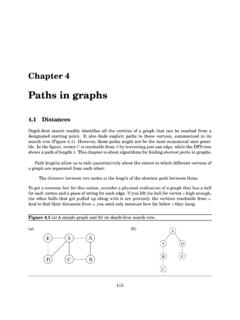
people.eecs.berkeley.edushows a path of length 3. This chapter is about algorithms for nding shortest paths in graphs. Path lengths allow us to talk quantitatively about the extent to which different vertices of a graph are separated from each other: The distance between two nodes is the length of the shortest path between them.
Chapter 13 The Multivariate Gaussian - People
people.eecs.berkeley.edu2 CHAPTER 13. THE MULTIVARIATE GAUSSIAN The factor in front of the exponential in Eq. 13.1 is the normalization factor that ensures that the density integrates to one.
Lab 2: Basic Concepts in Control System Design
people.eecs.berkeley.eduLab 2: Basic Concepts in Control System Design \There is nothing worse than a sharp image of a fuzzy concept." { Ansel Adams 1Objectives The goal of this lab is to understand some of the basic concepts behind control theory: equilibrium points, stability, feedback, steady-state response, and linearization.
Related documents

Lecture 10: Forward and Backward equations for SDEs
cims.nyu.eduLecture 10: Forward and Backward equations for SDEs Readings Recommended: Pavliotis [2014] 2.2-2.6, 3.4, 4.1-4.2 Gardiner [2009] 5.1-5.3 Other sections are recommended too – this is a great book to read (and own as a reference), and it is strongly suggested to start looking through it. Optional: Oksendal [2005] 7.3, 8.1,

Lecture10: Expectation-Maximization Algorithm
engineering.purdue.eduLecture10: Expectation-Maximization Algorithm (LaTeXpreparedbyShaoboFang) May4,2015 This lecture note is based on ECE 645 (Spring 2015) by Prof. Stanley H. Chan in the School of Electrical and Computer Engineering at Purdue University. 1 Motivation Consider a set of data points with their classes labeled, and assume that each class is a ...
POL571 Lecture Notes: Expectation and Functions of …
imai.fas.harvard.eduthat the conditional independence implies the conditional mean independence, but the latter does not imply the former. The conditional mean and variance have the following useful properties. Theorem 8 (Conditional Expectation and Conditional Variance) Let X and Y be ran-dom variables. 1. (Law of Iterated Expectation) E(X) = E[E(X | Y)].

Lecture 10 - University of Texas at Austin
web.ma.utexas.eduJan 24, 2015 · Lecture 10: Conditional Expectation 4 of 17 where the last equality follows from the fact that x1A is G-measurable. Therefore, x is (a version of) the conditional expectation E[XjG]. 1. An L2-argument.Suppose, first, that X 2L2.Let H be the family

Lecture 5a: ARCH Models - Miami University
www.fsb.miamioh.edu3. Statistically, volatility clustering implies time-varying conditional variance: big volatility (variance) today may lead to big volatility tomorrow. 4. The ARCH process has the property of time-varying conditional variance, and therefore can capture the volatility clustering 6

Lecture 10 : Conditional Expectation
www.stat.berkeley.eduLecture 10: Conditional Expectation 10-2 Exercise 10.2 Show that the discrete formula satis es condition 2 of De nition 10.1. (Hint: show that the condition is satis ed for random variables of the form Z = 1G where G 2 C is a collection closed under …

General Bivariate Normal - Duke University
www2.stat.duke.eduLecture 22: Bivariate Normal Distribution Statistics 104 Colin Rundel April 11, 2012 6.5 Conditional Distributions General Bivariate Normal Let Z 1;Z 2 ˘N(0;1), which we will use to build a general bivariate normal distribution.