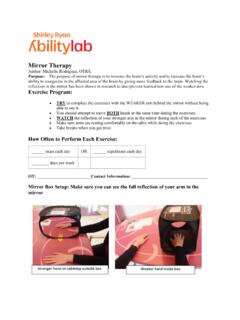
Mirror Therapy - Shirley Ryan AbilityLab
Yun G., Chun M., Park J., Kim B. (2011) The synergic effect of mirror therapy and neuromuscular electrical stimulation for hand function in stroke patients. Annals of …
Download Mirror Therapy - Shirley Ryan AbilityLab

Information
Domain:
Source:
Link to this page:
Documents from same domain

Upper Body: Range of Motion Exercises for the Arms ...
www.sralab.orgScapular Exercises . Up/Down (elevation/depression) – seated or sidelying Hand/Start positions #1: Place one hand on the back, so that fingers line up with the

Upper Body: Arm Strengthening Exercises with Tabletop …
www.sralab.orgUpper Body: Arm Strengthening Exercises with Tabletop Support Author: Sarah Housman, MS, OTR/L These exercises for the joints of the arm can help: Strengthen weak arm muscles; Improve range of motion; Minimize stiffness and pain. Instructions Use the muscles of your weak arm as much as possible.
Upper Body: Fine Motor Exercise Program Finger Exercises ...
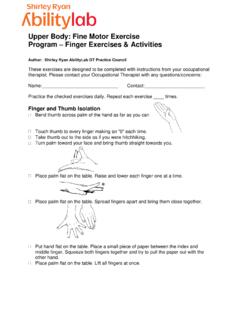
www.sralab.orgUpper Body: Fine Motor Exercise Program – Finger Exercises & Activities . Author: Shirley Ryan AbilityLab. OT Practice Council . These exercises are designed to be completed with instructions from your occupational
AbilityLab Home | Shirley Ryan AbilityLab
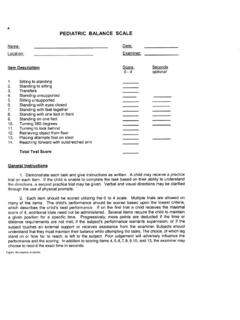
www.sralab.orgstationary foot. A taped line and/or footprints may be placed on the floor to help the child maintain a stationary foot position. In addition to a visual demonstration, a single physical prompt (assistance with placement) may be given. The child may be engaged in non-stressful conversation to maintain his/her attention span for 30 seconds.
The Numeric Pain Rating Scale Instructions
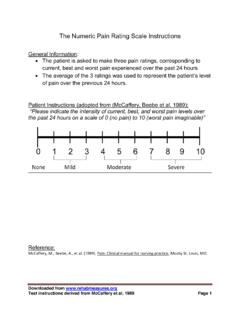
www.sralab.orgThe Numeric Pain Rating Scale Instructions General Information: The patient is asked to make three pain ratings, corresponding to current, best and worst pain experienced over the past 24 hours. The average of the 3 ratings was used to represent the patient’s level of pain over the previous 24 hours.
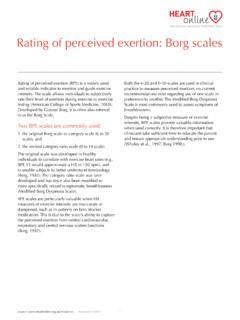
Rating of perceived exertion: Borg scales
www.sralab.orgRating of perceived exertion: Borg scales Rating of perceived exertion (RPE) is a widely used and reliable indicator to monitor and guide exercise intensity. The scale allows individuals to subjectively rate their level of exertion during exercise or exercise testing (American College of Sports Medicine, 2010).

CHEDOKE-McMASTER STROKE ASSESSMENT
www.sralab.orga clinical or research setting. ... If a client becomes excessively fatigued or apprehensive it is advisable to end the assessment. Client Comprehension of Instructions A therapist’s instruction, whether words or gestures, should be clear and concise. ... external rotation less than 60 ...
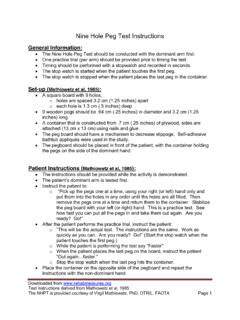
Nine Hole Peg Test Instructions - Shirley Ryan AbilityLab
www.sralab.orgNine Hole Peg Test Instructions General Information: The Nine Hole Peg Test should be conducted with the dominant arm first. One practice trial (per arm) should be provided prior to timing the test. Timing should be performed with a stopwatch and recorded in seconds. The stop watch is started when the patient touches the first peg.

JFK Coma Recovery Scale-Revised - AbilityLab Home
www.sralab.orgNov 01, 2005 · COMA RECOVERY SCALE-REVISED ©2004 Administration and Scoring Guidelines Joseph T. Giacino, Ph.D. and Kathleen Kalmar, Ph.D. Center for Head Injuries Edison, New Jersey Johnson Rehabilitation Institution Affiliated with JFK Medical Center Updated 11-1-05

Upper Body: Thera Band Exercise Program - Basic
www.sralab.orgImagine the face of a clock to help you position arms properly. Begin by holding the band in your right hand at 4 o’clock. Hold the other end of the band in your left hand at 10 o’clock. End Position Raise extended arm up with thumb pointed toward the ceiling. Keep your elbow straight. Repeat with opposite arm. End Position
Related documents

Principles of Electrosurgery
www.asit.orgStandard electrical current alternates at a frequency of 60 cycles per second (Hz). Electrosurgical systems could function at this frequency, but because current would be transmitted through body tissue at 60 cycles, excessive neuromuscular stimulation and perhaps electrocution would result.
Chiropractic Coding - AAPC
static.aapc.coma joint that has some effect in the body (soma). –Disease or bodily organ system dysfunction that can be traced to a impaired or altered joint position. 12 Difference in Outcome? •Joint and Neurophysiological Function –Serving a neuromuscular reflex system, which drives the perceptual and reflex basis of posture, movement and
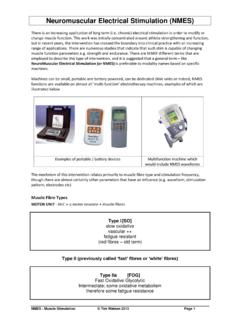
Neuromuscular Electrical Stimulation (NMES)
www.electrotherapy.orgNeuromuscular Electrical Stimulation (NMES) There is an increasing application of long term (i.e. chronic) electrical stimulation in order to modify or ... Effect of an electric stimulation facilitation program on quadriceps motor unit recruitment after stroke. Arch Phys Med Rehabil 85(12): 2040-5. Neuro - Spinal Cord Injury

Regional Meeting - American Association of Neuromuscular ...
www.aanem.orgRepetitive stimulation Other (mixed study) Least number of NCS needed to answer the clinical question I.e.. CTS ... Neuromuscular junction defects Myasthenia Gravis LEMS Motor Neuron Disease ALS ... Electrical signal travelling up to anterior horn cell “bounces” back
Contraindications to magnetic resonance imaging
rad.pitt.edufields can induce electrical currents in electri-cally conductive devices and may directly cause neuromuscular stimulation. 3. Pulsed radiofrequency fields—The main biologi-cal effects of …
Detecting and correcting patient-ventilator asynchronies
www.ers-education.orgSome asynchrony is inevitable because of the mechanical and electrical delays existing within ... The use of neuromuscular blocking agents at the early phase of acute respiratory distress …