
Name Score Classification
Rules you need to follow when classifying g Know what is being classified. Make many observations about the things being classified. Classifyy things based on your observations. Group the most similar things together. When grouping living things, place the most similar organisms in the same species.
Download Name Score Classification

Information
Domain:
Source:
Link to this page:
Documents from same domain

Lesson 10 Expressing Emotions and Managing Stress
www.warrencountyschools.orgBob Daemmrich/Stock Boston Expressing Emotions and Managing Stress • I will express emotions in healthful ways. • I will use stress-management skills.

A Guide for Teachers - Warren County Public Schools
www.warrencountyschools.orgTI.15: A Guide for Teachers Developed by Texas Instruments Incorporated Activities developed by Jane Schielack

“The Wizard of OZ” Book Report Example …
www.warrencountyschools.org“The Wizard of OZ” Book Report Example Protagonist: Main Character Dorothy is the protagonist in the story, “The Wizard of OZ”. Dorothy is a young lady who lives

TEXT FEATURES PRACTICE ASSESSMENT
www.warrencountyschools.orgTEXT FEATURES PRACTICE ASSESSMENT Thursday, February 16, 2012. ... Point out the main idea of the paragraph or section. D) Help the reader visualize the information.

DO NOT WRITE ON THIS PAPER
www.warrencountyschools.orgDO NOT WRITE ON THIS PAPER Context clues are hints in the writing that help you figure out what a word means. Each example below has hints within the passage or sentence to help you figure out the meaning of the word.

The Five Themes of Geography
www.warrencountyschools.orgThe Five Themes of Geography For each question, choose the best answer. 1. Which of the following best defines movement? A. explains where something is

The Malleus Maleficarum - Warren County Public …
www.warrencountyschools.orgthe malleus maleficarum the first part treating of the three necessary concomitants of witchcraft, which are the devil, a witch, and the permission of almighty god
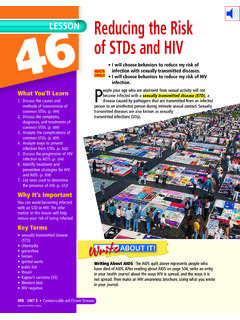
Lesson 46 Reducing the Risk of STDs and HIV
www.warrencountyschools.orgWhat You’ll Learn 1. Discuss the causes and methods of transmission of common STDs.(p. 499) 2. Discuss the symptoms, diagnoses, and treatments of
Name Score Classification - Warren County Public Schools
www.warrencountyschools.orgc. Use a classification key or field guide to identify organisms. d. Report on changes in classification systems as a result of new information or technology. Classification Notes What is classification? • To put things into groups of some kind. • It is usually done based on some type of similarities. ...

Lesson 5 Using Communication Skills
www.warrencountyschools.orgthe mediation process.(p. 49) 7. Discuss ways to avoid prejudicial behavior.(p. 54) ... as verbal communication, and shake ... LESSON 5 • Using Communication Skills 43 Listening is just as important a communication skill as speaking is. Good listeners have more effective conversations.
Related documents
WHAT IS ECONOMICS?
www.swlearning.comgoals of our society? We want a high standard of living for our citizens, clean air, safe streets, good schools, and more. What is holding us back from accomplishing all of these goals in a way that would satisfy everyone? You already know the an-swer: scarcity. In society’s case, the problem is a scarcity of resources—the things we use to

KS3 Science Revision Worksheets Special Edition
cbscience.weebly.com4) If living organisms did not R _ _ _ _ _ _ _ _ they would soon become extinct (die out). 5) The kidneys E _ _ _ _ _ _ a waste chemical called urea. Exercise 2 - A motor car moves but it is not living. Complete the two lists below to show which processes it does and does not show.
Coping with a Traumatic Event
www.cdc.govThere are many things you can do to cope with traumatic events. • Understand that your symptoms may be normal, especially right after the trauma. • Keep to your usual routine. • Take the time to resolve day-to-day conflicts so they do not add to your stress. • Do not shy away from situations, people and places that remind you of the trauma.

Living and Non-Living Activity Guide
www.nps.govclassify living and non-living things. Method By classifying things found in a classroom, students will learn to identify living versus non-living things. Background Living things have very specific characteristics. All living things need FOOD, water, reproduce, grow, move, breathe, adapt or respond to their environment, and produce

OW O ANTS MALS UNIT 7: Your Environment NEED CH OTHER?
www.alaska.edu2nd grade sequence #4: Living Things (Animals) B. Understand the needs of animals. C. Understands how we classify animals. D. Understands how animals grow and change. E. Uses scientific processes and inquiry to directly support the concepts of living things. 3rd grade sequence #4: Living Things (Animals)

Academic Standards for Science and Technology
www.stateboard.education.pa.govLiving things are made of the same components as all other matter, involve the same kinds of transformations of energy and move using the same basic kinds of forces as described in chemistry and physics standards. ... classifying, inferring, predicting, measuring, computing, estimating, communicating, using space/time relationships, defining ...

Answer Key Unit 1 Diversity of Living Things
earlhaig.caUnit 1 Diversity of Living Things Unit Preparation Questions (Assessing Readiness) (Student textbook pages 4–7) 1. d 2. e 3. c 4. a. Photosynthesis is the process that producers, such as plants, algae, and some bacteria, use to chemically convert carbon from carbon dioxide into glucose using light energy from the Sun. Oxygen is also

Attitudes to dementia
www.bsa.natcen.ac.uk800,000 people living with dementia, with the number predicted to double by 2040 (Department of Health, 2015). Although there is currently no known cure for dementia, there is a rapidly growing evidence base on risk reduction and protective factors which states that healthy living behaviours, such as not