
NIT 5 - NCERT
supra molecular assemblies, cells, tissues, organisms and indeed, populations and communities, each create emergent properties. In the chapters under this unit, major human physiological processes like digestion, exchange of gases, blood circulation, locomotion and movement are described in cellular and molecular terms. The last two
Download NIT 5 - NCERT

Information
Domain:
Source:
Link to this page:
Documents from same domain
ntse exam notification - National Council Of …
ncert.nic.inExamination: The tentative pattern of written examination will be as follows: Stage-I & Il : examination at the State/UT level will comprise of three papers i.e.
14 Effects Electric Current and Its - National …
ncert.nic.in76 EXEMPLAR PROBLEMS 3. Three bulbs A, B, C are connected in a circuit as shown in Figure 14.2. When the switch is ‘ON’ (a) bulb C will glow first. (b) bulb B and C will glow simulaneously and bulb A will
SEMICONDUCTOR AND SIMPLE CIRCUITSnot to be …
ncert.nic.in469 Semiconductor Electronics: Materials, Devices and Simple Circuits semiconductors. However , after 1990, a few semiconductor devices using organic semiconductors and semiconducting polymers have been
ENVIRONMENTAL CHEMISTRY - National Council …
ncert.nic.in400 CHEMISTRY (c) Hydrocarbons: Hydrocarbons are composed of hydrogen and carbon only and are formed by incomplete combustion of fuel …
LAWS OF MOTION
ncert.nic.inLAWS OF MOTION 91 In practice, the ball does come to a stop after moving a finite distance on the horizontal plane, because of the opposing force of friction which
DESIGN OF THE QUESTION PAPER Mathematics …
ncert.nic.inDESIGN OF THE QUESTION PAPER, SET-I 207 (A) 18 5 (B) 17 5 (C) 17 8 (D) 1 7. In the adjoining figure, PA and PB are tangents from a point P to a circle with centre O.
CHAPTER 10
ncert.nic.in(A) Main Concepts and Results Circle, radius, diameter , chord, segment, cyclic quadrilateral. • Equal chords of a circle (or of congruent circles) subtend equal angles at the
INDIA : CLIMATE, VEGETATION AND WILDLIFE
ncert.nic.inINDIA : CLIMATE, VEGETATION AND WILDLIFE 59 year. Therefore, they always appear gr een and are called evergreen forest as you may notice in Figure
Objectives Polymers - National Council of …
ncert.nic.in427 Polymers C:\Chemistry-12\Unit-15.pmd 28.02.07 Polymers can also be classified on the basis of mode of polymerisation into two sub groups.
TEXTBOOK IN GEOGRAPHY FOR CLASS IX
ncert.nic.inFOREWORD The National Curriculum Framework, (NCF) 2005, recommends that children’s life at school must be linked to their life outside the school. This principle
Related documents
Document1 - Gore's Anatomy & Physiology
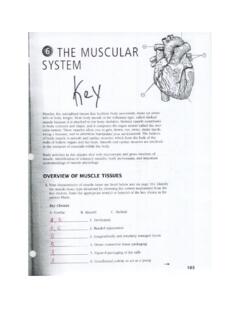
goresanatomy.weebly.comStudy activities in this chapter deal with microscopic and gross structure Of muscle, identification of voluntary muscles, body movements, and important understandings of muscle physiology. OVERVIEW OF MUSCLE TISSUES 1. Nine characteristics of muscle tissue are listed below and on page 104. Identify
Specialized Cells, Tissues, Organs and Organ Systems - Team 4
lms4.weebly.comCells Tissues Organs Organ Systems A tissue is a group of similar cells that work together to perform a specific function. For example, your brain is made mostly of nervous tissue, which consists of nerve cells. The next largest unit of organization is tissues. Each tissue type has a specific job based on where it is located in the body.

Cell Injury, Cell Death, and Adaptations - New Age Medical
www.newagemedical.orgfunctional changes that occur in cells, tissues, and organs. To render diagnoses and guide therapy, pathologists iden-tify changes in the gross or microscopic appearance (mor-phology) of cells and tissues, and biochemical alterations in body fluids (such as blood and urine). Traditionally, the discipline is divided into general pathology and sys-
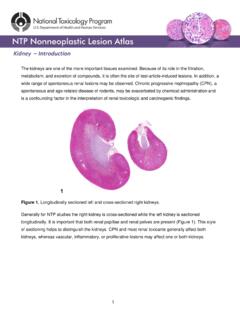
Kidney - Introduction - National Toxicology Program
ntp.niehs.nih.govOne of the most heterogeneous tissues in the body, the kidney has a wide variety of cell types. For the most part, renal tubules and/or ducts comprise most of the renal parenchyma and are lined by specialized epithelial cells. Renal interstitial tissue is sparse in the cortex and gradually increases toward the papilla.

LESSON 1. CELLS & TISSUES THE CELL - ACS
www.acs.edu.auCELLS & TISSUES Lesson Aim To explain the human body at a microscopic level, including the structure and function of cells, tissues and membranes. THE CELL All living matter is composed of functional units called cells. At one end of the scal e in the animal kingdom, there are unicellular organisms composed of a single cell (eg. Protozoa or ...

A Guide to Microscopic Structure of Cells, Tissues and …
www.histologyguide.com11. Organization (cells, tissues and organs) a. Arrangement of cells of similar and different types b. Arrangement of cells with respect to extracellular material 12. Compare and contrast with similar/differ-ent cells. 13. Heterogeneity among homologous cells: a. Cell development and differentiation b. Cell Cycle c. Active and resting cycles d.

The Nervous System - Los Angeles Mission College
www.lamission.edu1. Nerve tissue is composed of 2 main types of cells: Neurons-nerve cells that are specialized to detect and react to stimuli, by generating and conducting nerve impulses. Neuroglial cells-accessory cells for filling spaces and supporting neurons. 2. Microscopic anatomy of neurons All neurons have a cell body called soma which contains a
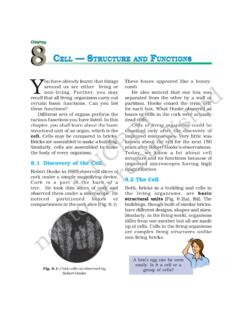
ELLELL TRUCTURETRUCTURE ANDAND UNCTIONSUNCTIONS …
www.ncert.nic.instructure and its functions because of improved microscopes having high magnification. ... up of tissues which in turn, are made up of cells. The cell in a living organism is the basic structural unit. ... of the cells are microscopic in size and are not visible to the unaided eye. They

Outline Introduction to Radiation ... - University of Toledo
www.utoledo.eduThe structure of DNA ... cells is caused by the hydroxyl radical (lifetime of ~10-3 s) oH O e 2 2 H O H O o H O OH x 2 2 3 x. 4 Chromosomes • DNA molecules carry the genetic information • Chromosome is an ... tissues and tumors – lower (~2 Gy) for late-responding tissues