Paging: Introduction
One of the most important data structures in the memory management subsystem of a modern OS is the page table. In general, a page table stores virtual-to-physical address translations, thus letting the system know where each page of an address space actually resides in physical memory. Because each address space requires such translations, in gen-
Download Paging: Introduction

Information
Domain:
Source:
Link to this page:
Documents from same domain
REVIEW - University of Wisconsin–Madison
pages.cs.wisc.edulearning discovers intricate structure in large data sets by using the backpropagation algorithm to indicate how a machine ... NATURE | VOL 521 | 28 MAY 2015 REVIEW

The Adaptive Lasso and Its Oracle Properties
pages.cs.wisc.eduThe Adaptive Lasso and Its Oracle Properties Hui Z OU Thelassoisapopulartechniqueforsimultaneousestimationandvariableselection.Lassovariableselectionhasbeenshowntobeconsistent

Cookbook - University of Wisconsin–Madison
pages.cs.wisc.eduThis cookbook integrates a variety of topics in probability the-ory and statistics. It is based on literature [1,6,3] and in-class material from courses of the statistics …

Understanding Modern Device Drivers
pages.cs.wisc.eduUnderstanding Modern Device Drivers Asim Kadav and Michael M. Swift Computer Sciences Department, University of Wisconsin-Madison ... kernel code with over 5 million lines of code in the Linux kernel, and cause significant complexity, bugs and development costs. ... drivers. In addition, a better understanding of driver code can lead ...
Introduction to Database Systems Module 1, Lecture 1
pages.cs.wisc.eduDatabase Management Systems, R. Ramakrishnan 5 Data Models A data model is a collection of concepts for describing data. A schema is a description of a particular collection of data, using the a given data model. The relational model of data is the most widely used model today.
DATABASE MANAGEMENT SYSTEMS SOLUTIONS MANUAL THIRD EDITION
pages.cs.wisc.edu1 INTRODUCTION TO DATABASE SYSTEMS Exercise 1.1 Why would youchoosea databasesysteminstead ofsimply storingdata in operating system files? When would it make sense not to use a database system? Answer 1.1 A database is an integrated collection of data, usually so large that it has to be stored on secondary storage devices such as disks or tapes.
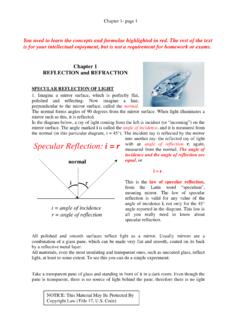
Specular Reflection: i = r
pages.cs.wisc.eduREFLECTION and REFRACTION SPECULAR REFLECTION OF LIGHT 1. Imagine a mirror surface, which is perfectly flat, polished and reflecting. Now imagine a line, perpendicular to the mirror surface, called the normal. The normal forms angles of 90 degrees from the mirror surface. When light illuminates a

CS 547 Lecture 34: Markov Chains
pages.cs.wisc.eduCS 547 Lecture 34: Markov Chains Daniel Myers State Transition Models A Markov chain is a model consisting of a group of states and specified transitions between the states. Older texts on queueing theory prefer to derive most of their results using Markov models, as opposed to the mean

CS 547 Lecture 35: Markov Chains and Queues
pages.cs.wisc.eduContinuous Time Markov Chains Our previous examples focused on discrete time Markov chains with a finite number of states. Queueing models, by contrast, may have an infinite number of states (because the buffer may contain any number of ... which are treated the same as any other transition in a Markov …

1 An Inside Look at Botnets
pages.cs.wisc.eduAn Inside Look at Botnets Paul Barford Vinod Yegneswaran {pb,vinod}@cs.wisc.edu Computer Sciences Department University of Wisconsin, Madison Abstract The continued growth and diversification of the Internet has been accompanied by an increasing prevalence of attacks and intrusions [40]. It can be argued, however,
Related documents
DATABASE MANAGEMENT SYSTEMS SOLUTIONS MANUAL …
pages.cs.wisc.educontents preface iii 1 introduction to database systems 1 2 introduction to database design 6 3therelationalmodel16 4 relational algebra and calculus 28 5 sql: queries, constraints, triggers 45 6 database application development 63 7 internet applications 66 8 overview of storage and indexing 73 9 storing data: disks and files 81 10 tree-structured indexing 88 11 hash-based …

Computer Systems Design and Architecture
people.cs.clemson.edu• A general purpose computer with enough memory is equivalent to a Turing machine • Over 50 years, computers have evolved • from memory size of 1 kiloword (1024 words) clock periods of 1 millisecond (0.001 s.) • to memory size of a Terabyte (240 bytes) and clock periods of less than one ns (10-9 s). • More speed and capacity is needed ...

Are You Sure You Want to Use MMAP in Your Database ...
cidrdb.orgJan 05, 2022 · needs to track which pages are in memory, nor does it need to track how often pages are accessed or which pages are dirty. Instead, the DBMS can simply access disk-resident data via pointers as if it were accessing data in memory while leaving all low-level page management to the OS. If the available memory fills up, then the

OPERATING SYSTEMS MEMORY MANAGEMENT - WPI
web.cs.wpi.edu8: Memory Management 12 MEMORY MANAGEMENT BARE MACHINE: No protection, no utilities, no overhead. This is the simplest form of memory management. Used by hardware diagnostics, by system boot code, real time/dedicated systems. logical == physical User can have complete control. Commensurably, the operating system has none. DEFINITION OF …
Chapter 8: Memory Management
www2.latech.eduOperating System Concepts! 8.6! Silberschatz, Galvin and Gagne ©2005! Logical vs. Physical Address Space! The concept of a logical address space that is bound to a separate physical address space is central to proper memory management" Logical address – generated by the CPU; also referred to as virtual address"