
Parenting with ACEs
Dec 10, 2019 · Parenting with ACEs . Breaking the ACEs Cycle. Some adults who had ACEs when they were children have a harder time providing a safe and nurturing environment for themselves and their children. In addition, being a parent with ACEs can increase the risk that your children will also have ACEs. It’s important to know about this connection.
Download Parenting with ACEs

Information
Domain:
Source:
Link to this page:
Documents from same domain

Chapter 2 Trauma and Trauma-Informed Care - ACEs Aware
www.acesaware.orgJun 30, 2018 · tionally afflicted by trauma and its effects. Understanding the devastating and mul-tiplicative effects of trauma on health and well-being and addressing the consequences of trauma are crucially important for healthcare providers and the systems in which they work. Preventing trauma and mitigating its adverse effects promote health equity.
Pediatric ACEs and Related Life Events Screener (PEARLS)
www.acesaware.orgPediatric ACEs and Related Life Events Screener (PEARLS) CHILD - To be completed by: Caregiver. At any point in time since your child was born, has your child seen or been present when the following experiences happened? Please include past and present experiences.

TEEN (Self-Report) - ACEs Aware
www.acesaware.orgPediatric ACEs and Related Life Events Screener (PEARLS) TEEN (Self-Report)- To be completed by: Patient. Teen (Self Report) - Identified. At any point in time since you were born, have you seen or been present when the following

Adverse Childhood Experience Questionnaire for Adults
www.acesaware.orgDid your parents or adults in your home ever hit, punch, beat, or threaten to harm each other? who went to jail or prison? home ever swear at you, insult you, or put you down? parent or adult in your home ever hit, beat, kick, physically hurt you in any way? in your family loved you or thought you were special? ...
ACE Screening Clinical Workflows, ACEs and Toxic Stress ...
www.acesaware.orgAssociated Health Conditions, the patient is at “high risk” for toxic stress physiology. In both cases, the provider should offer education on how ACEs may lead to a toxic stress response and associated health conditions, as well as practices and interventions demonstrated to buffer the toxic stress response, such as sleep, exercise, nutrition,

Adverse Childhood Experience Questionnaire for Adults
www.acesaware.orgAdverse Childhood Experience Questionnaire for Adults California Surgeon General’s Clinical Advisory Committee Our relationships and experiences—even those in childhood—can affect our health and well -being.

Provider Toolkit - ACEs Aware
www.acesaware.orgThis Provider Toolkit provides information on the ACEs Aware initiative, including how to screen for and respond to ACEs, and how Medi-Cal providers can get trained and receive payment for conducting ACE screenings. This toolkit is composed of a series of fact sheets that are designed to be read individually.

Screening Tools Overview - ACEs Aware
www.acesaware.orgThe Pediatric ACEs and Related Life Events Screener (PEARLS) was developed by the Bay Area Research Consortium on Toxic Stress and Health (BARC), a partnership between the Center for Youth Wellness, the University of California, San Francisco (UCSF), and …
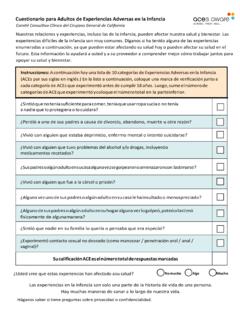
Cuestionario para Adultos de Experiencias Adversas en la ...
www.acesaware.orgCuestionario para Adultos de Experiencias Adversas en la Infancia Comité Consultivo Clínico del Cirujano General de California Nuestras relaciones y experiencias, incluso las de la infancia, pueden afectar nuestra salud y bienestar. Las experiencias difíciles de la infancia son muy comunes. Díganos si ha tenido alguna de las experiencias
Pediatric ACEs and Related Life Events Screener (PEARLS)
www.acesaware.orgor example, a parent/caregiver got a divorce or separated, or a romantic partner moved in or out) Add up the “yes” answers for this first section: Please continue to the other side for the rest of questionnaire. Teen (Parent/Caregiver Report) – Deidentified
Related documents
ACEs Resource Packet: Adverse Childhood Experiences …
www.childhealthdata.orgACEs Resource Packet: Adverse Childhood Experiences (ACEs) Basics . What are ACEs? The term Adverse Childhood Experiences (ACEs) refers to a range of events that a child can experience, which leads to stress and can result in trauma and chronic stress responses.

THE PROBLEM WITH ‘ACEs’ - University of Kent
blogs.kent.ac.ukThe ACEs approach claims that negative childhood experiences become embedded in the body of the individual, resulting in mental and physical difficulties in later life with attendant costs for society. Advocates assert, ‘ yo u r b o d y re me mb e rs wh a t …

Responding to Adverse Childhood Experiences
www.wales.nhs.uk1.3 Overview of ACEs 7 2 Methodology 10 3 Evidence-based interventions and approaches 11 3.1 Supporting parenting 12 3.2 Building relationships and resilience 15 3.3 Early identification of adversity 19 3.4 Responding to trauma and specific ACEs 21 4 Cross-cutting themes 25 5 What next? 28 References 30 Appendices 38 Appendix 1.
EVIDENCE BRIEFING Adverse Childhood Experiences (ACEs)
www.bps.org.ukACEs are stressful events occurring during childhood that directly affect a child (e.g. child maltreatment) or affect the environment in which they live (e.g. growing up in ... Parenting programmes to equip parents/carers with the tools to ensure the development of social,
Adverse Childhood Experiences Prevention Strategy
www.cdc.govAdverse Childhood Experiences (ACEs): Leveraging the Best Available Evidence, these strategies focus on primary prevention but also include strategies to mitigate the long-term consequences of ACEs. The six strategies are: 1) strengthening economic supports for families (e.g., earned income tax credits,
Preventing ACEs
www.cdc.govand behavioral consequences of ACEs. By addressing the conditions that give rise to ACEs and simultaneously addressing the needs of children and parents, these strategies take a multi-generation approach to prevent ACEs and ensure safe, stable, nurturing relationships and environments. Together, these strategies are intended to work in
Fact Sheet Adverse Childhood Experiences (ACEs)
www.pacesconnection.comACES also increase: risk for chronic illness, cancer, fractures, heart / lung / thyroid / autoimmune (more on w ebsite ) 1 ADHD & behavior problems in kids [ 23]; premature birth, greater challenges / difficulties in parenting

ACES Screening and Interventions
www.health.ny.govACEs Screening at Montefiore –Universal ACEs screening since 2016-CDC ACEs screener (adapted for child and parent) –Infant and Parent ACEs starting at 2 month visit –Child ACEs screening at each yearly well visit, starting at 12 months through adolescence

Adverse Childhood Experience (ACE) Questionnaire …
cdn2.sportngin.comCommon ACEs o! physical, sexual, verbal abuse o! physical and emotional neglect o! a parent who's an alcoholic (or addicted to other drugs) or diagnosed with a mental illness o! witnessing a parent experience abuse o! losing a parent to abandonment or divorce o! bullying •! ACEs can be totaled using a score card (see above)