
Past simple: regular and irregular verbs.
Past simple: regular and irregular verbs. Exercises A. Complete the sentences. Ejemplo: I didn´t watch TV last night. 1. On Saturday I _____ (play) computer games with
Download Past simple: regular and irregular verbs.

Information
Domain:
Source:
Link to this page:
Documents from same domain
Replace the personal pronouns by possessive …
www.language-worksheets.comSubject pronouns and possessive adjectives. Exercises. Replace the personal pronouns by possessive adjectives. 1. Where are (you) _____ friends now?

To be: affirmative, negative, questions. - Language …
www.language-worksheets.comFill in the correct form of `to be´. 1. John´s dog ___ very friendly. 2. Robert ___ ten years old. 3. These flowers ___ very pretty. 4. The two schools ___ close to each other.

A. Write the Comparative forms of the adjectives
www.language-worksheets.comComparative adjectives. Exercises. A. Write the Comparative forms of the adjectives: tall taller 1. fast _____ 2. heavy _____ 3. dangerous _____

Exercises. A. Put the sentences in the correct order.
www.language-worksheets.comWord Order. Exercises. A. Put the sentences in the correct order. 1. Help / my friends / I / with their homework _____ 2. make / people / laugh / when they are sad/ I

Demonstrative pronouns. - Language worksheets
www.language-worksheets.comDemonstrative pronouns. Exercises. A. Use `this´ or `these´. 1. Is _____ my drink? 2. _____ aren´t my trainers. 3. Is _____ an interesting museum.

Grammar Worksheets Secondary School
www.language-worksheets.comGrammar Worksheets Secondary School . 1. To be Complete the sentences using the most suitable form of be. Sometimes you must use the simple (am / is / are) and sometimes the continuous is more suitable (am / is / are being) 1. I can't understand why he’s being so selfish.
Related documents
Grammar snacks: The past simple regular verbs
learnenglishteens.britishcouncil.orgThe past simple is the most common way of talking about past events or states which have finished. It is often used with past time references (e.g. yesterday, two years ago).
Grammar videos: The past simple irregular verbs exercises
learnenglishteens.britishcouncil.org1. Check your grammar: true or false – past simple irregular verbs Are these sentences True or False? 1. To form the past simple, we add -ed to the end of regular verbs. True False 2. There are many different types of endings of irregular verbs in the past simple.
Rules for Using Irregular Verbs
www.chompchomp.com1 RULES FOR USING IRREGULAR VERBS Understand the problem. All verbs, whether regular or irregular, have five forms [often called principal parts]. These forms are the infinitive, simple present, simple past, past participle, and present participle. The difference between a regular and an irregular verb is the formation of the simple
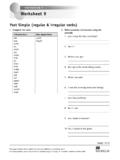
Past Simple (regular & irregular verbs) - Macmillan
www.macmillaninspiration.com3 Complete the postcard with the correct form of the verb in brackets. This page has been downloaded from www.macmillanenglish.com/inspiration. Title: insp.grammar ...
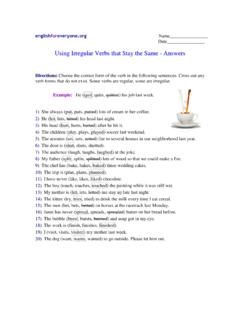
Using irregular verbs that stay the same - answers
englishforeveryone.orgenglish for everyone.org Name_____ Date_____ Using Irregular Verbs that Stay the Same - Answers
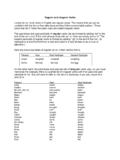
Regular and Irregular Verbs - Cabrillo College
www.cabrillo.eduRegular and Irregular Verbs Luckily for us, most verbs in English are regular verbs.This means that we can be confident with the forms they take because they follow a predictable pattern.

Past Tense Irregular Verbs - Grammar
www.grammar.clPast Tense Irregular Verbs www.grammar.cl A) Change the verbs in brackets into the past tense. Some are regular and some are irregular. Yesterday (to be) _____ a busy day.

IRREGULAR ENGLISH VERBS (ANGIELSKIE CZASOWNIKI ...
www.czasownikinieregularne.plirregular english verbs (angielskie czasowniki nieregularne) lista podstawowa: najczĘŚciej uŻywane czasowniki infinitive past tense past participle znaczenie

englisch-hilfen.de – LEARNING ENGLISH ONLINE infinitive ...
www.englisch-hilfen.deenglisch-hilfen.de – LEARNING ENGLISH ONLINE englisch-hilfen.de – LEARNING ENGLISH ONLINE Irregular verbs - difficult - page 1 infinitive simple past past participle