
PENNSYLVANIA CORE STANDARDS
(phonemes) in vowel, and final spoken single sound . syllable words. (phonemes) in • Add or substitute individual sounds. the three· (phonemes) inone phoneme (CVC) syllable words to . words. make new words. January 2013 5
Download PENNSYLVANIA CORE STANDARDS

Information
Domain:
Source:
Link to this page:
Documents from same domain

Academic Standards for Enviroment and Ecology
www.stateboard.education.pa.govEnvironment and Ecology is grounded in the complexity of the world we live in and our impact on its sustainability. The human interactions with the ecosystem and the results of human decisions are the main components of this academic area.

Pennsylvania Department of Education
www.stateboard.education.pa.govPennsylvania Department of Education Bureau of Career and Technical Education Public Postsecondary Vocational Education (PPPVE) institutions Final Draft Report

Academic Standards for Health, Safety and Physical Education
www.stateboard.education.pa.govThe Academic Standards for Health, Safety and Physical Education provide students with the knowledge and skills that will enable them to achieve and ... • health examinations B. Explain the relationship between health-related information and consumer choices.
Standards for English Language Development
www.stateboard.education.pa.govPennsylvania English Language Development Standards The PA ELDS Framework is designed to help educators effectively differentiate instruction and assessment across content areas for ELs at varying levels of English Language Proficiency (ELP).

Academic Standards for Civics and Government
www.stateboard.education.pa.govPrinciples and Documents of Government ... Throughout the standard statements, concepts found in lower grades must be developed more fully throughout higher grade levels. The Pennsylvania Constitution of 1790 was the basis for the Free Public School Act of 1834 that is the underpinning of today's

Academic Standards for History - State Board of Education
www.stateboard.education.pa.govAcademic Standards for History Pennsylvania Department of Education 22 Pa. Code, Chapter 4, Appendix C (#006-275) Final Form-Annex A July 18, 2002

Academic Standards for Science and Technology
www.stateboard.education.pa.govperspectives to a problem, consistent information emerges. A theory describes this verifiable event or phenomena. Theories are powerful elements in science and are used to predict other events. As theories lose their ability to predict, they are modified, expanded or generalized or incorporated into a broader theory.

Academic Standards for the Arts and Humanities
www.stateboard.education.pa.govAcademic Standards for the Arts and Humanities . XXVI. INTRODUCTION . The Academic Standards for the Arts and Humanities describe what students should know and be able to do at the end of grades 3, 5, 8 and 12 in the visual and performing arts and the understanding about humanities context within the arts. The arts include dance, music, theatre and
Academic Standards for Mathematics
www.stateboard.education.pa.govPennsylvania Core Standards Mathematics Standards cannot be viewed or addressed . in . isolation, as each standard depends upon or may lead into multiple standards across grades; thus, it is imperative that educators are familiar with both the standards that come before and those that follow a particular grade level. These revised standards
Related documents
Morphology - Duquesne University
www.mathcs.duq.eduPacker Morphology 2 of morphemes without changing its meaning. We can find {buy} in buying, buys, and {er} in seller, fisher, as well as buyer.And {s} can be found in boys, girls, and dogs. The more combinations a morpheme is found in, the more productive it is said to be.
Phonics: Theory and Practice
web.ntpu.edu.twimproves children’s ability to identify words. It reports that useful phonics strategies include teaching children the sounds of letters in isolation and in words, and ... letters to manipulate phonemes. 2. Explicit phonemic awareness instruction helps beginning readers and those having
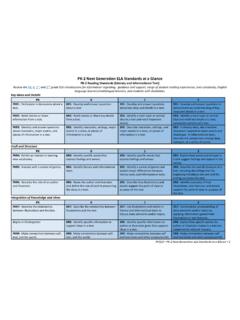
PK2 Next Generation ELA Standards at a Glance
www.nysed.govIdentify a main topic or central idea in a text and retell important details. 2R2: Identify a main topic or central ... sounds (phonemes) in spoken one-syllable words (e.g. the /m/ in map). KRF2: Demonstrate understanding of spoken words, syllables, and sounds (phonemes).

Kindergarten Common Core State Standards: California
d39smchmfovhlz.cloudfront.netIdentify new meanings for familiar words and apply them accurately (e.g., knowing duck is a bird and learning the verb to duck). b. Use the most frequently occurring inflections and affixes (e.g., -ed, -s, re-, un-, pre-, -ful, -less ) as a clue to the meaning of an

K-12 Student Standards for English Language Arts
files.eric.ed.govIdentify the front cover, back cover, and title page of a book. 6. ... and final sounds (phonemes) in three-phoneme (consonant-vowel-consonant, or CVC) words. 1 (This does not include CVCs ending with /l/, /r/, or /x/.) e. Add or substitute individual sounds (phonemes) in simple, one-syllable words to make new words. Phonics and Word Recognition.
Theoretical Review of Phonics Instruction for Struggling ...
files.eric.ed.govconsists of about 41 phonemes. Phonemes combine to form syllables and words. A few words have only one phoneme, such as a or oh. Most words consist of a blend of phonemes, such as go with two phonemes, or check with three phonemes, or stop with four phonemes. Phonemes are different from graphemes, which
Put Reading First 2006 - ed
lincs.ed.govphonemes (the sounds of spokenlanguage) and graphemes (the letters and spellings that represent those sounds in writtenlanguage). Phonemic awareness Phonemic awarenessis the ability to hear, identify, and manipulate the individual sounds—phonemes—in spoken words. Phonological awareness

English/Language Arts
www.isbe.netRI.K.5 Identify the front cover, back cover, and title page of a book. RI.K.6 Name the author and illustrator of a text and define the role of each in presenting the ideas or information in a text. RI.K.9 With prompting and support, identify basic similarities in and differences between two texts on the same
Essential Strategies for Teaching Phonemic Awareness
www.sagepub.comidentify the phonemes in [cat], students must understand that there are sounds at the beginning, middle, and end that can be manipulated. Students must also be able to complete phonemic awareness tasks such as the following: • Phoneme . isolation: Isolate phonemes; for example, “Tell me the first sound in . cat. ” • Phoneme . identity:
A-Law and mu-Law Companding Implementations Using the ...
www.ti.comphonemes is approximately ten times that of unvoiced and plosive phonemes, as clearly illustrated in Figure 1. As a result, the telephone system must provide for a large range of signal amplitudes. Although lower in amplitude, unvoiced and plosive phonemes contain more information and thus, higher entropy then voiced phonemes.