Transcription of Phonics: Theory and Practice
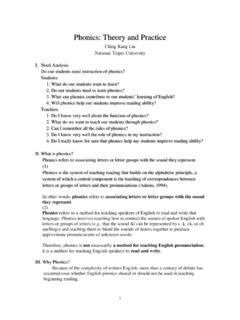
1 1 phonics : Theory and Practice Ching Kang Liu National Taipei University I. Need Analysis Do our students need instruction of phonics ? Students: 1. What do our students want to learn? 2. Do our students need to learn phonics ? 3. What can phonics contribute to our students learning of English? 4. Will phonics help our students improve reading ability? Teachers: 1. Do I know very well about the function of phonics ? 2. What do we want to teach our students through phonics ? 2. Can I remember all the rules of phonics ? 3. Do I know very well the role of phonics in my instruction? 4. Do I really know for sure that phonics help my students improve reading ability?
2 II. What is phonics ? phonics refers to associating letters or letter groups with the sound they represent. (1) phonics is the system of teaching reading that builds on the alphabetic principle, a system of which a central component is the teaching of correspondences between letters or groups of letters and their pronunciations (Adams, 1994). In other words, phonics refers to associating letters or letter groups with the sound they represent. (2) phonics refers to a method for teaching speakers of English to read and write that language. phonics involves teaching how to connect the sounds of spoken English with letters or groups of letters ( , that the sound /k/ can be represented by c, k, ck, or ch spellings) and teaching them to blend the sounds of letters together to produce approximate pronunciations of unknown words.
3 Therefore, phonics is not necessarily a method for teaching English pronunciation; it is a method for teaching English speakers to read and write. III. Why phonics ? Because of the complexity of written English, more than a century of debate has occurred over whether English phonics should or should not be used in teaching beginning reading. 2 Despite the work of 19th century proponents such as Rebecca Smith Pollard, some American educators, prominently Horace Mann, argued that phonics should not be taught at all. This led to the commonly used "look-say" approach ensconced in the "Dick and Jane" readers popular in the mid-20th century. Beginning in the 1950s, however, phonics resurfaced as a method of teaching reading.
4 Spurred by Rudolf Flesch's criticism of the absence of phonics instruction (particularly in his popular book, Why Johnny Can t Read, 1955) phonics resurfaced. IV. Whole Language In the 1980s, the "whole language" approach to reading further polarized the debate in the United States. Whole language instruction was predicated on the principle that children could learn to read given (a) proper motivation, (b) access to good literature, (c) many reading opportunities, (d) focus on meaning, and (e) instruction to help students use meaning clues to determine the pronunciation of unknown words. For some advocates of whole language, phonics was antithetical to helping new readers to get the meaning; they asserted that parsing words into small chunks and reassembling them had no connection to the ideas the author wanted to convey.
5 The whole language emphasis on identifying words using context and focusing only a little on the sounds (usually the alphabet consonants and the short vowels) could not be reconciled with the phonics emphasis on individual sound-symbol correspondences. Thus, a dichotomy between the whole language approach and phonics emerged in the United States causing intense debate. Ultimately, this debate led to a series of Congressionally-commissioned panels and government-funded reviews of the state of reading instruction in the In 1984, the National Academy of Education commissioned a report on the status of research and instructional practices in reading education, Becoming a Nation of Readers.
6 Among other results, the report includes the finding that phonics instruction improves children s ability to identify words. It reports that useful phonics strategies include teaching children the sounds of letters in isolation and in words, and teaching them to blend the sounds of letters together to produce approximate pronunciations of words. It also states that phonics instruction should occur in conjunction with opportunities to identify words in meaningful sentences and stories. In 1990, Congress asked the Department of Education to compile a list of available programs on beginning reading instruction, evaluating each in terms of the effectiveness of its phonics component.
7 As part of this requirement, the US DOE asked Dr. Marilyn J. Adams to produce a report on the role of phonics instruction in beginning reading, which resulted in her 1994 book Beginning to Read: Thinking and Learning about Print. In the book, Adams asserted that existing scientific research supported that phonics is an effective method for teaching students to read at the word 3 level. Adams argued strongly that the phonics and the whole language advocates are both right. phonics is an effective way to teach students the alphabetic code, building their skills in decoding unknown words. By learning the alphabetic code early, Adams argued, students can quickly free up mental energy they had used for word analysis and devote this mental effort to meaning, leading to stronger comprehension earlier in elementary school.
8 Thus, she concluded, phonics instruction is a necessary component of reading instruction, but not sufficient by itself to teach children to read. This result matched the overall goal of whole language instruction and supported the use of phonics for a particular subset of reading skills, especially in the earliest stages of reading instruction. Yet the argument about how to teach reading, eventually known as "the Great Debate," continued unabated. The National Research Council re-examined the question of how best to teach reading to children (among other questions in education) and in 1998 published the results in the Prevention of Reading Difficulties in Young Children (Catherine Snow, et.)
9 Al.). The National Research Council s findings largely matched those of Adams. They concluded that phonics is a very effective way to teach children to read at the word level, more effective than what is known as the "embedded phonics " approach of whole language (where phonics was taught opportunistically in the context of reading materials). They found that phonics instruction must be systematic (following a sequence of increasingly challenging phonics patterns) and explicit (teaching students precisely how the patterns worked, , "this is b, it stands for the /b/ sound").. In 1997,.. the National Reading Panel examined quantitative research studies on many areas of reading instruction, including phonics and whole language.
10 The resulting report Teaching Children to Read: An Evidence-based Assessment of the Scientific Research Literature on Reading and its Implications for Reading Instruction was published in 2000 and provides a comprehensive review of what is known about best practices in reading instruction in the The panel reported that several reading skills are critical to becoming good readers: phonics for word identification, fluency, vocabulary and text comprehension. With regard to phonics , their meta-analysis of hundreds of studies confirmed the findings of the National Research Council: teaching phonics (and related phonics skills, such as phonemic awareness) is a more effective way to teach children early reading skills than is embedded phonics or no phonics instruction.