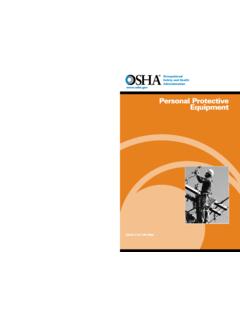
Personal Protective Equipment
provide personal protective equipment (PPE) to their employees and ensure its use. Personal protective equipment, commonly referred to as “PPE”, is equipment worn to minimize exposure to a variety of hazards. Examples of PPE include such items as gloves, foot and eye protection, protective hearing devices (earplugs,
Download Personal Protective Equipment

Information
Domain:
Source:
Link to this page:
Documents from same domain
Motor Vehicles Safe Driving Practices for Employees
www.osha.govMotor Vehicles Safe Driving Practices for Employees You are your employer’s most valuable asset! The way that you drive says everything about you and your
U. S. Department of Labor Occupational Safety and …
www.osha.govU. S. Department of Labor Occupational Safety and Health Administration Notice of Alleged Safety or Health Hazards . For the General Public: This form is provided for the assistance of any complainant and is not intended to constitute the exclusive means by
Controlling Hazardous Fume and - osha.gov
www.osha.govFactSheet Controlling Hazardous Fume and Gases during Welding Welding joins materials together by melting a metal work piece along with a …
OSHA 3220-10N 2004
www.osha.govWORKER SAFETY SERIES WAREHOUSING 11 Hazards & Solutions Warehouse operations can present a wide variety of potential hazards for the worker. For warehousing establishments, the
Job Safety and Health - osha.gov
www.osha.govJob Safety and Health. IT’S THE LAW! All workers have the right to: A safe workplace. Raise a safety or health concern with your employer or OSHA, or report a work-
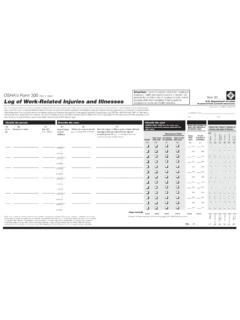
Year 20 Log of Work-Related Injuries and Illnesses
www.osha.govU.S. Department of Labor Occupational Safety and Health Administration OSHA’s Form 300 (Rev. 01/2004) Year 20__ __ Log of Work-Related Injuries and Illnesses You must record information about every work-related death and about every work-related injury or illness that involves loss of consciousness, restricted work activity or job transfer,
DEPARTMENT OF LABOR 29 CFR Part 1904
www.osha.gov2 The final rule also revises the requirements for reporting work-related fatality, injury, and illness information to OSHA. The current regulation requires employers to report …
CRANES AND DERRICKS IN CONSTRUCTION FINAL …
www.osha.govOSHA is making this document, the regulatory text, available for informational purposes only. This action does not affect the effective date of the final rule on Cranes and Derricks in Construction, which will be 90
Preventing Mold-Related Problems in the Indoor …
www.osha.govIntroduction This guide provides basic information about mold, mold sources, and building-related illnesses. Brief discussions are included on building design considerations for healthy indoor air,
HazardCommunicationGuidancefor CombustibleDusts
www.osha.govU.S.DepartmentofLabor OccupationalSafetyandHealthAdministration OSHA3371-08 2009 HazardCommunicationGuidancefor CombustibleDusts Occupational Safety and Health Act of 1970
Related documents
Personal Protective Equipment (PPE) for Welding and Cutting
app.aws.orgwear suitable protective equipment. In general, Personal Protective Equipment (PPE) must protect against hazards such as burns, sparks, spatter, electric shock, and radiation. The use of PPE is a good safe practice and may be required by regulatory agencies. For example, OSHA requires the use of PPE when engineering
PERSONAL PROTECTIVE EQUIPMENT (PPE) – BODY …
ehs.unl.eduPersonal Protective Equipment – Hand Protection. • PPE should be stored in a well-ventilated, clean, and dry environment, away from direct sunlight and contaminants. Sometimes, a manufacturer will specify storage of certain PPE in sealed bags. • Users of any type of PPE must read and adhere to the manufacturer’s use and
GUIDELINES FOR PERSONAL PROTECTIVE EQUIPMENT (PPE)
www.ehs.washington.eduThe Washington State Department of Labor and Industries (L&I) in WAC 296‐800‐160 Personal Protective Equipment (PPE) requires all employers to assess their workplace for hazards that might require the use of personal protective equipment. If …

Personal Protective Equipment (PPE) Program
ehs.research.uiowa.eduPersonal protective equipment (PPE) is used to create a protective barrier between a worker and hazards in the workplace. PPE includes such equipment as chemical resistant gloves, safety shoes, hard hats, safety glasses, respirators, and clothing such as gowns and aprons.
Personal Protective Equipment (PPE) Guide
lni.wa.govprotective measures. One type of protective measure is personal protective equipment (PPE). PPE is equipment or a device that protects a worker™s body from hazards and any harmful conditions (existing and potential) that may result in injury, illness, or possibly death. PPE may be an item worn on the body, such as gloves, or a device, such as a

Personal Protective equiPment
osha.washington.eduOSHA 11 Personal Protective Equipment Personal Protective equiPment learning objectives By the end of this lesson, students will be able to: • List types of Personal Protective Equipment (PPE) that can be used to protect the hands, face, head, eyes, and feet. Describe the hazards each type of PPE protects against.

Use Personal Protective Equipment (PPE) When Caring for ...
www.cdc.govof PPE, and proper care, maintenance, and disposal of PPE. • Demonstrate competency in performing appropriate infection control practices and procedures. CS 315838-A 03/20/2020 cdc.gov/COVID19 COVID-19 Personal Protective Equipment (PPE) for Healthcare Personnel Preferred PPE – Use N95 or Higher Respirator N95 or higher respirator

Personal Protective Equipment (PPE) 102
www.cdc.govDetermine what types of practices and personal protective equipment (PPE) are appropriate based on method of disease transmission. Apply this knowledge in patient care settings. 3. Standard Vs. Transmission -Based Precautions ... other body fluids. These are examples of coming into direct contact with the patient.

Steps to put on personal protective equipment (PPE)
www.who.intof PPE should be supervised by another trained member of the team. 3 Gather all the necessary items of PPE beforehand. Put on the scrub suit in the changing room. 4 Put on rubber boots. If not available, make sure you have closed, puncture and fluid resistant shoes and put on overshoes. Steps toput onpersonal protective equipment (PPE) 5 Place the