
Piaget’s Theory
Nature vs. Nurture •Nature and nurture interact to produce cognitive development. •Nature: maturation of brain and body; ability to perceive, learn, act; motivation •Nurture: –Adaptation: Children respond to the demands of the environment in ways that meet their own …
Download Piaget’s Theory

Information
Domain:
Source:
Link to this page:
Documents from same domain

•Nature and nurture combine forces in prenatal …
psych.colorado.edu1 Prenatal Development •Nature and nurture combine forces in prenatal development. •Much of development is generated by the fetus itself. Conception

SAS Output for Repeated Measures - University of …
psych.colorado.eduQMIN SAS Output for Repeated Measures - 3 Next we want to do a repeated measures analysis of variance. Here, drug is the independent variable (often called a “between subjects factor” in repeated measures) and

Psychology 3102: Introduction to Behavioral …
psych.colorado.eduPsychology 3102: Introduction to Behavioral Genetics (Carey) Problem Set: Heritability and Environmentability Two basic equations are required to calculate heritability and environmentability. The first equation is h2 + e2 = 1 where h2 is the heritability and e2 is the environmentability. This equation simply states that the total …

Chapter 18: Quantitative Genetics I – Important …
psych.colorado.eduChapter 18: Quantitative Genetics I – Important Concepts Introduction In the chapter on Mendel and Morgan, we saw how the transmission of genes from one generation to another follows a precise mathematical formula. The traits discussed in that chapter, however, were discrete traits—peas are either yellow or green, someone either has a …
Chapter 13: The Five Forces Behind Human Evolution
psych.colorado.eduChapter 13: The Five Forces Behind Human Evolution Introduction ... relative importance of each force. The fourth and fifth forces are new in the sense that they

Functional magnetic resonance imaging: Basic …
psych.colorado.eduFunctional magnetic resonance imaging (fMRI) has quickly become the preferred technique for imaging normal brain activity, especially in the typically developing child. This technique takes advantage of specific magnetic properties and physiological
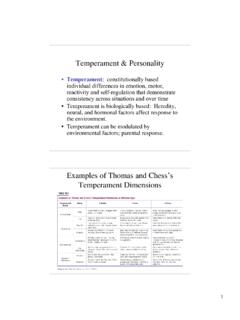
Temperament & Personality
psych.colorado.edu1 Temperament & Personality •Temperament: constitutionally based individual differences in emotion, motor, reactivity and self-regulation that demonstrate consistency across situations and over time

Positive and N egative Affectivity and T heir R elation to ...
psych.colorado.eduPositive and N egative Affectivity and T heir R elation ... (N A ) and Positive A ffectivity (PA ). N egative A ffect is a general factor of subjective distress, and subsum es a broad range of negative m ood states, including fear, anxiety, hostility, scorn, and disgust. M ood states related to de-
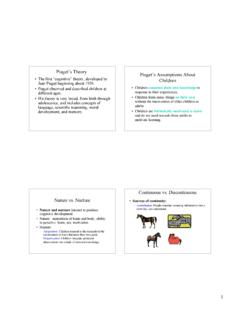
Piaget’s Theory Piaget’s Assumptions About Children
psych.colorado.edu3 Piaget’s Stages • Sensorimotor stage (birth to 2 years) •Preoperational stage (2 to 7 years) –Knowledge is represented by language, mental imagery,

Making Working Memory Work: A Computational Model of ...
psych.colorado.eduLETTER Communicated by Peter Dayan Making Working Memory Work: A Computational Model of Learning in the Prefrontal Cortex and Basal Ganglia Randall C. O Reilly
Related documents
Piaget’s Theory Piaget’s Assumptions About Children
psych.colorado.eduNature vs. Nurture •Nature and nurture interact to produce cognitive development. •Nature: maturation of brain and body; ability to perceive, learn, act; motivation •Nurture: –Adaptation: Children respond to the demands of the environment in ways that meet their own …

Nature, Nurture, and Human Diversity - Purdue
www.psych.purdue.eduNature, Nurture, and Human Diversity Developmental Similarities Across Groups Gender Development Gender Similarities and Differences 11 Nature vs. Nurture • Genes • For “universals,” looks for similarities across cultures (but can account for differences by sex) • Universals – Aggression?

Principles of Language Learning
angol.uni-miskolc.huComprehension and Production, 39 Nature or Nurture'. 39 Universale, 40 Systematicity and Variability, 4 2 Language and Thought. 42 Imitation, 43 Practice and Frequency, 45 Input, 46 Discourse, 47 First Language Acquisition Insights Applied to Language Teaching, 48 Topics and Questions Jar Study and Discussion. 51 Suggested Readings, 52
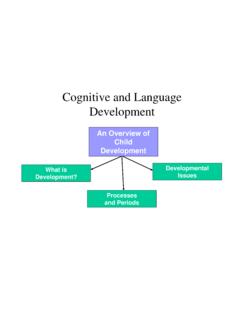
Cognitive and Language Development - Stony Brook
www.psychology.sunysb.eduNature-Nurture Issue Continuity-Discontinuity Issue Early-Later Experience Issue. Cognitive and Language Development Cognitive Development Piaget’s Theory The Brain Vygotsky’s Theory
Critical Period in Language Development
www.staff.city.ac.ukwith delays in language acquisition and perceptual differences, for example, deafness. Intimately linked with the complex interaction between nature and nurture, the term . critical period. stems from processes identified in developmental psy-chology and developmental biology. A critical period can be characterized as a maturational time frame

Primary School Curriculum
curriculumonline.iedevelopment. It is designed to nurture the child in all dimensions of his or her life—spiritual, moral, cognitive, emotional, imaginative, aesthetic, social and physical. The curriculum recognises the integrity of the child’s life as a child and aims to cater for his or her needs and potential as they evolve day by day.

Language A: language and literature guide
erhs.laApproaches to teaching and approaches to learning in studies in language and literatureAppendices. 67. 60 Glossary of command terms 67 Bibliography 69. Contents. Language A: language and literature guide. Introduction. 1. Purpose of this document. 1. The Diploma Programme. 2. Nature of the subject. 6. Aims. 14. Assessment objectives. 15 ...

Economics guide - Peda.net
peda.netWe nurture our curiosity, developing skills for inquiry and ... Nature of the subject 6 Approaches to teaching and learning in economics 11 Aims 16 Assessment objectives 17 ... language and a classical language), a humanities or social science subject, an experimental science,
REHABILITATION SERVICES PATIENT EDUCATION MANUAL …
psychiatry.ucsf.edufavorite smelling detergent, breathe in fresh smells of nature when outside, get some coffee and smell the aroma. TASTE Chew your favorite gum, suck on a piece of peppermint candy, savor a piece of chocolate, really taste the food you eat, eat one thing mindfully. TOUCH Take a bath, put lotion on your whole body, massage your feet, put

CHAPTER 1: AN INTRODUCTION TO GENDER
www.web.stanford.edunurture – as social and hence fluid – while sex is the result of nature, simply given by biology. However, nature and nurture intertwine, and there is no obvious point at which sex leaves off and gender begins. But the sharp demarcation fails because there is no single objective biological criterion for male or female sex.