PICC- Peripherally Inserted Central Catheter
catheter is in the correct place a chest x-ray will be taken to confirm its placement. This procedure will require the injection of a local ... Following your PICC insertion it is normal to experience some redness and tenderness in the area of the insertion for about 24 to 48 hours.
Download PICC- Peripherally Inserted Central Catheter

Information
Domain:
Source:
Link to this page:
Documents from same domain
Carbohydrate counting - Home | Queensland Health
www.health.qld.gov.au• Australian Carb Counter; The Traffic Light Guide to Food Check with your Dietitian about other ... NEMO carbohydrate counting nutrition education material
Guidelines for Subcutaneous Infusion Device …
www.health.qld.gov.au1 Guidelines for Subcutaneous Infusion Device Management in Palliative Care - Second Edition Revised by: John Haberecht Research Officer, Centre for Palliative Care Research and Education
The Administration of Electroconvulsive Therapy
www.health.qld.gov.auThe Administration of Electroconvulsive Therapy - ii - Guideline for the Administration of Electroconvulsive Therapy Published by the State of Queensland …
Maternity and Neonatal Clinical Guideline - Queensland Health
www.health.qld.gov.auQueensland Clinical Guideline: Early pregnancy loss. Flowchart version: F17.29-4-V1-R22 Refer to online version, destroy printed copies after use Page 4 of 39

Queensland Stay On Your Feet Community Good Practice ...
www.health.qld.gov.auQueensland Stay On Your Feet® community good practice guidelines i ... NARI National Ageing Research Institute NICE National Institute for Clinical Excellence NPHP National Public Health Partnership PHC Primary Health Care PMSEIC Prime Minister’s Science Engineering and
Management of Subcutaneous Infusions in Palliative Care
www.health.qld.gov.auManagement of Subcutaneous Infusions in Palliative Care Centre for Palliative Care Research and Education Palliative Care Australia PO Box 24 Deakin West
CSCF maternity services - Queensland Health
www.health.qld.gov.auThe aim of maternity services is to achieve the safe provision of care for mother and baby, as close as ... safe maternity care is the primary catalyst for a healthy society. Maternal health directly affects ... culturally appropriate and evidence-based written information (or verbal, if written information is
Asbestos health risks
www.health.qld.gov.auAsbestos health risks Guidance Note Introduction Asbestos is the term used to describe a group of naturally occurring minerals whose characteristic feature is that ...
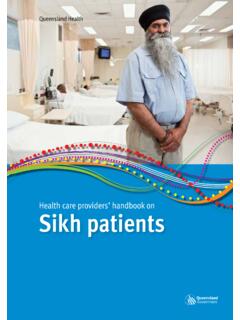
Health Care Providers' Handbook on Sikh Patients
www.health.qld.gov.au4 Healt ar ovider S atients Preface In 2010, Queensland Health and the Islamic Council of Queensland published the Health Care Providers’ Handbook on Muslim Patients (second edition) as a quick-reference tool for health workers when caring for Muslim patients. This handbook, the Health Care Providers’ Handbook on Sikh Patients, covers a similar range of topics and aims to inform
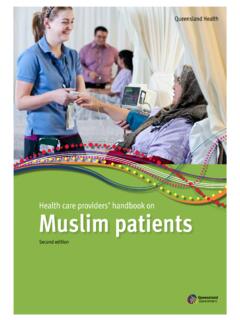
Health Care Providers' Handbook on Muslim Patients second ...
www.health.qld.gov.auMuslim Patients as a quick-reference tool for health workers when caring for Muslim patients. The handbook aimed to The handbook aimed to help health care providers understand the religious beliefs and practices of Muslims that could affect health care, and
Related documents

FEE-FOR-SERVICE PROVIDER - azahcccs.gov
www.azahcccs.govA provider who bills 36556 (Insertion of non-tunneled centrally inserted central venous catheter; age 5 years or older) should bill one unit. Billing the Basic Unit Value of four would indicate placement of four catheters. Reimbursement is based on capped fee schedule. Anesthesia Medical Direction
“Catheter-Associated Urinary Tract Infecion”
www.cdc.govTo prevent urinary tract infecions, doctors and nurses take the following acions. Catheter inserion . o Catheters are put in only when necessary and they are removed as soon as possible. o Only properly trained persons insert catheters using sterile (“clean”) technique.

Bloodstream Infection Event (Central Line-Associated ...
www.cdc.govAn intravascular catheter that terminates at or close to the heart, or . in one of the great vessels . AND. is used for infusion, withdrawal of blood, or hemodynamic monitoring. Consider the following great vessels when making determinations about CLABSI events and counting CL device days: • Aorta • Pulmonary artery • Superior vena cava

Central Vascular Access Drvice Insertion - Queensland Health
www.health.qld.gov.authe heart. The catheter does not go into your heart. When the catheter is in the correct place a chest x-ray will be taken to confirm its placement. Non-Tunnelled Catheter The catheter is inserted directly into the vein and is held in place with sutures and a dressing. This type of catheter can stay in for about a week. Tunnelled Catheter
Guidelines for the Prevention of Catheter- associated ...
www.hpsc.ie2.4.3 Catheter material 9 3.0 Insertion of a urinary catheter 10 3.1 Standard precautions 10 3.2 Aseptic technique 10 3.3 Hand decontamination 10 3.4 Personal protective equipment 11 3.5 Patient preparation 11 3.6 Meatal cleaning and disinfection 11 3.6.1 Prior to urethral catheterisation (indwelling or intermittent)

Central Venous Catheter (CVC) Workbook
www.westhertshospitals.nhs.uk•Size of catheter – Catheter too large for the vein in which it is placed •Fibrin mesh formation around the catheter can result in the formation of a blood clot •Traumatic insertion or catheter malposition •Pre-disposing factors (clotting disorders) •Catheter tip malposition Signs •Swelling in hand, upper limbs or neck