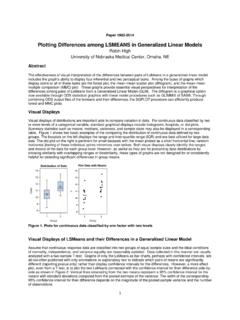
Plotting Differences among LSMEANS in Generalized Linear ...
1 Paper 1902-2014 Plotting Differences among LSMEANS in Generalized Linear Models Robin High University of Nebraska Medical Center, Omaha, NE
Download Plotting Differences among LSMEANS in Generalized Linear ...

Information
Domain:
Source:
Link to this page:
Documents from same domain
027-2009: Tips and Tricks for Creating the Reports …
support.sas.comPaper 027-2009 TIPS AND TRICKS FOR CREATING THE REPORTS YOUR CLIENTS NEED TO SEE Michael J Molter, INC Research, Raleigh, NC ABSTRACT Advanced reporting tools such as PROC REPORT have progressed by leaps and …
Step-by-Step Programming with Base SAS Software
support.sas.comThe correct bibliographic citation for this manual is as follows: SAS Institute Inc. 2001. Step-by-Step Programming with Base SAS® Software.Cary, NC: SAS Institute Inc.
227-2012: Executing a PROC from a DATA Step - …
support.sas.com2 Using RUN_MACRO to execute a PROC from a DATA step requires writing three blocks of code, described in the Introduction: a macro to execute a PROC, a user-written function to execute the macro, and a DATA step to call the
149-2012: Queries, Joins, and WHERE Clauses, Oh …
support.sas.comPaper 149-2012 Queries, Joins, and WHERE Clauses, Oh My!! Demystifying PROC SQL Christianna S. Williams, Chapel Hill, NC ABSTRACT Subqueries, inner joins, outer joins, HAVING expressions, set operators…just the terminology of PROC SQL might
158-2010: How to Use Arrays and DO Loops: Do I …
support.sas.com1 Paper 158-2010 How to Use ARRAYs and DO Loops: Do I DO OVER or Do I DO i? Jennifer L Waller, Medical College of Georgia, Augusta, GA ABSTRACT
248-2009: Learning When to Be Discrete: …
support.sas.com1 Paper 248–2009 Learning When to Be Discrete: Continuous vs. Categorical Predictors David J. Pasta, ICON Clinical Research, San Francisco, CA ABSTRACT
338-2011: An Introduction to Survival Analysis …
support.sas.com2 (Censored) Study Ends (From Applied Survey Data Analysis, p. 306) Figure 1. Prospective View of Event History Survey Data Time can be regarded as continuous or discrete and this basic distinction affects the analytic approach selected.
Dongsheng Yang and Jarrod E. Dalton - SAS
support.sas.com1 Paper 335-2012 A unified approach to measuring the effect size between two groups using SAS® Dongsheng Yang and Jarrod E. Dalton Departments of Quantitative Health Sciences and Outcomes Research
SAS/STAT 9.2 User's Guide: Introduction to Power …
support.sas.comSAS/STAT ® 9.2 User’s Guide Introduction to Power and Sample Size Analysis (Book Excerpt) SAS® Documentation
249-2012: A Tutorial on the SAS® Macro Language
support.sas.com1 Paper 249-2012 A Tutorial on the SAS® Macro Language John J. Cohen, Advanced Data Concepts LLC, Newark, DE ABSTRACT The SAS macro language is another language layering on top of regular SAS code.
Related documents

EC 823: Applied Econometrics - Boston College
fmwww.bc.eduIntroduction to generalized linear models GLM estimators are essentially generalizations of nonlinear least squares, and as such are optimal for a nonlinear regression model with
Linear Regression Models with Logarithmic Transformations
kenbenoit.net24 68 0 20 40 60 80 100 Log(Expenses) 3 Interpreting coefficients in logarithmically models with logarithmic transformations 3.1 Linear model: Yi = + Xi + i Recall that in the linear regression model, logYi = + Xi + i, the coefficient gives us directly the change in Y for a one-unit change in X.No additional interpretation is required beyond the

Log Linear Models - San Francisco State University
userwww.sfsu.eduThe following model refers to the traditional chi-square test where two variables, each with two levels (2 x 2 table), are evaluated to see if an association exists between the

A very basic tutorial for performing linear mixed effects ...
www.bodowinter.com2 Introduction: Fixed and random effects In tutorial 1, we talked about how we could use the linear model to express the relationships in our data in terms of a function.

Linear Elastic Cable Model With Creep Proportional to Tension
www.powline.comCopyright © Power Line Systems, Inc. 2010 1 610 N. Whitney Way, Suite 160 Madison, Wisconsin 53705, USA Phone No: (608) 238-2171 Fax No: (608) 238-9241

Generalized Linear Models - Columbia University
www.stat.columbia.eduGeneralized Linear Models We have previously worked with regression models where the response variable is quantitative and normally distributed.