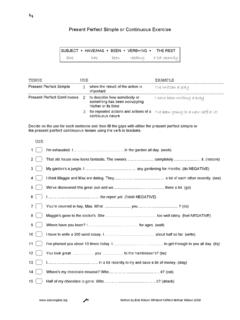
Present Perfect Simple or Continuous Exercise at Auto …
Present Perfect Simple or Continuous Exercise SUBJECT + HAVE/HAS + BEEN + VERB+ING + THE REST She has been reading a lot recently TENSE USE EXAMPLE Present Perfect Simple 1 when the result of the action is important I’ve written a play Present Perfect Continuous 2 to describe how somebody or
Download Present Perfect Simple or Continuous Exercise at Auto …

Information
Domain:
Source:
Link to this page:
Documents from same domain
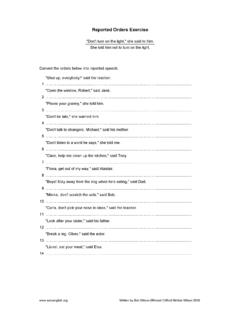
Reported Orders Exercise - autoenglish.org
www.autoenglish.orgReported Orders Exercise "Don't turn on the light," she said to him. She told him not to turn on the light. Convert the orders below into reported speech.

Adverbs of Manner Exercise
www.autoenglish.orgwww.autoenglish.org Written by Bob Wilson ©Robert Clifford McNair Wilson 2007 Adverbs of Manner Exercise 1 Fill the gaps in the table below.
Have Something Done Exercise - autoenglish.org
www.autoenglish.orgAnswers 1 We had the roof repaired last year. It cost us a packet. (repair) 2 Anne has her hair done every Friday afternoon. (do) 3 I have the brakes checked three times a year.
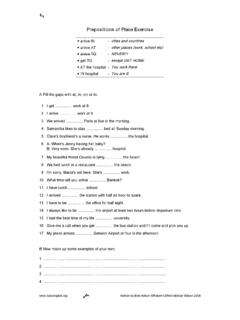
Prepositions of Place Exercise - autoenglish.org
www.autoenglish.orgwww.autoenglish.org Written by Bob Wilson ©Robert Clifford McNair Wilson 2008 Prepositions of Place Exercise Š arrive IN cities and countries
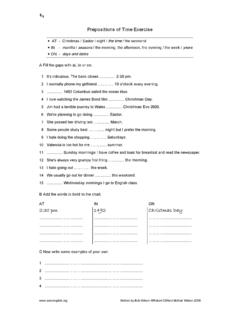
Prepositions of Time Exercise at Auto-English
www.autoenglish.orgwww.autoenglish.org Written by Bob Wilson ©Robert Clifford McNair Wilson 2008 Prepositions of Time Exercise Š AT Christmas / Easter / night /
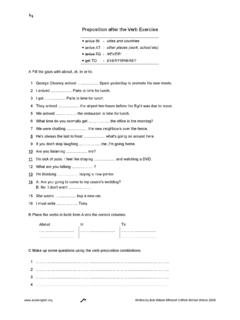
Preposition after the Verb Exercise - autoenglish.org
www.autoenglish.orgwww.autoenglish.org Written by Bob Wilson ©Robert Clifford McNair Wilson 2008 Preposition after the Verb Exercise Š arrive IN
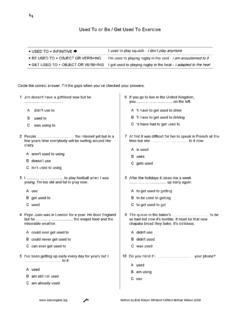
Used To or To Be Used To Exercise at Auto-English
www.autoenglish.orgwww.autoenglish.org Written by Bob Wilson ©Robert Clifford McNair Wilson 2008 Used To or Be / Get Used To Exercise Š USED TO + INFINITIVE ˘
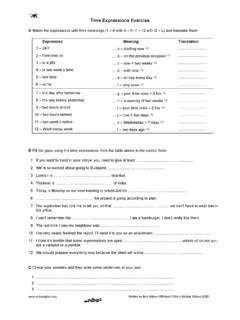
Time Expressions Exercise - autoenglish.org
www.autoenglish.orgwww.autoenglish.org Written by Bob Wilson ©Robert Clifford McNair Wilson 2008 Time Expressions Exercise A Match the expressions with their meanings (1 – 6 with A – F; 7 – 12 with G – L) and translate them.
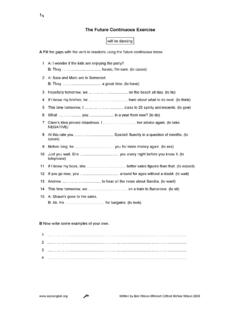
The Future Continuous Exercise - autoenglish.org
www.autoenglish.orgThe Future Continuous Exercise will be dancing A Fill the gaps with the verb in brackets using the future continuous tense. 1 A: I wonder if the kids are enjoying the party? B: They ..... havoc, I'm sure.
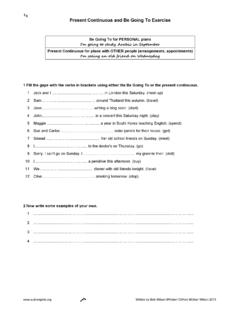
Present Continuous and Be Going To Exercise
www.autoenglish.orgPresent Continuous and Be Going To Exercise Be Going To for PERSONAL plans I'm going to study Arabic in September Present Continuous for plans with OTHER people (arrangements, appointments)
Related documents
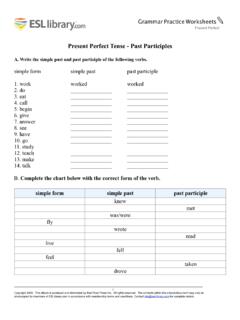
Present Perfect Tense - Past Participles
www.cubictalk.comPresent Perfect Tense - Negative A. Choose the correct verb from the list below to complete the following sentences. Put the verb in the negative form of the present prefect tense. fix / begin / arrive / be / see / stop / speak / buy / read / visit 1.

Mastering the Present Perfect Tense - Road to Grammar
www.roadtogrammar.comRemember that we use the present perfect tense to describe a non-specific time in the past. If we specify the time, we do not use the present perfect tense. We use the simple past tense: Wrong: I have seen that movie last week. Right: I saw that movie last week. If the time is not specified, it can be possible to use either tense.
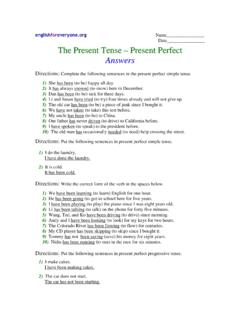
Present Perfect Tense - answers - EnglishForEveryone.org
englishforeveryone.orgThe Present Tense – Present Perfect Answers Directions: Complete the following sentences in the present perfect simple tense. 1) She has been (to be) happy all day. 2) It has always snowed (to snow) here in December. 3) Dan has been (to be) sick for three days. 4) Li and Susan have tried (to try) four times already and will not give up.
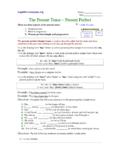
Present Perfect Tense - EnglishForEveryone.org
englishforeveryone.org1) Simple present 2) Present progressive 3) Present perfect (simple and progressive) _____ The present perfect (simple) tense is used to describe a fact that has been true from sometime in the past and continues to be true up through the present. • Use the helping verb “ has ” before a verb in present perfect simple tense to describe (he,

Complex Test Simple Past or Present Perfect
www.englisch-hilfen.deC - Which tense is used with the following actions? 1) Action beginning in the past and still continuing a) Present Perfect b) Simple Past 2) Result of an action in the past is important in the present a) Present Perfect b) Simple Past 3) Action …
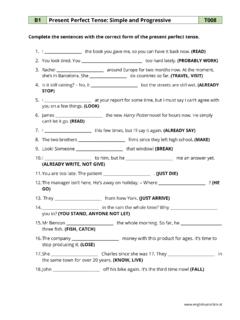
B1 Present Perfect Tense: Simple and Progressive T008
www.english-practice.atB1 Present Perfect Tense: Simple and Progressive T008 Complete the sentences with the correct form of the present perfect tense. 1. I _____ the book you gave me, so you can have it back now. (READ) 2. You look tired. You _____ too hard lately. (PROBABLY WORK) 3.
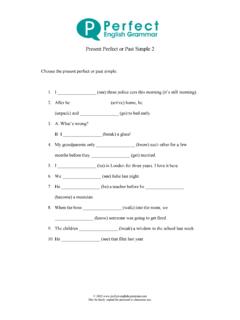
present perfect or past simple 2 - Perfect English Grammar
www.perfect-english-grammar.com© 2012 www.perfect-english-grammar.com May be freely copied for personal or classroom use. Present Perfect or Past Simple 2 Choose the present perfect or past simple:
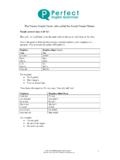
The Present Simple Tense - Perfect English Grammar
www.perfect-english-grammar.comThe Present Simple Tense (also called the Simple Present Tense) Simple present tense with 'be': The verb ‘be’ is different from the other verbs in this tense.
Related search queries
Present Perfect Tense, The present, Tense, The present perfect tense, Simple, The Present Tense, Present Perfect, The present perfect simple tense, Simple present, Present, The present perfect (simple) tense, Present perfect simple tense, Perfect, The present perfect, The Present Simple Tense, Simple present tense