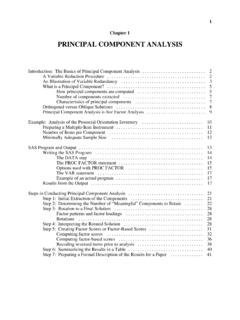
PRINCIPAL COMPONENT ANALYSIS - SAS Support
Principal Component Analysis 3 Because it is a variable reduction procedure, principal component analysis is similar in many respects to exploratory factor analysis.
Download PRINCIPAL COMPONENT ANALYSIS - SAS Support

Information
Domain:
Source:
Link to this page:
Documents from same domain
027-2009: Tips and Tricks for Creating the Reports …
support.sas.comPaper 027-2009 TIPS AND TRICKS FOR CREATING THE REPORTS YOUR CLIENTS NEED TO SEE Michael J Molter, INC Research, Raleigh, NC ABSTRACT Advanced reporting tools such as PROC REPORT have progressed by leaps and …
Step-by-Step Programming with Base SAS Software
support.sas.comThe correct bibliographic citation for this manual is as follows: SAS Institute Inc. 2001. Step-by-Step Programming with Base SAS® Software.Cary, NC: SAS Institute Inc.
227-2012: Executing a PROC from a DATA Step - …
support.sas.com2 Using RUN_MACRO to execute a PROC from a DATA step requires writing three blocks of code, described in the Introduction: a macro to execute a PROC, a user-written function to execute the macro, and a DATA step to call the
149-2012: Queries, Joins, and WHERE Clauses, Oh …
support.sas.comPaper 149-2012 Queries, Joins, and WHERE Clauses, Oh My!! Demystifying PROC SQL Christianna S. Williams, Chapel Hill, NC ABSTRACT Subqueries, inner joins, outer joins, HAVING expressions, set operators…just the terminology of PROC SQL might
158-2010: How to Use Arrays and DO Loops: Do I …
support.sas.com1 Paper 158-2010 How to Use ARRAYs and DO Loops: Do I DO OVER or Do I DO i? Jennifer L Waller, Medical College of Georgia, Augusta, GA ABSTRACT
248-2009: Learning When to Be Discrete: …
support.sas.com1 Paper 248–2009 Learning When to Be Discrete: Continuous vs. Categorical Predictors David J. Pasta, ICON Clinical Research, San Francisco, CA ABSTRACT
338-2011: An Introduction to Survival Analysis …
support.sas.com2 (Censored) Study Ends (From Applied Survey Data Analysis, p. 306) Figure 1. Prospective View of Event History Survey Data Time can be regarded as continuous or discrete and this basic distinction affects the analytic approach selected.
Dongsheng Yang and Jarrod E. Dalton - SAS
support.sas.com1 Paper 335-2012 A unified approach to measuring the effect size between two groups using SAS® Dongsheng Yang and Jarrod E. Dalton Departments of Quantitative Health Sciences and Outcomes Research
SAS/STAT 9.2 User's Guide: Introduction to Power …
support.sas.comSAS/STAT ® 9.2 User’s Guide Introduction to Power and Sample Size Analysis (Book Excerpt) SAS® Documentation
249-2012: A Tutorial on the SAS® Macro Language
support.sas.com1 Paper 249-2012 A Tutorial on the SAS® Macro Language John J. Cohen, Advanced Data Concepts LLC, Newark, DE ABSTRACT The SAS macro language is another language layering on top of regular SAS code.
Related documents
Overview of Factor Analysis - Stat-Help.com
www.stat-help.comChapter 2 Exploratory Factor Analysis 2.1 Objectives † The primary objectives of an EFA are to determine 1. The number of common factors in°uencing a set of measures. 2. The strength of the relationship between each factor and each observed measure.
A Beginner’s Guide to Factor Analysis: Focusing on ...
www.tqmp.orgTutorials in Quantitative Methods for Psychology 2013, Vol. 9(2), p. 79-94. 79 A Beginner’s Guide to Factor Analysis: Focusing on Exploratory Factor Analysis
Think Stats - Green Tea Press
greenteapress.comThink Stats Exploratory Data Analysis in Python Version 2.0.35 Allen B. Downey Green Tea Press Needham, Massachusetts

Teachers’ Perception Toward Mathematics Teaching ...
educationforatoz.com98 Teachers’ Perception toward Mathematics To discuss teachers’ perception toward teaching innovation, I need to
Best practices in exploratory factor analysis: four ...
www.pareonline.netPractical Assessment Research & Evaluation, Vol 10, No 7 3 Costello & Osborne, Exploratory Factor Analysis calculated by hand. Therefore the best choice for
200-31: Exploratory or Confirmatory Factor Analysis?
www2.sas.com1 Paper 200-31 Exploratory or Confirmatory Factor Analysis? Diana D. Suhr, Ph.D. University of Northern Colorado Abstract Exploratory factor analysis (EFA) could be described as orderly simplification of interrelated measures.
203-30: Principal Component Analysis versus Exploratory ...
www2.sas.com1 Paper 203-30 Principal Component Analysis vs. Exploratory Factor Analysis Diana D. Suhr, Ph.D. University of Northern Colorado Abstract Principal Component Analysis (PCA) and Exploratory Factor Analysis (EFA) are both variable reduction techniques

Science Motivation Questionnaire: Construct validation ...
www.peggybrickman.uga.eduJOURNAL OF RESEARCH IN SCIENCE TEACHING Science Motivation Questionnaire: Construct Validation With Nonscience Majors Shawn M. Glynn,1,2 Gita Taasoobshirazi,3 Peggy Brickman4 1Department of Educational Psychology and Instructional Technology, 329 Aderhold, University of Georgia, Athens, Georgia 30602
Related search queries
Factor Analysis, Exploratory Factor Analysis, Factor, Think Stats, Think Stats Exploratory, Analysis, Teachers’ Perception Toward Mathematics Teaching, Exploratory, Confirmatory Factor Analysis, Principal Component Analysis, Science Motivation Questionnaire: Construct validation, Science Motivation Questionnaire: Construct Validation With