Probability 2 - Notes 5 Conditional expectations E X Y as ...
Probability 2 - Notes 5 Conditional expectations E(XjY) as random variables Conditional expectations were discussed in lectures (see also the second part of Notes 3). The
Download Probability 2 - Notes 5 Conditional expectations E X Y as ...

Information
Domain:
Source:
Link to this page:
Documents from same domain

Notes on Probability - School of Mathematical …
www.maths.qmul.ac.ukPreface Here are the course lecture notes for the course MAS108, Probability I, at Queen Mary,UniversityofLondon,takenbymostMathematicsstudentsandsomeothers
Notes on Combinatorics - QMUL Maths
www.maths.qmul.ac.ukii Preface: What is Combinatorics? Combinatorics, the mathematics of patterns, ..., helps us design com-puter networks, crack security codes, or solve sudokus
Peter J. Cameron October 2013 - QMUL Maths
www.maths.qmul.ac.uk2 Preface Group theory is a central part of modern mathematics. Its origins lie in geome-try (where groups describe in a very detailed way the symmetries of geometric
Solutions to Exercises Chapter 4: Recurrence …
www.maths.qmul.ac.ukSolutions to Exercises Chapter 4: Recurrence relations and generating functions 1 (a) There are n seating positions arranged in a line. Prove that the number
A Course on Number Theory - QMUL Maths
www.maths.qmul.ac.ukiv They will be able to work with Diophantine equations, i.e. polyno-mial equations with integer solutions. They will know some of the famous classical theorems and conjectures in number theory, such as
Ten Chapters of the Algebraical Art - QMUL Maths
www.maths.qmul.ac.uk2 CHAPTER 1. WHAT IS MATHEMATICS ABOUT? If and only if We will come back to this later. For now, it means that, for any value of n, either the two statements “n is odd” and “ n2 is odd” are both true, or they are both false.
4.5 Autoregressive Processes AR(p)
www.maths.qmul.ac.uk4.5. AUTOREGRESSIVE PROCESSES AR(P) 77 So, we obtained the linear process form of the AR(1) Xt = X∞ j=0 φjZ t−j = X∞ j=0 φ jBZ t. Remark 4.13. Note, that from the equation (4.24) it followsthat ψ(B)is an inverse
Probability 2 - Notes 11 The bivariate and multivariate ...
www.maths.qmul.ac.ukThis is just the m.g.f. for the multivariate normal distribution with vector of means Am+b and variance-covariance matrix AVAT. Hence, from the uniqueness of the joint m.g.f, Y » N(Am+b;AVAT). Note that from (2) a subset of the Y0s is multivariate normal. NOTE. The results concerning the vector of means and variance-covariance matrix for linear
Notes on Linear Algebra - Queen Mary University of London
www.maths.qmul.ac.ukLinear algebra has two aspects. Abstractly, it is the study of vector spaces over fields, and their linear maps and bilinear forms. Concretely, it is matrix theory: matrices occur in all parts of mathematics and its applications, and everyone work-ing in the mathematical sciences and related areas needs to be able to diagonalise
6.2 ACF and PACF of ARMA(p,q)
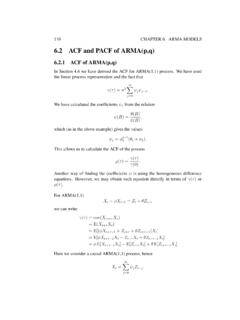
www.maths.qmul.ac.uk6.2.2 PACF of ARMA(p,q) We have seen earlier that the autocorrelation function of MA(q) models is zero for all lags greater than qas these are q-correlated processes. Hence, the ACF is a good indication of the order of the process. However AR(p) and ARMA(p,q) pro-
Related documents

C D P C S G I G N P C I H D A P C N H LK S g I N n H A i G ...
apps.pittsburghpa.gov2 9-4 1 5 l a w n s t 2 n d a v e 2 0 0-3 9 9 a o p h e li a s t 2 8 0-3 2 7 n s p c r a f t b a v e blvd of th ea li s f o r b e s m a v e 3 1 0 0 - 3 1 9 9 s t n o ...
X Y be two random variables, with means µ and Var(X ) = = …
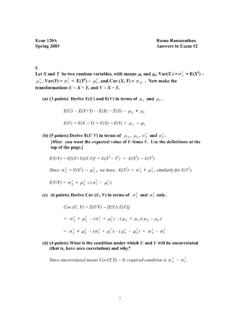
econweb.ucsd.eduEcon 120A Ramu Ramanathan Spring 2003 Answers to Exam #2 I. Let X and Y be two random variables, with means µ x and µ y, Var(X) = 2 = E(X σX 2) − 2, Var(Y) = = E(Y µX 2 σY 2) − 2, and Cov (X, Y) = µY σXY.Now make the transformations U = X + Y, and V = X − Y. (a) (3 points) Derive E(U) and E(V) in terms of µX and µY.
Gauss Law E - Stony Brook University
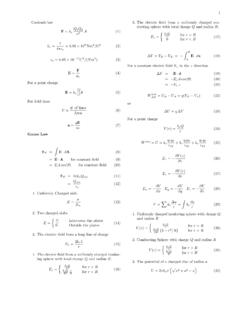
tonic.physics.sunysb.edu3 (b) If the loop direction is the with the battery (Fig. 3) the voltage change is (∆V) E = +E (59) If the loop and battery are opposite −E (c) For each capacitor if the loop direction is in
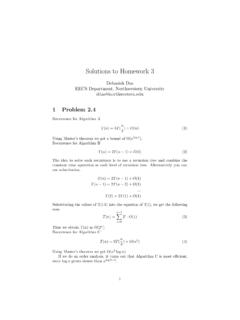
Solutions to Homework 3 - Northwestern Engineering
www.ece.northwestern.eduER = (v,u) : (u,v) ∈ E. We assume that each edge e has a source vertex u and We assume that each edge e has a source vertex u and a sink vertex v associated with it.

Solutions to Homework 5 - Northwestern Engineering
www.ece.northwestern.edu(c)Linear time algorithm to check whether there is a cycle containing a specific edge e: Let e = (u,v). Start a DFS from u and exclude edge e while considering outgoing edges from u.
IN FO R MA TI O NA L H EA RI N G an d S IT E V IS I T
www.energy.ca.govMar 01, 2001 · B r ad F or li e r, V i ce P r es id e nt , D ev el o pm en t W a yn e H of fm a n, E n vi ro n me nt a l Ma n ag er S t ev e G os ch k e, P l an t M an ag e r, M or ro Ba y R a nd y V ig or , M os s L an d in g P ow er Pl an t P ro j ec t D u ke E n er gy No rt h A me …

b c d f e g h i l m j n k o p q r s c t f x y { | w z v e ...
www.houstontx.govv e ~ | f y Ë Ì Í Î Ï ... ö ÷ ø ù ú û. Department(s) Name Email Office Phone Administration & Regulatory Affairs Martinez, Sergio - HR Sergio.Martinez2@houstontx.gov (832) 393-7223 City Council Ruiz, Alejandra - FIN Alejandra.Ruiz@houstontx.gov (838) 393-0781 City Secretary's Office Martinez, Sergio - HR Sergio.Martinez2@houstontx ...

T h is d o c u m e n t w a s d e v e lo p e d u n d e r g ...
www.ncjfcj.orgN a v ig a tin g C u s to d y & V is ita tio n E v a lu a tio n s in C a s e s w ith D o m e s tic V io le n c e : A Ju d g e Õs G u id e In tro d u ctio n It is m o re lik e ly th a n n o t, a c c o rd in g to c u rre n t re se a rc h ,2 th a t ju d g e s
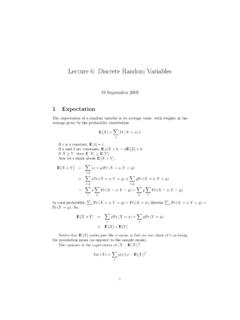
Lecture 6: Discrete Random Variables - CMU Statistics
www.stat.cmu.eduLecture 6: Discrete Random Variables 19 September 2005 1 Expectation The expectation of a random variable is its average value, with weights in the average given by the probability distribution E[X] = X x Pr(X = x)x If c is a constant, E[c] = c. If a and b are constants, E[aX +b] = aE[X]+b. If X ≥ Y, then E[X] ≥ E[Y] Now let’s think about ...

S a s h a W / P O w n e r ’ s M a n ua l
www.wilsonaudio.comWi l s o n Au d i o S p e c i a l t i e s Section 1.1 – Room Acoustics Section 1.1 – Room Acoustics You are surely excited about setting up Sasha W/P™ loudspeakers and doing some listening, but before you begin, we would like to discuss some of the important room acoustical information that will help you set up your loudspeakers properly.