Probability, Statistics, and Stochastic Processes
1.3 The Axioms of Probability 7 1.4 Finite Sample Spaces and Combinatorics 16 1.4.1 Combinatorics 18 1.5 Conditional Probability and Independence 29 1.5.1 Independent Events 35 1.6 The Law of Total Probability and Bayes’ Formula 43 1.6.1 Bayes’ Formula 49 1.6.2 Genetics and Probability 56 1.6.3 Recursive Methods 58 2 Random Variables 79
Download Probability, Statistics, and Stochastic Processes

Information
Domain:
Source:
Link to this page:
Documents from same domain
ELEMENTARY DIFFERENTIAL EQUATIONS - Trinity …
ramanujan.math.trinity.eduELEMENTARY DIFFERENTIAL EQUATIONS William F. Trench Andrew G. Cowles Distinguished Professor Emeritus Department of Mathematics Trinity University
THE METHOD OF LAGRANGE MULTIPLIERS - Trinity …
ramanujan.math.trinity.eduTHE METHOD OF LAGRANGE MULTIPLIERS William F. Trench Andrew G. Cowles Distinguished Professor Emeritus Department of Mathematics Trinity University
INTRODUCTION TO REAL ANALYSIS - Trinity …
ramanujan.math.trinity.eduINTRODUCTION TO REAL ANALYSIS William F. Trench AndrewG. Cowles Distinguished Professor Emeritus Departmentof Mathematics Trinity University San Antonio, Texas, USA
Improper Integrals - Trinity University
ramanujan.math.trinity.eduThat’s the easy implication. For the converse, now suppose the stated Cauchy criterion holds. For natural numbers n alet a n = Z n a f(x)dx: Let …
STUDENT SOLUTIONS MANUAL FOR …
ramanujan.math.trinity.eduSTUDENT SOLUTIONS MANUAL FOR ELEMENTARY DIFFERENTIAL EQUATIONS AND ELEMENTARY DIFFERENTIAL EQUATIONS WITH BOUNDARY VALUE PROBLEMS William F. Trench Andrew G. Cowles Distinguished Professor Emeritus Department of Mathematics Trinity University San Antonio, Texas, USA
ELEMENTARY DIFFERENTIAL EQUATIONS
ramanujan.math.trinity.eduPreface Elementary Differential Equations with Boundary Value Problems is written for students in science, en-gineering,and mathematics whohave completed calculus throughpartialdifferentiation.
The one dimensional heat equation: Neumann and …
ramanujan.math.trinity.eduNeumann Boundary Conditions Robin Boundary Conditions Remarks At any given time, the average temperature in the bar is u(t) = 1 L Z L 0 u(x,t)dx. In the case of Neumann boundary conditions, one has u(t) = a 0 = f. That is, the average temperature is constant and is equal to the initial average temperature.
The two dimensional wave equation - Trinity University
ramanujan.math.trinity.eduThe 2D wave equation Separation of variables Superposition Examples Representability The question of whether or not a given function is equal to a double Fourier series is partially answered by the following result. Theorem If f(x,y) is a C2 function on the rectangle [0,a] ×[0,b], then
Introduction to Sturm-Liouville Theory - Trinity University
ramanujan.math.trinity.eduOrthogonality Sturm-Liouville problems Eigenvalues and eigenfunctions Inner products with weight functions Suppose that w(x) is a nonnegative function on [a,b].
The Chinese Remainder Theorem - ramanujan.math.trinity.edu
ramanujan.math.trinity.eduThe Chinese remainder theorem (CRT) asserts that there is a unique class a+ NZ so that xsolves the system (2) if and only if x2a+ NZ, i.e. x a(mod N). Thus the system (2) is equivalent to a single congruence modulo N. Although we only proved one implication, one can actually show that the …
Related documents
Review of Probability Theory - Stanford University
cs229.stanford.eduReview of Probability Theory Arian Maleki and Tom Do Stanford University Probability theory is the study of uncertainty. Through this class, we will be relying on concepts from probability theory for deriving machine learning algorithms. These notes attempt to cover the basics of probability theory at a level appropriate for CS 229.

CHAPTER 3: Random Variables and Probability Distributions
homepage.divms.uiowa.eduReview: 1. A sale engineer for a manufacturer of high-speed grinding equipment has just returned from visiting ve possible clients. She believes that the following table describes the distribution of the number of sales she ... The probability density function of the time to failure of an electronic component in a copier (in hours) is f(x) = 8 ...

Unit 8 Probability Worksheet Packet Answer Key
pebblebrookhigh.typepad.comName Worksheet E3 : Review for Unit 3 Test The spinner shown is spun once. For each problem find. 1. 2 3. 4 5 6. 7 a. the probability of each event,

PROBABILITY AND STATS ENGINEERING AND SCIENCES, …
www.ru.ac.bd2 Probability Introduction 52 2.1 Sample Spaces and Events 53 2.2 Axioms, Interpretations, and Properties of Probability 58 2.3 Counting Techniques 66 2.4 Conditional Probability 75 2.5 Independence 85 Supplementary Exercises 91 Bibliography 94 3 Discrete Random Variables and Probability Distributions Introduction 95 3.1 Random Variables 96
Chap. 5: Joint Probability Distributions
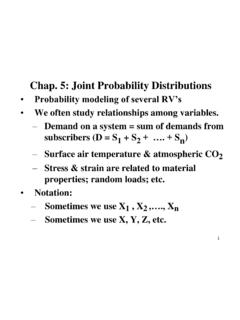
www.asc.ohio-state.edu1 Chap. 5: Joint Probability Distributions • Probability modeling of several RV‟s • We often study relationships among variables. – Demand on a system = sum of demands from subscribers (D = S 1 + S 2 + …. + S n) – Surface air temperature & atmospheric CO 2 – Stress & strain are related to material properties; random loads; etc.
AP Statistics Review Probability
www.northernhighlands.orgProbability Rules A sample space contains all the possible outcomes observed in a trial of an experiment, a survey, or some random phenomenon. • The sum of the probabilities for all possible outcomes in a sample space is 1. • The probability of an outcome is a number between 0 and 1 inclusive. An outcome that always happens has probability 1.
9 Convergence in probability - University of California, Davis
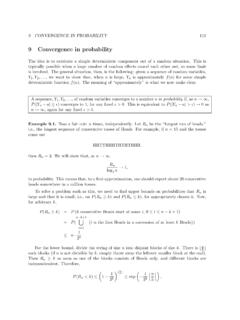
www.math.ucdavis.edu• a risky “stock” which increases your investment by 50% with probability 0.8 and wipes it away with probability 0.2. Putting an amount s in the bond, then, gives you 1.06s after a year. The same amount in the stock gives you 1.5s with probability 0.8 and 0 with probabiliy 0.2; note that the expected value is 0.8 ·1.5s = 1.2s > 1.06s.
MATH 125 Probability Homework Problem 1.
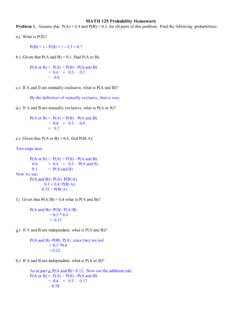
faculty.mansfield.eduthe probability of passing the physical exam is 0.85 and that once the physical exam is passed the probability of passing the written exam is 0.60. a) What is the probability that Janice passes both exams? A direct translation of the language above is This: P(Pass Physical) = 0.85.