
Problem Solving with Algorithms and Data Structures
Problem Solving with Algorithms and Data Structures, Release 3.0 Control constructs allow algorithmic steps to be represented in a convenient yet unambiguous way. At a minimum, algorithms require constructs that perform sequential processing, selection for decision-making, and iteration for repetitive control. As long as the language provides these
Download Problem Solving with Algorithms and Data Structures

Information
Domain:
Source:
Link to this page:
Documents from same domain

Introduction to Weka - The University of Auckland
www.cs.auckland.ac.nzWhat is Weka? Weka is a collection of machine learning algorithms for data mining tasks. The algorithms can either be applied directly to a dataset or called from your own Java code.

When was the first computer invented?
www.cs.auckland.ac.nzIn 1968, Hewlett Packard began marketing the first mass-marketed PC and the first desktop computer, the HP 9100A. The first workstation Although it was never sold, the first workstation is considered to be the Xerox Alto, introduced in 1974. The computer was revolutionary for its time and included a fully functional computer, display, and mouse.
String Matching Algorithms - Auckland
www.cs.auckland.ac.nzOutlineString matchingNa veAutomatonRabin-KarpKMPBoyer-MooreOthers 1 String matching algorithms 2 Na ve, or brute-force search 3 Automaton search 4 Rabin-Karp algorithm 5 Knuth-Morris-Pratt algorithm 6 Boyer-Moore algorithm 7 Other string matching algorithms Learning outcomes: Be familiar with string matching algorithms Recommended reading:

Image Filtering - Auckland
www.cs.auckland.ac.nzMedian Filtering example The following example shows the application of a median filter to a simple one dimensional signal. A window size of three is used, with one entry immediately preceding and following each entry. ... – It defines a probability distribution for noise or data.

1 Exercises and Solutions - Auckland
www.cs.auckland.ac.nz4. Assume that each of the expressions below gives the processing time T(n) spent by an algorithm for solving a problem of size n. Select the dominant term(s) having the steepest increase in n and specify the lowest Big-Oh complexity of each algorithm. Expression Dominant term(s) O(...) 5+0.001n3 +0.025n 500n+100n1.5 +50nlog 10 n 0.3n+5n 1.5 +2 ...
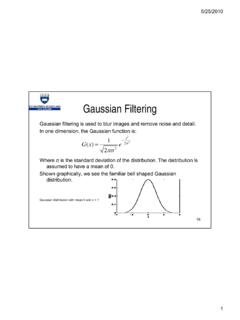
Gaussian Filtering - Auckland
www.cs.auckland.ac.nzThis means we can normally limit the kernel size to contain only values within three standard deviations of the mean. 5/25/2010 7 ... This is a common first step in edge detectionThis is a common first step in edge detection. The images below have been processed with a …

Big-Oh notation: few examples - Auckland
www.cs.auckland.ac.nzthe Big-Oh condition cannot hold (the left side of the latter inequality is growing infinitely, so that there is no such constant factor c). Example 3: Prove that running time T(n) = n3 + 20n + 1 is O(n4) Proof: by the Big-Oh definition, T(n) is O(n4) if T(n) ≤ c·n4 for some n ≥ n0 . Let us check this condition: if n3 + 20n + 1 ≤ c·n4 ...

Python 3 – Turtle graphics - Auckland
www.cs.auckland.ac.nzLogo and Turtle graphics In 1967, Seymour Papert and Wally Feurzeig created an interpretive programming language called Logo. Papert added commands to Logo so that he could control a turtle robot, which drew shaped on paper, from his computer Turtle graphics is now part of Python Using the Turtle involves instructing the turtle to move on the

Image Filtering - School of Computer Science
www.cs.auckland.ac.nz5/25/2010 2 Median Filtering example The following example shows the applicati on of a median filter to a simple one dimensional signal. A window size of three is used, wi th one entry immediately preceding and
Related documents

Learning Algorithms Through Programming and Puzzle Solving
nikku1234.github.iothat we support: C, C++, Java, JavaScript, Python, Scala, C#, Haskell, Ruby, and Rust (the last four programming languages are supported by Coursera only). These code challenges are embedded in our Coursera and edX online courses. 2. ALGORITHMIC PUZZLES provide you with a fun way to “invent” the key algorithmic ideas on your own!

Introduction to Pseudocode
bioinformaticsalgorithms.comA Introduction to Pseudocode What is Pseudocode? An algorithm is a sequence of instructions to solve a well-formulated computational problem specified in terms of its input and output.An algorithm uses the input to generate the output. For example, the algorithm PATTERN COUNTuses strings Text and Pattern as input to generate the number COUNT(Text,Pattern) …

Algorithmic Problem Solving with Python
eecs.wsu.eduAlgorithmic Problem Solving with Python John B. Schneider Shira Lynn Broschat Jess Dahmen February 22, 2019

Table of Contents - Tynker
www.tynker.comlanguages like Java, Python, or Ruby, but even kids can easily learn to code using a ... conditional logic, and algorithmic thinking. ... game to play, help them find a game that uses problem-solving skills. ...

Maths with Python Documentation - Read the Docs
buildmedia.readthedocs.org• Algorithmic thinking: understanding how to convert the solution to a problem into a sequence of steps that can ... • Effective implementation: solving a problem on a computer once is great. Being able to re-use your solution on ... Python already installed, for the use of other software. However, for programming, it is best to have an ...

Algorithms Notes for Professionals - GoalKicker.com
goalkicker.comSection 1.1: A sample algorithmic problem An algorithmic problem is specified by describing the complete set of instances it must work on and of its output after running on one of these instances. This distinction, between a problem and an instance of a problem, is fundamental. The algorithmic problem known as sorting is defined as follows ...
Lecture 1: Introduction and Peak Finding
ocw.mit.edu• Real implementations in Python • Fun problem sets! The course is divided into 8 modules — each of which has a motivating problem and problem set(s) (except for the last module). Tentative module topics and motivating problems are as described below: 1. Algorithmic Thinking: Peak Finding 2. Sorting & Trees: Event Simulation 3.

Building Java Programs - Pearson
www.pearsonhighered.com• Emphasis on algorithmic thinking. Our procedural approach allows us to emphasize algorithmic problem solving: breaking a large problem into smaller problems, using pseudocode to refine an algorithm, and grappling with the chal-lenge of expressing a large program algorithmically. • Layered approach.

Computational Physics
www.uio.noproblem. To device an algorithm and thereafter write a code for solving physics problems is a marvelous way of gaining insight into complicated physical systems. The algorithm you end up writing reflects in essentially all cases your own understanding of the physics and the mathematics (the way you express yourself) of the problem.