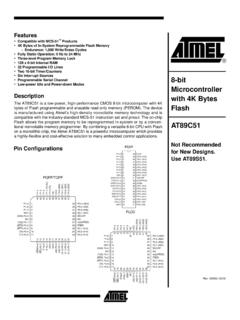
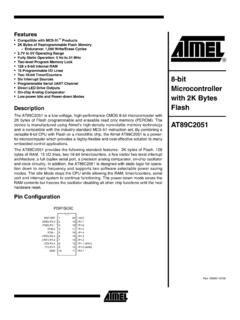
Programmable Serial Channel 8-bit Microcontroller
Output from the inverting oscillator amplifier. Oscillator Characteristics XTAL1 and XTAL2 are the input and output, respectively, of an inverting amplifier which can be configured for use as an on-chip oscillator, as shown in Figure 1. Either a quartz crystal or ceramic resonator may be used. To drive the
Download Programmable Serial Channel 8-bit Microcontroller

Information
Domain:
Source:
Link to this page:
Documents from same domain
GettingStarted - Keil
www.keil.comGetting Started: Building Applications with RL-ARM 3 Preface This manual is an introduction to the Real-Time Library (RL-ARM™), which is a group of tightly coupled libraries designed to solve the real-time and

Using Cortex-M3/M4/M7 Fault Exceptions
www.keil.comAN209 – Using Cortex-M3/M4/M7 Fault Exceptions Copyright © 2017 ARM Ltd. All rights reserved feedback@keil.com www.keil.com/appnotes/docs/apnt_209.asp
SD3502 General Purpose Z-Wave SoC - Keil
www.keil.comPowering the new digital home The SD3502 is a general-purpose Z-Wave SoC with a built-in microcontroller and Z-Wave RF transceiver, making it ideal for single microcontroller products, such as thermostats, door

Z-Wave Module - Keil
www.keil.comThe ZM5202 module combines a Z-Wave® SD3502 SoC (with a built-in microcontroller and Z-Wave RF transceiver), crystal, and passive RF components.
Genesis GM2121 Data Sheet - Keil
www.keil.comgm2121 Preliminary Data Sheet C2121-DAT-01F 5 December 2002 http://www.genesis-microchip.com List Of Tables Table 1. Analog Input Port.....11
DESIGNWARE DW8051 MACROCELL SOLUTION
www.keil.comOVERVIEW The DesignWare® DW8051™ MacroCell is a high-performance, configurable, fully-synthesizable, and reusable 8051 core. It is fully binary compatible with the industry standard 803x/805x microcontrollers.
8-bit Microcontroller with 4K Bytes In-System …
www.keil.commonolithic chip, the Atmel AT89S51 is a powerful microcontroller which provides a highly-flexible and cost-effective solution to many embedded control applications.
AS3525 datasheet - Keil
www.keil.comAS3525-A/-B C22O22 Data Sheet, Confidential © 2005-2009, austriamicrosystems AG, 8141 Unterpremstaetten, Austria-Europe. All Rights Reserved.
433/868/915MHz RF Transceiver with …
www.keil.comPRODUCT SPECIFICATION nRF9E5 Single Chip Transceiver with Embedded Microcontroller and ADC Main office: Nordic Semiconductor ASA - Vestre Rosten 81, N-7075 Tiller, Norway -Phone +4772898900 - Fax +4772898989
2K Bytes of Reprogrammable Flash Memory …
www.keil.comAT89C2051 3 Pin Description VCC Supply voltage. GND Ground. Port 1 Port 1 is an 8-bit bi-irectional I/O port. Port pins P1.2 to P1.7 provide internal pullups.
Related documents
ELECTRONIC MEASUREMENT & INSTRUMENTATION LAB LAB …
ggnindia.dronacharya.infoquartz crystal oscillator within a sealed temperature-controlled chamber known as a crystal oven or OCXO (oven controlled crystal oscillator). Q.6 Why time period measurement is done in frequency meters ? A.6 For achieving high accuracy in the case of low frequency measurement. Q.7 What is the order of input impedance in digital instruments ?
CRYSTAL OSCILLATOR CIRCUITS - bgaudioclub.org
bgaudioclub.orgThe U.S. Army Signal Corps funded an intense quartz crystal de-velopment program during and after World War II and funded a small amount of oscillator circuit development along the way. Edson did a study of VHF harmonic oscillator circuits in 1950 181 and published his classic book on vacuum tube oscillators of all types in 1953 [Q]. In 1965,

64 x 8, Serial, I2C Real-Time Clock - Maxim Integrated
datasheets.maximintegrated.comConnections for Standard 32.768kHz Quartz Crystal. The internal oscillator circuitry is . L) of 12.5pF. X1 is the input to the oscillator and can optionally be connected to an external 32.768kHz oscillator. The output of the internal oscillator, X2, is floated if an external oscillator is

I2C Serial Real-Time Clock - Maxim Integrated
datasheets.maximintegrated.comConnections for a Standard 32.768kHz Quartz Crystal. The internal oscillator circuitry is designed for operation with a crystal having a specified load capacitance (C L) of 6pF. For more information about crystal selection and crystal layout considerations, refer to Application Note 58: Crystal Considerations with Dallas Real-Time Clocks. An ...

8-bit Microcontroller with 2K Bytes Flash AT89C2051
ww1.microchip.comJan 23, 2004 · Output from the inverting oscillator amplifier. 5. Oscillator Characteristics The XTAL1 and XTAL2 are the input and output, respectively, of an inverting amplifier which can be configured for use as an on-chip oscillator, as shown in Figure 5-1. Either a quartz crystal or ceramic resonator may be used.
ELECTRONIC DEVICES AND CIRCUITS B.Tech IIIsemester …
www.iare.ac.in1.2a shows the crystal structure of Si at absolute zero temperature (0K). Hence a pure SC acts has poor conductivity (due to lack of free electrons) at low or absolute zero temperature. Covalent bond Valence electron Fig. 1.2a crystal structure of Si at 0K

PCF85263A WatchDog timer - NXP
www.nxp.comquartz crystal calibration. For a selection of NXP Real-Time Clocks, see Table 71. 2 Features and benefits • UL Recognized Component (PCF85263ATL) • Provides year, month, day, weekday, hours, minutes, seconds and 100th seconds based on a 32.768 kHz quartz crystal • Stop-watch mode for elapsed time counting. From 100th seconds to 999 999 hours

Recommended Crystal, XO, TCXO, and OCXO Reference …
www.skyworksinc.comA crystal (XTAL) in timing refers to a quartz crystal that works on the piezo-electric effect: an electrical voltage across it causes a mechanical perturbation and this in turn causes an electrical voltage to develop across it. The XTAL needs to be driven by a circuit to sustain its oscillation.