
Prokaryotic Cell Structure & Function
Structure of the Cell Wall •Provides shape and strong structural support •Most are rigid because of peptidoglycan content •Target of many antibiotics- disrupt the cell wall, and cells have little protection from lysis •Gram-positive cell (2 layers) –A thick (20 to 80 nm) petidoglycan cell wall and membrane •Gram-Negative Cell (3 layers)
Download Prokaryotic Cell Structure & Function

Information
Domain:
Source:
Link to this page:
Documents from same domain

Balancing Equations Worksheet - 3-13
www.ahschools.usHonors Chemistry Name: _____ Writing and Balancing Equations Worksheet STO.1 Balance a chemical equation. STO.2 Identify the parts of a chemical equation. RXN.1 Describe a chemical reaction using words and symbolic equations. For each of the following problems, write complete chemical equations to describe the chemical

Study Guide The House on Mango Street by Sandra …
www.ahschools.us“The House on Mango Street” pages 3 – 5 Esperanza tells the readers all about the problems of the house on Mango Street. She says that her parents told …

IB Chemistry: Guide to a Successful Internal Assessment ...
www.ahschools.usIB Chemistry: Guide to a Successful Internal Assessment (IA) Be sure to read pages 177-178 in “Baby Blue” for IA hints.The Internal Assessment write-up should be between 6 and 12 pages long.Investigations exceeding this

Thermodynamics Worksheet - Anoka-Hennepin School …
www.ahschools.usThermodynamics Worksheet Fill the blanks in the following sentences with the correct thermodynamics term: 1) The thing we measure when we want to determine the average kinetic energy of random motion in the particles of a substance is temperature. 2) The specific heat is the energy needed to raise the temperature of one gram of a

Introduction to Psychological Disorders
www.ahschools.usDissociative Disorders •Disorders in which the sense of self has become separated (dissociated) from previous memories, thoughts, or feelings . ... •Group of severe disorders characterized by disorganized and delusional thinking, disturbed perceptions, and inappropriate

Honors Geometry Solutions Manual
www.ahschools.us4¬ x LM 2x 3 LM 2(4) 3 8 3 LM 11 11. BC 6CD because they both have length 10 inches. BE ED because they both have length 8 inches. BA DAbecause they both have length 14.4 inches. Pages 17–19 Practice and Apply 12. Each inch on the ruler is divided into sixteenths. Point B is closer to the 11 5 6-inch mark.Thus,AB is about 11 5

Argument Writing Cheat Sheet - Anoka-Hennepin School ...
www.ahschools.us#2: 24 Paired Activity Planning Cards Purpose: To give step by step support to student pairs as they plan an argument piece Each card includes: 1) a Topic/Issue, 2) Getting Started Information, and 3) a Research Planning Guide. #3: A Paired Activity Discussion Card Purpose: To help students internalize the components of The

Mole Conv WS Key - Anoka-Hennepin School District / …
www.ahschools.usCreated Date: 2/23/2015 4:14:14 PM
Related documents

Bacterial Cell Structure and Function
uomosul.edu.iqGeneral Microbiology | Bacterial Cell Structure and Function | Sumaya Yaseen Al-dabbagh Page | 7 Bacteria with flagella are motile; that is, they have the ability to move on their own. Flagellum is a semi rigid, helical structure that moves the cell by rotating from the basal body. The movement of
STRUCTURE AND FUNCTION OF BIO- MOLECULES
www.coledavid.comStructure and function of Biomolecules - 10 - little tendency to form ions • Elements from the top of the groups double bonds possible light atoms, i.e. strong bonds Carbon atoms can link to each other and form 3D structures Ions: Na+, K+, Mg2+, Ca2+, Cl-

RNA AND ITS STRUCTURE, FUNCTION AND TYPES
www.eagri.orgRNA AND ITS STRUCTURE, FUNCTION AND TYPES . With the discovery of the molecular structure of the DNA. double helix in 1953, researchers turned to the structure of ribonucleic acid (RNA) as the next critical puzzle to be solved on the road to …
Newspaper Article Analysis - bsu.by
fsc.bsu.byNewspaper Article Analysis I. Introduce the article 1. Name the title of the article. 2. If there is a byline, say who the author of the article is, what his/her qualifications are, where and when the article was published. 3. Name the topic of the article. 4. Name the message of the article, if there is one. II. Summarize the article III.
The Structure and Function of Nucleic Acids
www.biochemistry.orgA study of the structure and function of nucleic acids is needed to be able to understand how information controlling the characteristics of an organism is stored in the form of genes in a cell and how these genes are transmitted to future generations of offspring. The rapid developments in the area of genetic engineering and recombinant DNA ...

Use your DNA structure notes and Chapter 17 to answer ...
www.commackschools.org10. Draw the basic structure of a nucleotide with its three parts. 11. Write the complementary sequence to following DNA strand: 12. Use the image at the right to complete the follow: Circle a nucleotide. Label the sugar and phosphate. Label the bases that are not already labeled 13. On the Following Page, color the DNA structure.
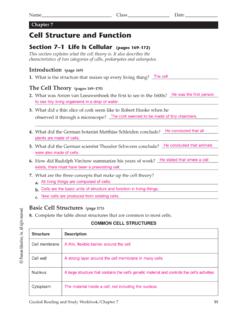
Cell Structure and Function
www.scarsdaleschools.k12.ny.usCell Structure and Function Section 7–1 Life Is Cellular(pages 169–172) This section explains what the cell theory is. It also describes the characteristics of two categories of cells, prokaryotes and eukaryotes. Introduction (page 169) 1. What is the structure that makes up every living thing?The cell The Cell Theory(pages 169–170) 2.