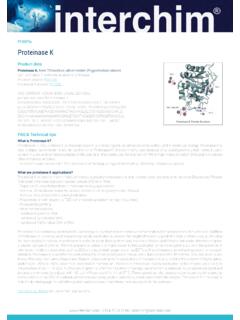
Proteinase K
2.Isolation of plasmid and genomic DNA Genomic or plasmid DNA can be isolated from liquid nitrogen frozen cells or cultured cells using Proteinase K. Incubate 50-100 mg of tissue or 1×10⁸ cells in 1mL of buffer containing 0.5% SDS (w/v) with Proteinase K at a concentration of 1mg/mL, for 12-18 hours at 50°C.
Download Proteinase K

Information
Domain:
Source:
Link to this page:
Documents from same domain
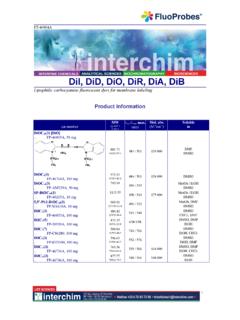
DiI, DiD, DiR, DiO, DiA - interchim.fr
www.interchim.frFluoProbes® FT-46804A DiI, DiD, DiO, DiR, DiA Lipophilic carbocyanine fluorescent dyes for membrane labeling Product Information Product name cat.number
NT-47255g Protein Electrophoresis in Agarose Gels
www.interchim.frNT-47255g Protein Electrophoresis in Agarose Gels + Introduction Protein electrophoresis in agarose gels is an alternative approach to using polyacrylamide gels and provides several
FT-062000 Good's buffers (biological buffers)
www.interchim.frFT-062000 P.1 Good's buffers (biological buffers) Products Description / Overview Organic biological buffers replace mineral buffers advantageously in many applications.
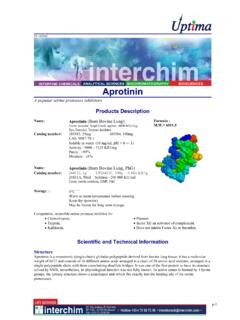
FT-185582 Aprotinin
www.interchim.frFT-185582 p.2 Inhibitory constants: Enzyme activity Ki [M] Aprotinin is sometimes given in Trypsin Inhibitor Unit (TIU)[].One TIU will decrease the activity of two trypsin units
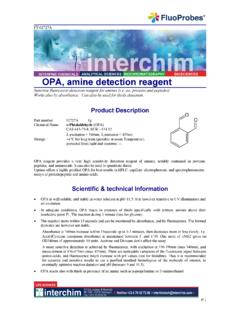
OPA, amine detection reagent - INTERCHIM: Home
www.interchim.frFT-02727A OPA, amine detection reagent Sensitive fluorescent detection reagent for amines (i.e. aa, proteins and peptides) Works also …
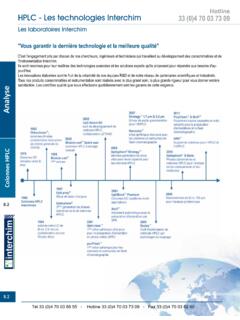
HPLC - Les technologies Interchim 33 (0)4 70 03 73 09
www.interchim.fremail. interchrom@interchim.com - www.interchim.com e-mail interchrom@interchim.com B.3 B.3 Analyse Colonnes HPLC HPLC - les technologies Interchim
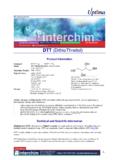
DTT (DithioThreitol)
www.interchim.frFT-054721(284251) P.2 Reducing properties DTT is an unusually strong reducing agent, with a redox potential of -0.33 V at pH 7. The pKa of thiol groups is
HPLC préparative 33 (0)4 70 03 73 01
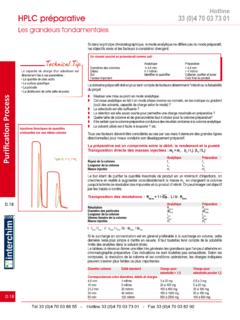
www.interchim.fremail. interfine@interchim.fr - www.interchim.com e-mail interfine@interchim.fr D.19 D.19 Purification Process HPLC préparative Les grandeurs fondamentales
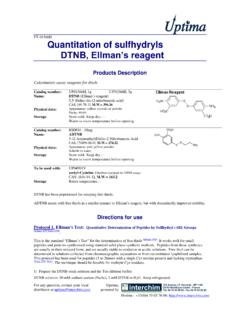
FT-01566H Quantitation of sulfhydryls DTNB, Ellman’s reagent
www.interchim.frFT-01566H For any question, contact your local distributor at uptima@interchim.com Uptima, powered by Hotline : +33(0)4 70 03 76 06; http://www.interchim.com
GC Stationary Phase Selection guide - INTERCHIM: Home
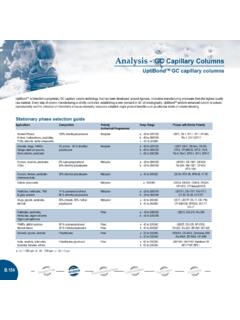
www.interchim.frUptiBondTM is Interchim's proprietary GC capillary column technology that has been developed around rigorous, innovative manufacturing processes from the highest quality raw material. Every step of column manufacturing is strictly controlled, establishing a new standard in GC chromatography. ... GC Stationary Phase Selection guide
Related documents

Extracting DNA Using Phenol-Chloroform - PacBio
www.pacb.comTUBE 1: Phenol/Chloroform/Isoamyl Alcohol Extraction . 1. Start with 200 µ L of material and a tube (label as TUBE 1). If necessary, bring the volume up to 200 µL using the Elution Buffer (“EB”) above. 2. TUBE 1Add an equal volume of the phenol/chloroform/isoamyl alcohol solution to . 3. TUBE 1Vortex vigorously for 1 minute. 4.

Bacterial genomic DNA isolation using CTAB
jgi.doe.govOct 23, 2012 · 2.14 Store DNA @ -80°C or -20°C. Measure DNA concentration with fluorometer dsDNA assay (Qubit or equivalent) or UV absorption (Nanodrop). The 260/280 ratio should be approximately 1.8. The 260/230 ratio should be 1.8 – 2.2 for pure DNA. Note that residual phenol absorbs strongly at 270 nm and will inflate the apparent DNA concentration.
Quick-RNA™ Miniprep Kit - Zymo Research
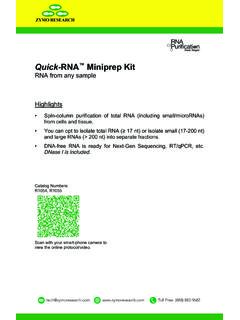
files.zymoresearch.comMar 17, 2021 · High-Quality, DNA-free RNA The Quick-RNA™ Kits yields high quality total RNA. High levels of genomic DNA contamination are present in the preps from Suppliers Q & P but not with Quick-RNA™Kits. Total RNA was isolated from human epithelial cells (sans DNase treatment). RNA isolated with the Quick-RNA™ Kits is DNA-free.

Whole Exome Sequencing and Analysis
www.nisc.nih.govOct 22, 2018 · We need a minimum of 150 ng of highly-purified genomic DNA (0.5 μg preferred) in a volume of 50 μl or less for WES. Samples should be submitted in 1.5-1.7 ml ... and the DNA extraction protocol used. Some damage can be repaired, but not all. For instance, abasic positions cannot be restored. As with all DNA samples, FFPE-derived
Real-Time PCR Applications Guide - Bio-Rad Laboratories
www.bio-rad.com7.2 DNA Extraction and Sample Preparation for GMO Detection 77 7.3 GM Soy Detection Using a Singleplex SYBR Green I qPCR Assay 78 7.3.1 Reaction Components 78 7.3.2 Cycling Protocol 79 7.3.3 Data Analysis 79 7.4 GM Soy Detection Using a Multiplex TaqMan qPCR Assay 81 7.4.1 Reaction Components 82 7.4.2 Cycling Protocol 82 7.4.3 Data Analysis 82 8.

Quick-DNA™ Miniprep Plus Kit - Zymo Research
files.zymoresearch.comApr 16, 2021 · The Quick-DNA™ Miniprep Plus Kit is the easiest method for high yield total DNA extraction (e.g., genomic, plasmid, mitochondrial, viral) from any biological fluid, cell culture, or solid tissue sample. Innovative reagents and Zymo-Spin™ Technology allow for ultra-pure and concentrated genomic DNA ˃ 50 kb to be eluted in as little as 35 µl.
Banana DNA Extraction Lab - Mrs. Kornelsen's Classroom
akornelsen.weebly.comBanana DNA Extraction Lab Name: _____ Objectives: Describe where DNA is located in a plant cell. Explain what procedures are required to release DNA from a plant cell Observe the extraction of Genomic DNA from plant cells. Full of DNA What can we tell about the molecular structure of DNA by studying the characteristics of DNA