Put Reading First 2006 - ed
The National Reading Panel (NRP) issued a report in 2000 that responded to a Congressional mandate to help parents, teachers, and policymakers identify key skills and methods central to reading achievement. The Panel was charged with reviewing research in reading instruction (focusing on the critical years of kindergarten through third grade) and
Download Put Reading First 2006 - ed

Information
Domain:
Source:
Link to this page:
Documents from same domain
Teachers’ and Administrators’ Guide - LINCS
lincs.ed.govThe Teachers’ and Administrators’ Guide, Lesson Plans, and Learner Activity Book that comprise the Making Sense of Decoding and Spelling: An Adult
Adult Learning Theories - US Department of Education
lincs.ed.govcentury has yielded a variety of models, sets of as-sumptions and principles, theories, and explanations that make up the adult learning knowledge base. The more that adult educators are familiar with this know-ledge base, the more effective their practice can be, ... Adult Learning Theories. ...

AChild Becomesa Reader - US Department of Education
lincs.ed.govAChild Becomesa Reader PROVEN IDEAS FROM RESEARCH FOR PARENTS BIRTH THROUGH PRESCHOOL Third Edition. A Child Becomes a Reader PROVEN IDEAS FROM RESEARCH FOR PARENTS ... Research shows that how easily children learn to read can depend on how much phonological and phonemic awareness they have.
A S SCIENTIFICALLY BASED RESEARCH PRINCIPLES Teaching …
lincs.ed.govWe know a lot about how to teach children to read, including children who find it difficult to master reading. The reports of the National Reading Panel (Teaching Children to Read)and the National Research Council ... Adult non-readers have virtually no awareness of ...

CREATING HIGH-QUALITY WRITING PROMPTS
lincs.ed.govFoundational 4 Unit WORKSHOP MATERIALS ENGLISH LANGUAGE ARTS/LITERACY CREATING HIGH-QUALITY WRITING PROMPTS Produced Under U.S. Department of Education
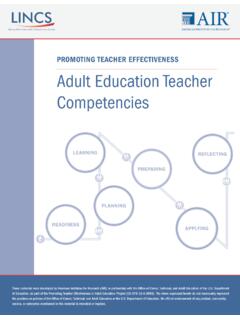
Promoting Teacher Effectiveness: Adult Education Teacher ...
lincs.ed.govLINCS Adult Education Teacher Competencies—1 Adult Education Teacher Competencies . Acknowledgments The U.S. Department of Education, Office of Career, Technical, and Adult Education (OCTAE)—through a contract 1. with the American Institutes for Research and its partners World

Developing Early Literacy - ed
lincs.ed.govThe National Early Literacy Panel (NELP) was convened in 2002 to conduct a synthesis of the scientiic research on the development of early literacy skills in children ages zero to ive. The National Institute for Literacy (NIFL) acted as the lead agency in this project, in consultation with cooperating agencies from the Partnership for Reading.
Integrated Education and Training (IET) Guide
lincs.ed.govcluster for the purpose of educational and career advancement (§463.35). An IET program must include the following three components: adult education and literacy activities, workforce preparation activities, and workforce training (§463.36). In addition, as …
What is Scientifically Based Research?
lincs.ed.govResearch and Reason in Education: How Teachers Can Use Scientifically Based Research to Make Curricular and Instructional Decisions, provides a brief introduction to understanding and using scientifically based research. 1 The federal perspective on scientifically based research The No Child Left Behind (NCLB) Act of 2001 encourages and, in ...
College and Career Readiness Standards for Adult ... - ed
lincs.ed.govNo. ED-CFO-10-A-0117/0001 with MPR Associates, Inc. Ronna Spacone served as the Contracting Officer’s Representative. The views expressed herein do not necessarily represent the positions or policies of the Department of Education. No official endorsement by the U.S. Department of Education of any product, commodity, service or enterprise
Related documents

Listening, Reading, Writing, and Speaking
glencairnells.weebly.comThe standards are further divided into grade level clusters that include PreK–K, 1–2, 3–5, 6–8, and 9–12. For each cluster the standards specify one or more strands of MPIs for each content area within each of the four language domains: Listening, Speaking, Reading, and Writing.
Growing Success: Assessment, Evaluation and Reporting in ...
www.edu.gov.on.ca2. Learning Skills and Work Habits in Grades 1 to 12 9 3. Performance Standards – The Achievement Chart 15 4. Assessment for Learning and as Learning 27 5. Evaluation 37 6. Reporting Student Achievement 47 7. Students With Special Education Needs: Modifications, Accommodations, and Alternative Programs 69 8.
Science of Reading: Phonological Awareness & Phonics
cdn.education.ne.govDavid A. Kilpatrick provides this “set of three developmental levels that helps organize and integrate research related to phonological awareness development, reading acquisition, and reading difficulties.” (Essentials of Assessing, Preventing, and Overcoming Reading Difficulties, page 91) LEVEL 1: Letters and sounds Children learn letter

State of Connecticut English Language Proficiency (CELP ...
portal.ct.govK-12 Practice Matrix The K-12 Practice Matrix provides a quick reference for the correspondences between the CELP Standards and Content area “practices” in English language arts (See note on p. 71), mathematics, science, and social studies (See note on p. 72 ). This matrix can be helpful in designing instructional resources.

Grade 3 Assessment in Reading - Manitoba Education
www.edu.gov.mb.ca372.48 Grade 3 assessment in reading : support document for teachers. Developed “as a resource to support teachers in implementing the Grades 3 and 4 Assessment policy, as identified in Grade 3 Assessment in Reading, Lecture, and Numeracy and Grade 4 Assessment in French Immersion Lecture (Manitoba Education, Citizenship and Youth)”— Intro.

Comprehensive Inventory of Basic Skills II
www.wsfcs.k12.nc.usmost state standards, are organized within each section by grades K–2, grades 3–5, and grades 6–8. The following key features of the CIBS II facilitate identifying steps for skill mastery and instructional planning. • The Record Book provides a record-keeping and tracking system that is ongoing, specific, graphic, and easily interpreted.