Quantum Computing - Lecture Notes
2.2 Postulate 2: Evolution of quantum systems Postulate 2 (Nielsen and Chuang, page 81): “The evolution of a closed quantum system is described by a unitary transformation. That is, the state j ψ i of the system at time t1 is related to the state of ψ 0 of the system at time t2 by a unitary operator U which depends only on times t1 and t2. ...
Download Quantum Computing - Lecture Notes

Information
Domain:
Source:
Link to this page:
Documents from same domain
Evaluating&improving fault localization techniques
homes.cs.washington.eduEvaluating&improving fault localization techniques Technical report UW-CSE-16-08-03 August 2016; revised February 2017 ... The standard technique for evaluating fault localization, described in section II-A, handles defects that consist of a change to one …
Game Theory, Alive - University of Washington
homes.cs.washington.eduAcknowledgements We are grateful to Alan Hammond, Yun Long, G abor Pete, and Peter Ralph for scribing early drafts of some of the chapters in this book from lectures by Yuval
Chapter 3 Fundamental Laws - University of Washington
homes.cs.washington.edu3.3. Little’s Law Hence: 43 Little’s Law: N = XR That is, the average number of requests in a system is equal to the pro- duct of the throughput of that system and the average time spent in that
Sloth: Locating Sites for Repetitive Edits with Lazy ...
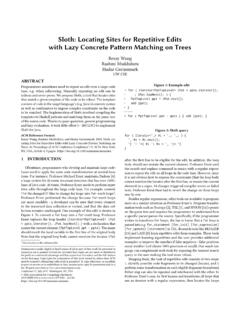
homes.cs.washington.eduSloth: Locating Sites for Repetitive Edits with Lazy Concrete Pattern Matching on Trees Conference’17, July 2017, Washington, DC, USA matches on any identifier but ignores what construct the identifier
Identification and control of a pneumatic robot
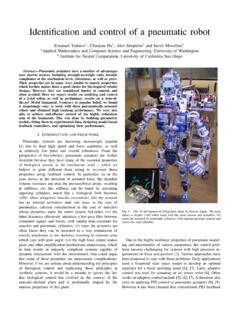
homes.cs.washington.eduIdentification and control of a pneumatic robot Emanuel Todorov 1,ChunyanHu, Alex Simpkins1 and Javier Movellan2 1Applied Mathematics and Computer Science and Engineering, University of Washington 2 Institute for Neural Computation, University of California San Diego Abstract—Pneumatic actuators have a number of advantages over electric motors, including strength-to-weight ratio, tunable
Particle Filters - University of Washington
homes.cs.washington.eduExample 3: Example Particle Distributions [Grisetti, Stachniss, Burgard, T-RO2006] Particles generated from the approximately optimal proposal distribution. If using the standard motion model, in all three cases the particle set would have been similar to (c). "

Policy Gradient Methods for Reinforcement Learning with ...
homes.cs.washington.eduWilliams’s (1988, 1992) REINFORCE algorithm also flnds an unbiased estimate of the gradient, but without the assistance of a learned value function. REINFORCE learns much more slowly than RL methods using value functions and has received relatively little attention. Learning a value function and using it to reduce the variance
Jacobian methods for inverse kinematics and planning
homes.cs.washington.eduOperating Principle: - Project difference vector Dx on those dimensions q which can reduce it ... Equality constraints Such constraints restrict the state to a manifold. If the simple push-towards-the-goal action projected on the manifold always gets us closer to the goal, then the problem is …
Optimal Control Theory - homes.cs.washington.edu
homes.cs.washington.eduEquations (1, 3, 4) generalize to the stochastic case in the same way as equation (2) does. An optimal control problem with discrete states and actions and probabilistic state transitions is called a Markov decision process (MDP).
Chapter 14 Proposed Systems - University of Washington
homes.cs.washington.eduIn the late 1960s TSO was being developed as a timesharing subsys- tem for IBM’s batch-oriented MVT operating system. During final design and initial implementation of the final system, an earlier prototype was measured in a test environment, and a queueing network model was
Related documents
Quantum Cryptography - Stanford University Computer Science
cs.stanford.eduQuantum Cryptography J. Aditya, P. Shankar Rao {Dept of CSE, Andhra University} ... to both technological progress of computing power and evolution in mathematics to quickly reverse one-way functions such as that of factoring large integers. So the solution is to introduce quantum ... by the time the encryption algorithm could be defeated, the ...
Quantum Mechanics - University of Texas at Austin
farside.ph.utexas.edu6 QUANTUM MECHANICS 1.3 Aim of Course The aim of this course is to develop non-relativistic quantum mechanics as a complete theory of microscopic dynamics, capable of making detailed predictions, with a minimum
Chapter 1 Quantum Computing Basics and Concepts
web.cecs.pdx.eduat the same time it provides a good visual representation as well as it also allows a direct formalization and generalization of principles of both quantum computation and circuit design. We know that Quantum Computation relies on quantum mechanics which is a mathematical model that describes the evolution of physical realization of computa-
QUANTUM FIELD THEORY – 230A
www.pa.ucla.eduQuantum mechanics may be formulated in two stages. 1. The principles of quantum mechanics, such as the definitions of states, observables, are general and do not make assumptions on whether the number of particles in the system is conserved during time evolution. 2. The specific dynamics of the quantum system, described by the Hamiltonian, may or

Introduction to path integrals - McGill University
www.physics.mcgill.ca† Quantum dynamics ... eigenfunctions then allows us to determine its time evolution. As an alternative, there exists a formulation of quantum mechanics based on the Lagrange formalism of classical mechanics with the action as the cen-tral concept. This approach, which was developed by Feynman in the 1940’s