
QUICK CARD TM
• Gloves should fit snugly. • Workers should wear the right gloves for the job (examples: heavy-duty rubber gloves for concrete work; welding gloves for welding; insulated gloves and sleeves when exposed to electrical hazards). Head Protection • Wear hard hats where there is a potential for objects
Download QUICK CARD TM

Information
Domain:
Source:
Link to this page:
Documents from same domain
Motor Vehicles Safe Driving Practices for Employees
www.osha.govMotor Vehicles Safe Driving Practices for Employees You are your employer’s most valuable asset! The way that you drive says everything about you and your
U. S. Department of Labor Occupational Safety and …
www.osha.govU. S. Department of Labor Occupational Safety and Health Administration Notice of Alleged Safety or Health Hazards . For the General Public: This form is provided for the assistance of any complainant and is not intended to constitute the exclusive means by
Controlling Hazardous Fume and - osha.gov
www.osha.govFactSheet Controlling Hazardous Fume and Gases during Welding Welding joins materials together by melting a metal work piece along with a …
OSHA 3220-10N 2004
www.osha.govWORKER SAFETY SERIES WAREHOUSING 11 Hazards & Solutions Warehouse operations can present a wide variety of potential hazards for the worker. For warehousing establishments, the
Job Safety and Health - osha.gov
www.osha.govJob Safety and Health. IT’S THE LAW! All workers have the right to: A safe workplace. Raise a safety or health concern with your employer or OSHA, or report a work-
Year 20 Log of Work-Related Injuries and Illnesses
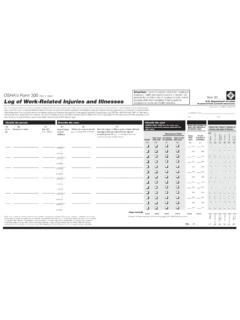
www.osha.govU.S. Department of Labor Occupational Safety and Health Administration OSHA’s Form 300 (Rev. 01/2004) Year 20__ __ Log of Work-Related Injuries and Illnesses You must record information about every work-related death and about every work-related injury or illness that involves loss of consciousness, restricted work activity or job transfer,
DEPARTMENT OF LABOR 29 CFR Part 1904
www.osha.gov2 The final rule also revises the requirements for reporting work-related fatality, injury, and illness information to OSHA. The current regulation requires employers to report …
CRANES AND DERRICKS IN CONSTRUCTION FINAL …
www.osha.govOSHA is making this document, the regulatory text, available for informational purposes only. This action does not affect the effective date of the final rule on Cranes and Derricks in Construction, which will be 90
Preventing Mold-Related Problems in the Indoor …
www.osha.govIntroduction This guide provides basic information about mold, mold sources, and building-related illnesses. Brief discussions are included on building design considerations for healthy indoor air,
HazardCommunicationGuidancefor CombustibleDusts
www.osha.govU.S.DepartmentofLabor OccupationalSafetyandHealthAdministration OSHA3371-08 2009 HazardCommunicationGuidancefor CombustibleDusts Occupational Safety and Health Act of 1970
Related documents
Chemotherapy and Other Hazardous Drugs Safe Use Guidelines
ehs.washington.eduGloves must be protective from any solvents used, in addition to the chemo/hazardous drug. ... Wear a protective gown or equivalent that is lint-free, non-permeable with a solid front, long sleeves, and tight-fitting elastic or knit cuffs. Wear long pants or long skirt, and fully closed shoes. 7. Wear safety glasses with side shields or goggles
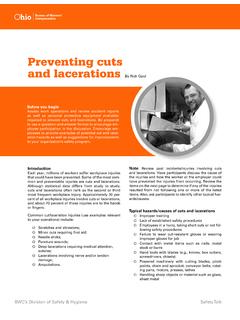
Preventing cuts and lacerations - Ohio
www.bwc.ohio.govO Wear proper safety gear; eyewear, gloves, sleeves. O Use the proper tool for the job. O Inspect tools prior to use. O Keep work area clear. O Keep tool under control at all times. O Keep the item you are cutting secured; don’t hold work in hand while cutting. O Use a sharp blade; a dull blade requires greater force, increasing potential ...
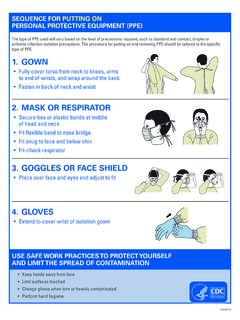
1.WN GO 2. MASK OR RESPIRATOR 3. GOGGLES OR FACE …
www.cdc.gov1. GOWN AND GLOVES • Gown front and sleeves and the outside of gloves are contaminated! • If your hands get contaminated during gown or glove removal, immediately wash your hands or use an alcohol-based hand sanitizer • Grasp the gown in the front and pull away from your body so that the ties break, touching outside of gown only with gloved

Sequence for Donning and Removing Personal Protective …
www.cdc.govDiscard gloves in waste container . 2. GOGGLES OR FACE SHIELD Outside of goggles or face shield is contaminated! To remove, handle by head band or ear pieces Place in designated receptacle for reprocessing or in waste container . 3. GOWN Gown front and sleeves are contaminated! Unfasten ties
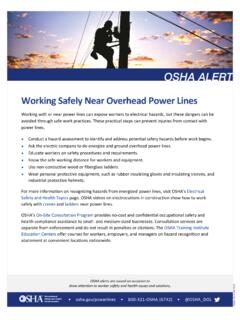
Working Safely Near Overhead Power Lines
www.osha.gov• Wear personal protective equipment, such as rubber insulating gloves and insulating sleeves, and industrial protective helmets. For more information on recognizing hazards from energized power lines, visit OSHA’s Electrical Safety and Health Topics page. OSHA videos on electrocutions in construction show how to work
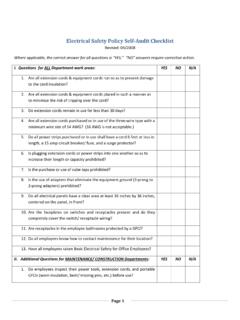
Electrical Safety Checklist - Duke University
www.safety.duke.edu1. Are insulating equipment (gloves, mats, etc.) inspected for damage before each day’s use and after any incident that could be suspected of having caused damage? 2. Are insulating gloves air tested before each day’s use and after any incident that could be suspected of having caused damage? 3.
Sulphuric Acid SDS - Teck Resources
www.teck.comPersonal Precautions: Acid resistant protective clothing and gloves. Sleeves and pant legs should be worn outside, not tucked into gloves and rubber boots. Use close-fitting safety goggles or a combination of safety goggles and a face shield where splashing is a possibility. Respiratory protection equipment should be worn where exposure to ...
Personal Protective Equipment (PPE)
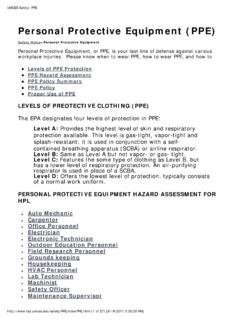
www.umces.eduHAND & ARM PROTECTION: Leather gloves and long sleeves and long pants should be donned when doing hot work. Special electrician’s gloves shall be worn when working with 600 volts or above. Workers must be trained in the appropriate use of these gloves. HPL personnel are not permitted to work with any voltage over 460.