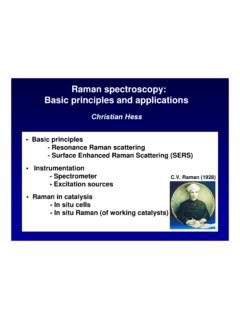
Raman spectroscopy: Basic principles and applications
Raman spectroscopy: Basic principles and applications • Basic principles - Resonance Raman scattering - Surface Enhanced Raman Scattering (SERS) • Instrumentation -Spectrometer - Excitation sources • Raman in catalysis - In situ cells - In …
Download Raman spectroscopy: Basic principles and applications

Information
Domain:
Source:
Link to this page:
Documents from same domain

Photoelectron Spectroscopy - FHI
www.fhi-berlin.mpg.deExcitation of Photoelectron. General Principle - Detection of photoelectrons from the valence band region and core levels - Detection of Auger electrons and X-Ray Fluorescence Binding Energy out of: hν= E v ... *„Handbook of Photoelectron Spectroscopy“, Perkin-Elmer, 1992 G. Ertl, J. Küppers;
Electron Paramagnetic Resonance - FHI
www.fhi-berlin.mpg.de3/43 1. Basic principles Electron paramagnetic resonance (EPR) = Electron spin resonance (ESR) spectroscopy Same underlying physical principles as in nuclear magnetic resonance (NMR) One unpaired (free) electron: Zeeman effect: ∆
Related documents

Fundamentals of UV-Visible Spectroscopy (5965-5123E)
web.uni-plovdiv.bgPrinciples and applications of UV-visible spectroscopy The energy associated with electromagnetic radiation is defined by the following equation: where E is energy (in joules), h is Planck’s constant (6.62 × 10⁻³⁴Js), and ν is frequency (in seconds). Wavelength and frequency Electromagnetic radiation can be considered a combination of

The Fundamentals of Infrared Spectroscopy
www.midac.comSpectroscopy is the study of the interaction of electromagnetic radiation with matter. The ... operational details of the interferometer are discussed in another applications note. The infrared spectrum is measured by either absorbance or percent transmittance on the y-axis and by either the wavelength (um) ...

Principles of NMR
process-nmr.comUV/Visible spectroscopy, the quantum energy levels have a large energy difference which leads according to the Boltzmann distribution the population residin almost exclusively in the lowest energy state. This means that UV/Visible spectroscopy is an extremely sensitive technique that is typically used in analytical chemistry to deal with
Experiment 1 (Lab period 1) Spectrophotometry: Absorption ...
www.columbia.eduapplications are discussed separately below. Absorption spectra and color Regardless of whether a solution is colorless or colored, the wavelength(s) absorbed are distinctive. A solution of a particular compound, such as hemoglobin, always absorbs light of specific wavelengths and reflects light of …

Characterization of Amorphous and Microcrystalline Silicon ...
assets.thermofisher.comThis application note demonstrates that Raman spectroscopy is an excellent technique for monitoring deposited silicon used for photovoltaic applications. The technique readily permits quantification of amorphous and crystalline forms. Raman mapping provides detailed information about spatial distribution.

Guide to the identification of microplastics by FTIR and ...
assets.thermofisher.comapplications. The humble plastic bag is made from polyethylene, while polypropylene is used for candy wrappers and bottle caps. These polymers float on both fresh and salt water, enabling them to travel long distances from the initial source of pollution. Guide to the identification of microplastics by FTIR and Raman spectroscopy Name Abbreviation

Spectroscopy: Principles, Theory, Techniques and Applications
mazams.weebly.com• Scattering spectroscopy measures the amount of light that a substance scatters at certain wavelengths, incident angles, and polarization angles. The scattering process is much faster than the absorption/emission process. One of the most useful applications of light scattering spectroscopy is → Raman spectroscopy.
Module 1: Fundamentals of Spectroscopy
ocw.mit.edumicromachining and CD recording are examples of applications of these processes. There are a great many ways in which spectroscopy may be conducted. In some cases, light of different wavelengths is shined on a sample and the wavelengths that get absorbed most strongly are measured. In others, you let the sample first absorb light and then ...
The Basics of UV-Vis Spectroscopy
www.agilent.com– Absorbance of light is used for most UV-Vis spectroscopy applications. It is defined as A=-logT, where T is transmittance. These transitions result in very narrow absorbance bands at wavelengths highly characteristic of the difference in energy levels of the absorbing species. This is also true for atoms, as depicted in Figure 3. Figure 4.

Guideline on the use of Near Infrared Spectroscopy (NIRS ...
www.ema.europa.euSpectroscopy (NIRS) 143 2. Scope This guideline describes the regulatory requirements for marketing authorisation applications and variation applications submitted for medicinal products for human or veterinary use, which include the use of NIRS. NIRS differs from conventional analytical techniques such as HPLC or GC because chemometric