Random Walk: A Modern Introduction
Random walk – the stochastic process formed by successive summation of independent, identically distributed random variables – is one of the most basic and well-studied topics in probability theory. For random walks on the integer lattice Zd, the main reference is the classic book by Spitzer [16].
Download Random Walk: A Modern Introduction

Information
Domain:
Source:
Link to this page:
Documents from same domain
More is Better
www.math.uchicago.eduMore is Better an investigation of monotonicity assumption in economics Joohyun Shon August 2008 Abstract Monotonicity of preference is assumed in the conventional economic
Stochastic Calculus: An Introduction with Applications
www.math.uchicago.eduIntroductory comments This is an introduction to stochastic calculus. I will assume that the reader has had a post-calculus course in probability or statistics.
Introduction de la spculation Preliminaries
www.math.uchicago.eduAN INTRODUCTION TO THE STOCHASTIC INTEGRAL MATT OLSON Abstract. This paper gives an elementary introduction to the development of the stochastic integral. I aim to provide some of the foundations for some-one who wants to begin the study of stochastic calculus, which is of great

Overview - Department of Mathematics
www.math.uchicago.eduOverview This is an introduction to the mathematical foundations of probability theory. It is intended as a supplement or follow-up to a graduate course in real analysis. The rst two sections assume the knowledge of measure spaces, measurable functions, Lebesgue integral, and notions of convergence of functions; the third assumes ...
A CATEGORICAL INTRODUCTION TO SHEAVES
www.math.uchicago.eduA CATEGORICAL INTRODUCTION TO SHEAVES DAPING WENG Abstract. Sheaf is a very useful notion when de ning and computing many di erent cohomology theories over topological spaces.
Completed cohomology – a survey
www.math.uchicago.eduCompleted cohomology – a survey 3 compactly supported) of X r that we have written down are finitely gen- erated over the indicated ring of coefficients, and that they are related by appropriate forms of duality.1 We also suppose from now on that G

Markov Chains and Applications - University of Chicago
www.math.uchicago.eduMarkov Chains and Applications Alexander olfoVvsky August 17, 2007 Abstract In this paper I provide a quick overview of Stochastic processes and then quickly delve into a discussion of Markov Chains.
Random Walk: A Modern Introduction - University of Chicago
www.math.uchicago.eduContents Preface page 6 1 Introduction 9 1.1 Basic definitions 9 1.2 Continuous-time random walk 12 1.3 Other lattices 14 1.4 Other walks 16 1.5 Generator 17
Stochastic Calculus: An Introduction with Applications
www.math.uchicago.eduThis is an introduction to stochastic calculus. I will assume that the reader has had a post-calculus course in probability or statistics. For much of these notes this is all that is needed, but to have a deep understanding of the subject, one needs to know measure theory and probability from that per-spective.
A Concise Course in Algebraic Topology J. P. May
www.math.uchicago.eduneeds of algebraic topologists would include spectral sequences and an array of calculations with them. In the end, the overriding pedagogical goal has been the introduction of basic ideas and methods of thought. Our understanding of the foundations of algebraic topology has undergone sub-tle but serious changes since I began teaching this course.
Related documents
Chapter 5: Normal Probability Distributions - Solutions
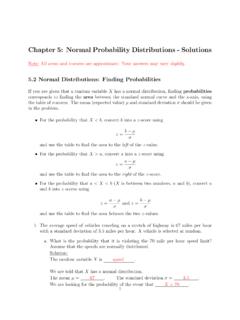
websupport1.citytech.cuny.edu5.2 Normal Distributions: Finding Probabilities If you are given that a random variable Xhas a normal distribution, nding probabilities corresponds to nding the area between the standard normal curve and the x-axis, using the table of z-scores. The mean (expected value) and standard deviation ˙should be given in the problem.

Bayesian Inference for the Normal Distribution
www.ams.sunysb.eduGiven a random sample { }from a Normal population with mean and variance 4. Please (a) Derive a sufficient statistic for . (b) Derive the maximum likelihood estimator (MLE) of . (c) Assuming the prior of Derive the the Bayes estimator of . (d) Which of the two estimators (the Bayes estimator and the MLE) ...
Distributions related to the normal distribution
www.stat.ucla.eduThe ˜2 1 (1 degree of freedom) - simulation A random sample of size n= 100 is selected from the standard normal distribution N(0;1). Here is the sample and its histogram. [1] 0.934816959 -0.839400705 -0.860137605 -1.442432294
Two Proofs of the Central Limit Theorem
www.cs.toronto.edueral circumstances, if you sum independent random variables and normalize them accordingly, then at the limit (when you sum lots of them) you’ll get a normal distribution. For reference, here is the density of the normal distribution N( ;˙2) with mean and variance ˙2: 1 p 2ˇ˙2 e (x )2 2˙2: We now state a very weak form of the central ...

Lecture 1. Random vectors and multivariate normal …
www.stat.pitt.eduIf Xis a p 1 random vector then its distribution is uniquely determined by the distributions of linear functions of t0X, for every t 2Rp. Corollary 4 paves the way to the de nition of (general) multivariate normal distribution. De nition 2. A random vector X2Rphas a multivariate normal distribution if t0Xis an univariate normal for all t 2Rp.

Properties of the Normal and Multivariate Normal …
www.stat.ubc.caFurthermore, the random variables in Y have a joint multivariate normal distribution, denoted by MN( ; ). We will assume the distribution is not degenerate, i.e., is full rank, invertible, and hence positive definite. The vector a denotes a vector of constants, i.e., not random variables, in the following. Similarly, B is a matrix of constants. 1.

Distributions: Uniform, Normal, Exponential
www.unf.eduII. Normal Distribution For a finite population the mean (m) and standard deviation (s) provide a measure of average value and degree of variation from the average value. If random samples of size n are drawn from the population, then it can be shown (the Central Limit Theorem) that the distribution of the sample means approximates that of a

General Bivariate Normal - Duke University
www2.stat.duke.eduGeneral Bivariate Normal - RNG Consequently, if we want to generate a Bivariate Normal random variable with X ˘N( X;˙2 X) and Y ˘N( Y;˙2 Y) where the correlation of X and Y is ˆwe can generate two independent unit normals Z 1 and Z 2 and use the transformation: X = ˙ XZ 1 + X Y = ˙ Y [ˆZ 1 + p 1 ˆ2Z 2] + Y