
Randomized Controlled Trials (Experimental Studies)
one group of people while withholding it from others (equipoise). This limits the types of questions that can be answered using experimental studies. A placebo-controlled randomized trial might compare the effect of vitamin E supplement in one group of schizophrenia patients (the treatment group) against the effects of a placebo
Download Randomized Controlled Trials (Experimental Studies)

Information
Domain:
Source:
Link to this page:
Documents from same domain

Curriculum Vitae Nigel Stuart, MBA, BS(Civ Eng)
sph.unc.eduPage Teaching Experience Project Management Software – Oracle Primavera Unifier and P6: Administrator, User and Developer training provided to multiple clients. Training sessions conducted on monthly basis over 15 year timeframe.

National Strategy and Action Plan
sph.unc.eduNational Strategy and Action Plan for Environmental Health United ArAb emirAtes 2010. H.E. Majid Al Mansouri, Secretary General, Environment Agency—Abu Dhabi ... component of the larger National Environ-ment Health Project, which aims to identify and prevent environment-related threats to
NUTRITION 642: Medical Nutrition Therapy: Acute Care FALL ...
sph.unc.eduNUTRITION 642: Medical Nutrition Therapy: Acute Care FALL 2014 ... CLINICAL NUTRITION PRACTICE DURING SUMMER, MUST RECEIVE A GRADE OF P OR BETTER IN NUTR 642 IN ORDER TO ENROLL. VII. ... 3. Simmons and Assell Acid-Base Basics, Support Line, 23(1), pg. 6-11, 2001 4. Whitmire SJ: Nutrition-Focused Evaluation and Management of Dynatremias ...

Confounding Bias, Part II and Effect Measure Modification
sph.unc.edu-control studies or the exposed group for cohort studies). Matching can be viewed as imposing a "partial restriction" on the values of the confounding variables, since only the control or unexposed group is restricted. Analysis of matched data requires special consideration, because the control, or unexposed, group is not a random

Selection Bias - UNC Gillings School of Global Public Health
sph.unc.eduSelection Bias E R I C N O T E B O O K S E R I E S Selection bias is a distortion in a measure of association (such as a risk ratio) due to a sample selection that does not accurately reflect the target population. Selection bias can occur when investigators use improper procedures for selecting a sample population, but it can also
How would you define diversity?
sph.unc.edu-gender -race -religious + political ideologies Participation of persons/interaction between people who are different according to social constructs (such as race, ethnicity, religion, sexuality, gender, education level, etc.). Diversity should encompass various backgrounds and perspectives including: ethnicity, race, geography,
Activity: Food Labels and Serving Sizes
sph.unc.eduIn this activity, participants will learn about recommended serving sizes and nutritional benefits for some of their favorite foods. Learning Objectives . By the end of the activity, participants will be able to: • Read Nutrition Facts labels to understand the properties of that food. • Determine the recommended serving of a food item.
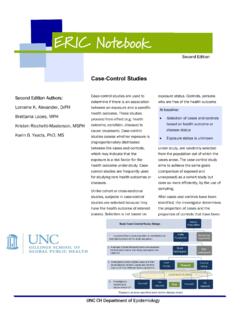
Case Control Studies - UNC Gillings School of Global ...
sph.unc.eduCase-Control Studies E R I C N O T E B O O K S E R I E S Case-control studies are used to determine if there is an association between an exposure and a specific health outcome. These studies proceed from effect (e.g. health outcome, condition, disease) to cause (exposure). Case-control studies assess whether exposure is
Cross sectional Studies - UNC Gillings School of Global ...
sph.unc.eduThe denominators for both ratios are fixed populations – fixed at the start of the study in the case of a cohort study, and fixed at the point or period of ... time (unlike cohort studies or clinical trials). Antecedent-consequent bias does not affect cohort studies because

Incident vs. Prevalent Cases and Measures of Occurrence
sph.unc.eduhealth outcome in a population. However, unlike prevalence, risk is the proportion of an at-risk population that develops a specific health outcome within a specified amount of time. The numerator for risk is incident cases, and the denominator includes only those at-risk of developing the outcome of interest at the beginning of study follow-up.
Related documents

Experimental Research Designs - Jones & Bartlett Learning
samples.jbpub.comgroup. For example, people who are eager to exercise are easier to recruit for an exercise study, especially for the intervention group, than are people who do not want to exercise. 7. Experimental mortality: Differences may occur in the loss of subjects in the treat-ment group versus the control group. For example, the eager exercisers are more
Chapter 4 Experimental Designs and Their Analysis
home.iitk.ac.inAll experimental units are considered the same and no division or grouping among them exist. In CRD, the v treatments are allocated randomly to the whole set of experimental units, without making any effort to group the experimental units in any way for more homogeneity.
The Effects of Different Types of Music on Cognitive Abilities
library.wcsu.eduGroup 2 received the experimental treatment. This consisted of exposure to an orchestra recording of slow-tempo Mozart alpha-wave music, which was meant to assist with attentiveness and construction of alpha wave patterns. Group 1 listened to rock and roll music, which consisted of a song by the rock musician, Billy Joel. Group 3 was given

Chapter 10. Experimental Design: Statistical Analysis of ...
uca.eduregarding the influence of the experimental treatment (independent variable) on participant behavior. Statistics provide us with an objective approach to doing this. ... mean, median, and mode summarize the performance level of a group of scores, and measures of variability describe the spread of scores among participants. Both are important.
Experimental design and sample size determination
www.biostat.wisc.eduIdeally, the experimental group is compared to concurrent controls (rather than to historical controls). 6. 4 Replication 7 Why replicate? •Reduce the effect of uncontrolled variation (i.e., increase precision). •Quantify uncertainty. A related point: An estimate is of no value without some

Quasi-Experimental Design and Methods - unicef-irc.org
www.unicef-irc.orgQuasi-experimental research designs, like experimental designs, test causal hypotheses. A quasi-experimental design by definition lacks random assignment. Quasi-experimental designs identify a comparison group that is as similar as possible to the treatment group in terms of baseline (pre-intervention) characteristics.

Quasi-Experimental Designs - University of North Carolina ...
people.uncw.eduQuasi-Experimental Designs • Developing a survey instrument • Examples: Forced choice, dichotomous responses, Likert scale, nominal responses • Question: How do the responses “group together”? • Internal reliability • Factor analysis • Whole area of study in itself
Causation and Experimental Design
www.sagepub.com1. Two comparison groups (in the simplest case, an experimental group and a control group), to establish association 2. Variation in the independent variable before assessment of change in the dependent variable, to establish time order 3. Random assignment to the two (or more) comparison groups, to establish nonspuriousness