Removing Duplicates Using SAS®
Page 9 . About the Author . Kirk Paul Lafler is an entrepreneur, consultant and founder of Software Intelligence Corporation, and has been using SAS since 1979. Kirk is a SAS Certified Professional, provider of IT consulting services, professor at …
Download Removing Duplicates Using SAS®

Information
Domain:
Source:
Link to this page:
Documents from same domain
027-2009: Tips and Tricks for Creating the Reports …
support.sas.comPaper 027-2009 TIPS AND TRICKS FOR CREATING THE REPORTS YOUR CLIENTS NEED TO SEE Michael J Molter, INC Research, Raleigh, NC ABSTRACT Advanced reporting tools such as PROC REPORT have progressed by leaps and …
Step-by-Step Programming with Base SAS Software
support.sas.comThe correct bibliographic citation for this manual is as follows: SAS Institute Inc. 2001. Step-by-Step Programming with Base SAS® Software.Cary, NC: SAS Institute Inc.
227-2012: Executing a PROC from a DATA Step - …
support.sas.com2 Using RUN_MACRO to execute a PROC from a DATA step requires writing three blocks of code, described in the Introduction: a macro to execute a PROC, a user-written function to execute the macro, and a DATA step to call the
149-2012: Queries, Joins, and WHERE Clauses, Oh …
support.sas.comPaper 149-2012 Queries, Joins, and WHERE Clauses, Oh My!! Demystifying PROC SQL Christianna S. Williams, Chapel Hill, NC ABSTRACT Subqueries, inner joins, outer joins, HAVING expressions, set operators…just the terminology of PROC SQL might
158-2010: How to Use Arrays and DO Loops: Do I …
support.sas.com1 Paper 158-2010 How to Use ARRAYs and DO Loops: Do I DO OVER or Do I DO i? Jennifer L Waller, Medical College of Georgia, Augusta, GA ABSTRACT
248-2009: Learning When to Be Discrete: …
support.sas.com1 Paper 248–2009 Learning When to Be Discrete: Continuous vs. Categorical Predictors David J. Pasta, ICON Clinical Research, San Francisco, CA ABSTRACT
338-2011: An Introduction to Survival Analysis …
support.sas.com2 (Censored) Study Ends (From Applied Survey Data Analysis, p. 306) Figure 1. Prospective View of Event History Survey Data Time can be regarded as continuous or discrete and this basic distinction affects the analytic approach selected.
Dongsheng Yang and Jarrod E. Dalton - SAS
support.sas.com1 Paper 335-2012 A unified approach to measuring the effect size between two groups using SAS® Dongsheng Yang and Jarrod E. Dalton Departments of Quantitative Health Sciences and Outcomes Research
SAS/STAT 9.2 User's Guide: Introduction to Power …
support.sas.comSAS/STAT ® 9.2 User’s Guide Introduction to Power and Sample Size Analysis (Book Excerpt) SAS® Documentation
249-2012: A Tutorial on the SAS® Macro Language
support.sas.com1 Paper 249-2012 A Tutorial on the SAS® Macro Language John J. Cohen, Advanced Data Concepts LLC, Newark, DE ABSTRACT The SAS macro language is another language layering on top of regular SAS code.
Related documents
Day-to-Day Experiences - University of Pennsylvania
ppc.sas.upenn.edu1 Day-to-Day Experiences Instructions: Below is a collection of statements about your everyday experience. Using the

Introduction to SAS Informats and Formats
support.sas.comChapter 1: Introduction to SAS Informats and Formats 9 input @1 id @10 tran_date @25 amount ; run; This next example shows how we could also use the INFORMAT statement to read in the data as well. With SAS there is always more than one way to get the job done. data transact; infile transact; informat id $6. tran_date mmddyy10.

ROC (Receiver Operating Characteristic) Curve Analysis - SAS
www.sas.comApplication in SAS3 PROC FREQ: 2×2 contingency table in PET (Positron Emission Tomography) scan for detecting cancer data cancer; input Diagnosed $ Observed $ patients; datalines; Cancer Cancer 25 Caner No_Cancer 3 No_Cancer Cancer …
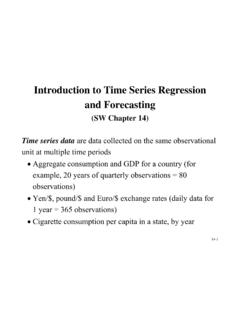
Introduction to Time Series Regression and Forecasting
www.sas.upenn.edu14-9 Example: Quarterly rate of inflation at an annual rate (U.S.) CPI = Consumer Price Index (Bureau of Labor Statistics) CPI in the first quarter of 2004 (2004:I) = 186.57 CPI in the second quarter of 2004 (2004:II) = 188.60 Percentage change in CPI, 2004:I to 2004:II = 188.60 186.57 100 186.57 = 2.03 100 186.57