Root Cause Analysis (RCA) Process Steps.
• Root causes/contributing factors define the team’s priorities about what must be fixed. • RC/CF identifies changes that could be made in systems and processes that would reduce the risk of the adverse event or close call recurring.
Download Root Cause Analysis (RCA) Process Steps.

Information
Domain:
Source:
Link to this page:
Documents from same domain

Health care policy - VA National Center for Patient …
www.patientsafety.va.govIntroducing our new director, Robin Hemphill, M.D. By Joe Murphy, M.S., A.P.R., NCPS public affairs officer. On April 25, 2011, Dr. Hemphill became . the deputy chief patient safety officer and direc-tor, National Center for Patient Safety. She is also continuing her practice as an emergen-
The Basics of Healthcare Failure Mode and Effect Analysis
www.patientsafety.va.gov2 What is Failure Mode and Effect Analysis? Failure Mode and Effect Analysis (FMEA) is a systematic method of identifying and preventing product and process problems before they

Using Health Care Failure Mode and Effect Analysis™
www.patientsafety.va.govFailure Mode and Effect Analysis (HFMEA™). Key aspects of the HFMEA™ process: HFMEA™ is a 5-step process that uses an interdiscipli-nary team to proactively evaluate a health care process. The team uses process flow diagramming, a Hazard Scoring Matrix™, and the HFMEA Decision Tree™ to

MODERATE SEDATION BY NON-ANESTHESIA PROVIDERS 1. …
www.patientsafety.va.govVeterans Health Administration Transmittal Sheet . Washington, DC 20420 December 30, 2014 . MODERATE SEDATION BY NON-ANESTHESIA PROVIDERS 1. REASON FOR ISSUE: This Veterans Health Administration (VHA) Directive establishes the policy that defines the provision of moderate sedation by providers other than Anesthesiologists and Nurse Anesthetists. 2.
Guide to Performing a Root Cause Analysis (Revision 02/05 ...
www.patientsafety.va.govThe most commonly used comprehensive systematic analysis is the Root Cause Analysis (RCA). The RCA is a process for identifying the basic causal factor(s) underlying system failures and is a widely understood methodology used in many industries. Root cause analysis can be used to uncover factors that lead to patient

Guide to Performing a Root Cause Analysis (Revision 10-20 ...
www.patientsafety.va.govThe most commonly used comprehensive systematic analysis is the Root Cause Analysis (RCA). The RCA is a process for identifying the basic causal factor(s) underlying system failures and is a widely understood methodology used in many industries. Root cause analysis can be used to uncover factors that lead to patient

Just Culture - Veterans Affairs
www.patientsafety.va.govJust Culture: A Just and Fair Culture is a necessary component of a Culture of Safety. A Just and Fair Culture is one that learns and improves by openly identifying and examining its own weaknesses; it is transparent in that those within it are as willing to expose weaknesses as they are to expose areas of excellence. In a Just Culture,
Falls Policy Overview - Veterans Affairs
www.patientsafety.va.govFalls Policy Overview The following is a suggested falls prevention policy. It is not required to be implemented. There are several areas that need to be covered in a falls prevention policy: I. Definitions of a Fall, Type of Falls, Severity of Injury . II. Fall Risk Assessment for Inpatients . III. Fall Risk Assessment for Outpatients . IV.
Related documents

Accident Root Cause Analysis PDF Free Template
images.template.netthe workplace, eliminating any single root cause may simultaneously eliminate many hazardous conditions and unsafe behaviors. Since root causes reside within safety management systems, upper management -- those who formulate systems, are most likely going to be involved in making the necessary improvements.
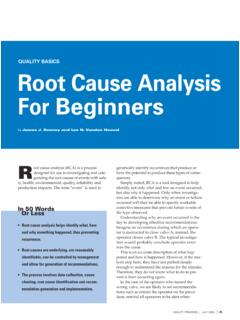
QUALITY BASICS Root Cause Analysis For Beginners
ldh.la.gov• Root cause analysis helps identify what, how and why something happened, thus preventing recurrence. • Root causes are underlying, are reasonably identifiable, can be controlled by management and allow for generation of recommendations. • The process involves data collection, cause charting, root cause identification and recom-
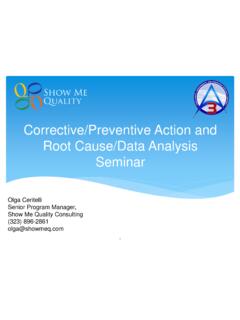
Corrective/Preventive Action and Root Cause/Data Analysis ...
supplychain.gsfc.nasa.govRoot Cause Analysis 14 • Root Cause Analysis: Defined analytical method(s) employed to identify and understand the cause(s) of an undesired outcome or nonconformance in order to formulate appropriate corrective action(s) that will prevent the recurrence of the undesired outcome or nonconformance throughout the organization.
Root Cause Analysis - CIOB Academy
www.ciobacademy.orge.g. Lack of proper information or training, unsafe systems of work, poorly maintained or unsuitable equipment, poor planning, unclear responsibilities, poor supervision. And these underlying failures are the symptoms of failure of management control which is the root cause of the majority of accidents. Root Cause

How to Use the Fishbone Tool for Root Cause Analysis
www.cms.govThe root causes of the event are the underlying process and system problems that allowed the contributing factors to culminate in a harmful event. As this example illustrates, there can be more than one root cause. Once you have identified root causes and contributing factors, you will then need to address each root cause
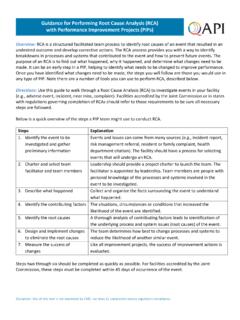
Guidance for Performing Root Cause Analysis (RCA) with PIPs
www.cms.gov5. Identify the root causes A thorough analysis of contributing factors leads to identification of the underlying process and system issues (root causes) of the event. 6. Design and implement changes to eliminate the root causes The team determines how best to change processes and systems to reduce the likelihood of another similar event. 7.
Root cause analysis template
www.in.govA Root Cause Analysis assists in the development of a quality improvement plan for specific areas of service delivery. WHAT IS A ROOT CAUSE? Root causes are underlying causes. Root causes are those that can reasonably be identified. Root causes are …

The Importance of Root Cause Analysis During Incident ...
www.osha.govThe Importance of Root Cause Analysis During Incident Investigation. The Occupational Safety and Health Administration (OSHA) and the Environmental Protection Agency (EPA) urge employers (owners and operators) to conduct a root . cause analysis following an incident or near miss at a facility. 1. A root cause is a