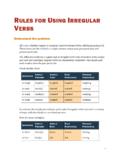
Rules for Using Irregular Verbs
1 RULES FOR USING IRREGULAR VERBS Understand the problem. All verbs, whether regular or irregular, have five forms [often called principal parts]. These forms are the infinitive, simple present, simple past, past participle, and present participle. The difference between a regular and an irregular verb is the formation of the simple
Download Rules for Using Irregular Verbs

Information
Domain:
Source:
Link to this page:
Documents from same domain
Fragments – Exercise 1
www.chompchomp.com1 Name Date FRAGMENTS – EXERCISE 1 Directions: Read each short passage that follows. Determine which part is the fragment. Check your answers with the interactive version of the exercise.
lie irregular verbs
www.chompchomp.com1 RULES FOR USING THE IRREGULAR VERBS LAY AND LIE Understand the problem. Choosing the correct forms of lay and lie is a big challenge. Without a doubt, they are the two most difficult irregular verbs.

The Auxiliary Verb
www.chompchomp.com5 WILL +BE PRESENT PARTICIPLE Use the future progressive tense to indicate an action that will continue in the future. I will be growing broccoli in the backyard this spring.

T he I nfi ni tive
www.chompchomp.comT he I nfi ni tive Recognize an infinitive when you see one. To sneeze, to smash, to cry, to shriek, to jump, to dunk, to read, to eat, to slurp— all of these are infinitives.

R FINDING AND F SENTENCE FRAGMENTS
www.chompchomp.com1 RULES FOR FINDING AND FIXING SENTENCE FRAGMENTS Recognize the difference between a sentence and a fragment. A fragment resembles a sentence in two ways. Both groups of words begin with a
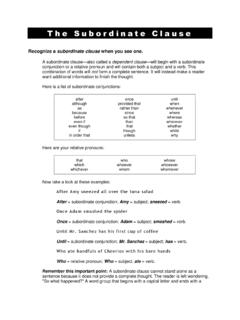
T he Subor dinat e Cl aus e
www.chompchomp.comT he Subor dinat e Cl aus e Recognize a subordinate clause when you see one. A subordinate clause—also called a dependent clause—will begin with a subordinate ...
Name Date W C E 1: THEIR T RE
www.chompchomp.com1 Name Date WORD CHOICE – EXERCISE 1: THEIR, THERE, AND THEY’RE Directions: Fill in the blanks with the appropriate choice—their, there, or they're…

T he G er und
www.chompchomp.comT he G er und Recognize a gerund when you see one. Every gerund, without exception, ends in ing.Gerunds are not, however, all that easy to identify. The problem is that all present participles also end in ing.

T he G er und Phr as e
www.chompchomp.comT he G er und Phr as e Recognize a gerund phrase when you see one. A gerund phrase will begin with a gerund, an ing word, and …
Subject-Verb Agreement – Exercise 4
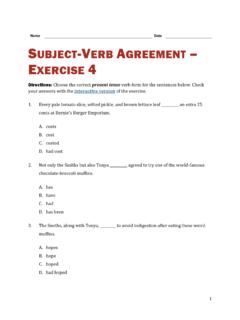
www.chompchomp.com1 Name Date SUBJECT-VERB AGREEMENT – EXERCISE 4 Directions: Choose the correct present tense verb form for the sentences below. Check your answers with the interactive version of the exercise. 1. Every pale tomato slice, wilted pickle, and …
Related documents
Unit 18: Present Perfect Tense vs. Past Tense
www.prolinguaassociates.comUnit 18: Present Perfect Tense vs. Past Tense • 81. Exercise 8: Write the sentences that your teacher reads. Use the words in the box. The number with each word is the sentence number that the word is in.
TENSES - laps.in
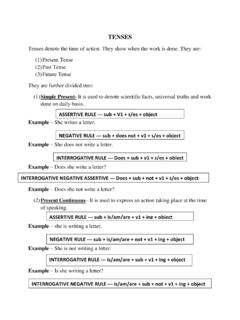
www.laps.inExample – Is she not writing a letter? (3) Present Perfect– It is used to show an action that started in the past and has just finished. Example-She has written a letter.Example – She has not written a letter. Example-Has she written a letter?Example– Has she not written a letter? (4) Present Perfect Continuous– This tense shows the action which …
The Present Perfect or The Past Simple Exercise at …
www.autoenglish.orgwww.autoenglish.org Written by Bob Wilson ©Robert Clifford McNair Wilson 2008 Answers A Past Simple Present Perfect Uses Clue words

Past perfect tense - English for Everyone
englishforeveryone.orgnow A time in the past An earlier time in the past 2) It is cold. Directions: Now make your own sentences in the past perfect simple tense. 1) _____ 2) _____ The past perfect (progressive) tense is used to describe an action that was happening
Present Perfect Tense - English for Everyone
englishforeveryone.orgnow A time in the past 2) It is cold. Directions: Now make your own sentences in the present perfect simple tense. 1) _____ 2) _____ The present perfect (progressive) tense is used to describe an action that has already begun to happen sometime in the past and continues to happen up through the present.
Present, Past, and Future Tenses - Syracuse, NY
www.syracusecityschools.comName Class ^^^^10.4 H Present, Past, and Future Tenses Date Key Information Verb tenses reveal when something happens. The present tense of a verb names an action that happens regularly. It can also express a general truth. I talk to her every day The past tense of a verb names an action that has already happened. I talked to her yesterday The future tense …
PARTICIPLES - The Latin Library
www.thelatinlibrary.comPARTICIPLES A participle is a form of a verb used as an adjective. The participle may be active or passive, but will always agree in number, case, and gender with the noun that it …
Connecting past and present 2 - …
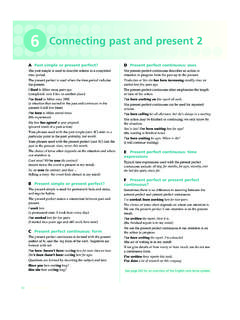
www.businessenglishonline.net30 a Past simple or present perfect? The past simple is used to describe actions in a completed time period. The present perfect is used when the time period includes
Verb Tense Chart based on Azar - University of …
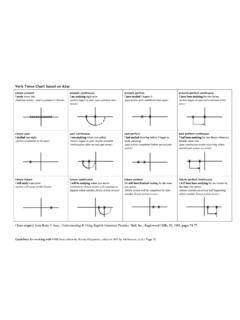
writing.umn.eduGuidelines for working with NNS (first edition by Renata Fitzpatrick; edited in 2007 by Kit Hansen, et al.) Page 16 Verb Tense Chart based on Azar simple present I study every day. (habitual action – past to present to future)
Related search queries
Unit 18: Present Perfect Tense vs. Past Tense, TENSES, Present perfect, Past, Tense, The present perfect, Past perfect tense, English for Everyone, Past perfect, Present Perfect Tense, The present, Present, Past, and Future Tenses, The present tense, Past tense, PARTICIPLES, Connecting past and present 2, Verb Tense Chart, Present