
Rules for Using Irregular Verbs
1 RULES FOR USING IRREGULAR VERBS Understand the problem. All verbs, whether regular or irregular, have five forms [often called principal parts]. These forms are the infinitive, simple present, simple past, past participle, and present participle. The difference between a regular and an irregular verb is the formation of the simple
Download Rules for Using Irregular Verbs

Information
Domain:
Source:
Link to this page:
Documents from same domain
Fragments – Exercise 1
www.chompchomp.com1 Name Date FRAGMENTS – EXERCISE 1 Directions: Read each short passage that follows. Determine which part is the fragment. Check your answers with the interactive version of the exercise.

lie irregular verbs
www.chompchomp.com1 RULES FOR USING THE IRREGULAR VERBS LAY AND LIE Understand the problem. Choosing the correct forms of lay and lie is a big challenge. Without a doubt, they are the two most difficult irregular verbs.

The Auxiliary Verb
www.chompchomp.com5 WILL +BE PRESENT PARTICIPLE Use the future progressive tense to indicate an action that will continue in the future. I will be growing broccoli in the backyard this spring.

T he I nfi ni tive
www.chompchomp.comT he I nfi ni tive Recognize an infinitive when you see one. To sneeze, to smash, to cry, to shriek, to jump, to dunk, to read, to eat, to slurp— all of these are infinitives.

R FINDING AND F SENTENCE FRAGMENTS
www.chompchomp.com1 RULES FOR FINDING AND FIXING SENTENCE FRAGMENTS Recognize the difference between a sentence and a fragment. A fragment resembles a sentence in two ways. Both groups of words begin with a
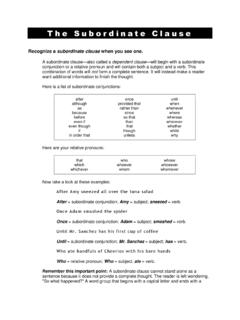
T he Subor dinat e Cl aus e
www.chompchomp.comT he Subor dinat e Cl aus e Recognize a subordinate clause when you see one. A subordinate clause—also called a dependent clause—will begin with a subordinate ...
Name Date W C E 1: THEIR T RE
www.chompchomp.com1 Name Date WORD CHOICE – EXERCISE 1: THEIR, THERE, AND THEY’RE Directions: Fill in the blanks with the appropriate choice—their, there, or they're…

T he G er und
www.chompchomp.comT he G er und Recognize a gerund when you see one. Every gerund, without exception, ends in ing.Gerunds are not, however, all that easy to identify. The problem is that all present participles also end in ing.

T he G er und Phr as e
www.chompchomp.comT he G er und Phr as e Recognize a gerund phrase when you see one. A gerund phrase will begin with a gerund, an ing word, and …
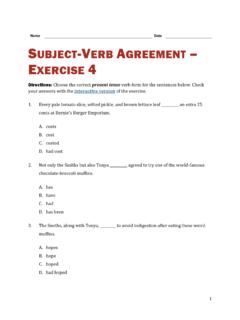
Subject-Verb Agreement – Exercise 4
www.chompchomp.com1 Name Date SUBJECT-VERB AGREEMENT – EXERCISE 4 Directions: Choose the correct present tense verb form for the sentences below. Check your answers with the interactive version of the exercise. 1. Every pale tomato slice, wilted pickle, and …
Related documents

Gerund or Infinitive Fill in the correct form.
www.english-grammar.atGERUND - INFINITIVE GI 2 Gerund or Infinitive – Fill in the correct form. 1. Mary enjoys listening to music. 2. I don’t mind doing the washing up. 3. Irregular verbs are not easy to remember. 4. Mathew is really good at cooking. 5.
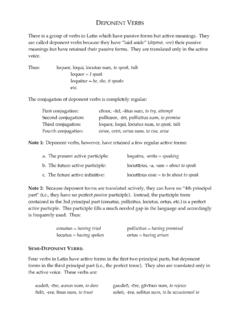
DEPONENT VERBS - The Latin Library
www.thelatinlibrary.comDEPONENT VERBS There is a group of verbs in Latin which have passive forms but active meanings. They are called deponent verbs because they have “laid aside” (dëpönö, -ere) their passive meanings but have retained their passive forms.
T he I nfi ni tive
www.chompchomp.comT he I nfi ni tive Recognize an infinitive when you see one. To sneeze, to smash, to cry, to shriek, to jump, to dunk, to read, to eat, to slurp— all of these are infinitives. An infinitive will almost always begin with to followed by the simple form of the verb, like this:

Gerund or Infinitive after the Verb Exercise 1 at Auto-English
www.autoenglish.orgwww.autoenglish.org Written by Bob Wilson ©Robert Clifford McNair Wilson 2008 Gerund or Infinitive after the Verb Exercise 1

verbs - Basby
basby.dk3 The use of the tenses Infinitive Like in English infinitive – without at (to) - is used after modal verbs: Jeg vil gerne smage din kaffe (I would like to taste your coffee) Jeg skal arbejde på søndag (I am going to work next Sunday) Jeg kan svømme (I can swim) Jeg må gå (I must/have to go)

GCSE French vouloir + infinitive/vouloir que + subjunctive ...
filestore.aqa.org.ukTravailler comme bénévole © 2015 AQA. Created by Teachit for AQA Page 1 of 5 Teaching notes This resource is designed to enable students to broaden their range of ...

Grammar videos: Verb + -ing or verb + infinitive
learnenglishteens.britishcouncil.orgRemember to w conversation After certain verbs we use the -ing form, and after other verbs we use the infinitive.Sometimes we can use either form and there is no change in meaning. Occasionally we can use either form and

englisch-hilfen.de – LEARNING ENGLISH ONLINE infinitive ...
www.englisch-hilfen.deenglisch-hilfen.de – LEARNING ENGLISH ONLINE englisch-hilfen.de – LEARNING ENGLISH ONLINE Irregular verbs - difficult - page 1 infinitive simple past past participle

1. Check your grammar: grouping verb + -ing or verb ...
learnenglishteens.britishcouncil.orgGrammar videos: Verb + -ing or verb + infinitive – exercises 3. Check your grammar: gap fill – verb + -ing or verb + infinitive Complete the sentences with the correct form of the verb in brackets.