Ruminant Digestive Anatomy and Function
Feb 28, 2011 · The ruminant digestive system uniquely qualifies ruminant animals such as cattle to make efficient use of high roughage feedstuffs such as forages. Anatomy of the ruminant digestive system includes the mouth, tongue, salivary glands, esophagus, 4-compartment stomach (rumen, reticulum, omasum, and abomasum), pancreas, gall
Download Ruminant Digestive Anatomy and Function

Information
Domain:
Source:
Link to this page:
Documents from same domain

4-H Shooting Sports - Mississippi State University
extension.msstate.eduTo develop an understanding of clay target-throwing traps and equipment. 5. To develop the ability to recognize and follow a clay target in flight. ... 4-H Shooting Sports Fundamentals of Shotgun Shooting Equipment & Handling. ... -Demonstrate using different chokes. 2. Show literature showing importance of choke. 3. Show how to tell choke of ...

Beef Cattle Handling Facilities - Mississippi State University
extension.msstate.edudrinking water for cattle and additional space. The number of cattle that will comfortably fit in a pen is based on the width and length of the pen and the size of the cattle. In general, cattle need 14 to 20 square feet of space each (see Table 1). Pen areas should be roughly tripled when holding animals for extended periods, such as overnight.

Reducing Images to 2MB Max File Size
extension.msstate.eduReducing Images to 2MB Max File Size . When uploading images on Community Connections, you must make sure the file size is less than or equal to 2MB. This guide is designed to help you find you rfile size and reduce the file size if necessary. ... Center for Technology Outreach .

Estimating Cattle Age Using Dentition
extension.msstate.eduEstimating Cattle Age Using Dentition Knowing cattle age is useful for both cattle management and marketing. Age affects cattle value. Both replacement and market cows typi-

ServSafe@ Practice Tests and Answer Keys - Diagnostic Test
extension.msstate.edu!9 When should a food handler with a sore throat and fever be excluded from the operation? A Customers served are primarily a high-risk population B Fever is over 100°F (38°C) C Sore throat has lasted for more than 5 days D Before the regulatory authority is notified @0What is a basic characteristic of a virus? A Destroyed by cooking B Grows ...
ServSafe Practice Test 7th Edition
extension.msstate.eduC where to find Safety Data Sheets in the operation. D whom to contact about suspicious activity. 5 A food handler who has just bused tables must do what before handling food? A Change apron B Wash hands C Put disposable gloves back on D Wipe hands on a cloth towel 6 As part of handwashing, food handlers must scrub their hands and arms for at least
Understanding the Ruminant Animal Digestive System
extension.msstate.eduanimal age. Ruminant Feeding Types Based on the diets they prefer, ruminants can be classified into distinct feeding types: concentrate selectors, grass/roughage eaters, and intermediate types. The relative sizes of various digestive system organs differ by ruminant feeding type, creating differences in feeding adaptations.

Fluid Fertilizers - Mississippi State University
extension.msstate.eduFluid Fertilizers Fluid fertilizers are popular because of the ease of handling and use. Movement is by pump, and they usually require less labor to handle. Some pesticides can be injected into the fluid, saving trips across the field. Fertilizers custom blended to specifications are available. Properly applied, fluid fertilizers are no more or ...

Beef Cattle Behavior and Handling
extension.msstate.eduBeef Cattle Behavior and Handling Understand Behavior to Improve Handling By understanding cattle behavioral con-cepts and sensory characteristics, handlers can take advantage of natural cattle behav-iors for low-stress handling. This can im-prove the overall safety of cattle handling. Proper animal handling also can result in a

P2632 Simple Ration Formulation: Pearson's Square
extension.msstate.edugrams are below: 1. To convert lb to kg: a. 1 lb = 0.454 kg b. 10 lb * 0.454 = 4.54 kg 2. To convert kg to lb: a. 1 kg = 2.2 lbs b. 10 kg * 2.2 = 22 lbs Converting As-Fed to Dry Matter Feeds can be reported on a dry matter (DM) or wet/as-fed basis. Almost always, nutrient concentra - tions will be reported as a percent of dry matter.
Related documents

Monogastric Digestive System - Weebly
astoriaagdepartment.weebly.comDifferent Digestive Systems •The three different types of digestive systems are: •Monogastric •Modified Monogastric •Ruminant. 8/7/2014 3 molecules capable of being used by the organism Digestion is the process by which large, complex nutrient molecules are broken down into simpler
Grades 6 to 8 • Digestive System - KidsHealth
classroom.kidshealth.orgWhen it’s functioning properly, the digestive system helps the body get the nutrients and energy it needs. But problems can occur in the digestive system. Read the KidsHealth.org article on the digestive system and the articles below, or search for others, and select one problem related to the digestive system. Research as much
Understanding the Ruminant Animal Digestive System
extension.msstate.edua digestive system designed to ferment feedstuffs and provide precursors for energy for the animal to use. By better understanding how the digestive system of the ruminant works, livestock producers can better understand how to care for and feed ruminant animals.

Digestive System of the Horse and Feeding Management - …
horses.extension.orghorse digestive tract. Figure 2. Components of Horse Digestive Tract The foregut includes the mouth, esophagus, stomach and small intestine. Digestion begins in the mouth where feeds are chewed and wetted with saliva. The chewing process cracks the outer shell of grains, reduces the particle size of feeds and increases the surface area
The Digestive System - Los Angeles Mission College
www.lamission.eduOrganization of The Digestive System Organs of the digestive system are divided into 2 main group : the gastrointestinal tract (GI tract) and accessory structures . GI tract is a continuous tube extending through the ventral cavity from the mouth to the anus –it consists of the mouth , oral cavity , oropharynx , esophagus ,
Mammalian digestive tracts - University of Illinois Urbana ...
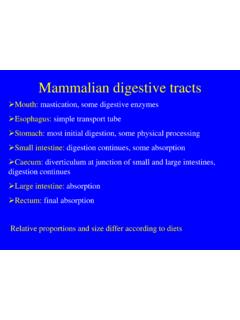
www.life.illinois.eduproportions of digestive and absorptive regions: Carnivores/insectivores: food (meat) is easy to process and digest, so 1. Relatively short post-gastric tract (2-6 X HBL) 2. Caecum reduced or absent 3. Little differentiation between small and large intestines (See examples of carnivores and insectivores on handout)
The Digestive System - National Institute of Diabetes and ...
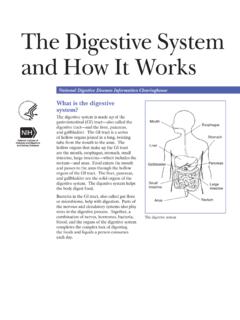
www.niddk.nih.govdigestive system. The digestive system helps the body digest food. Bacteria in the GI tract, also called gut lora or microbiome, help with digestion. Parts of the nervous and circulatory systems also play roles in the digestive process. Together, a combination of nerves, hormones, bacteria, blood, and the organs of the digestive system
Super Teacher Worksheets: Digestive System
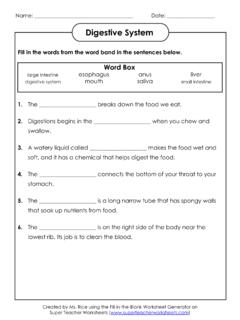
www.peekskillcsd.orgThe (digestive system) breaks down the food we eat. 2. Digestions begins in the (mouth) when you chew and swallow. 3. A watery liquid called (saliva) makes the food wet and soft, and it has a chemical that helps digest the food. 4. The (esophagus) connects the bottom of your throat to your stomach. 5. The (small intestine) is a long narrow tube ...