Second Order Linear Partial Differential Equations Part I
into a simultaneous system of 2 ordinary differential equations. They are a second order homogeneous linear equation in terms of x, and a first order linear equation (it is also a separable equation) in terms of t. Both of them can be solved easily using what we have already learned in this class.
Download Second Order Linear Partial Differential Equations Part I

Information
Domain:
Source:
Link to this page:
Documents from same domain

National Incident Management System (NIMS), An …
www.personal.psu.eduTable of Contents Table of Contents Self-Study Guide August 2004 Page 1 Lesson 1: What Is the National Incident Management System (NIMS)? Lesson Overview..... 1-2

THEORY & DESIGN OF TURBOMACHINERY
www.personal.psu.eduA COURSE ANNOUNCEMENT FOR SPRING 2002 Department of Aerospace Engineering THEORY & DESIGN OF TURBOMACHINERY Tuesday and …

DEEP LEARNING - REVIEW - Pennsylvania State …
www.personal.psu.eduSource : Deep learning Yann LeCun, Yoshua Bengio, Geoffrey Hinton Nature 521, 436– 444 (28 May 2015) doi:10.1038/nature14539 . STOCHASTIC GRADIENT DESCENT.
TRAIT AND BEHAVIORAL THEORIES OF …
www.personal.psu.edupersonnel psychology 2011, 64, 7–52 trait and behavioral theories of leadership: an integration and meta-analytic test of their relative validity

Elementary Differential Equations and Boundary …
www.personal.psu.eduFirst Order Differential Equations place to permit successful breeding, and the population rapidly declined to extinc-tion. The last survivor died in 1914. The precipitous decline in the passenger pigeon ... Elementary Differential Equations and Boundary Value Problems, Ninth Edition ...

S. Shyam Sundar - Pennsylvania State University
www.personal.psu.eduS. Shyam Sundar (PhD, Stanford University) is distinguished professor and founding director of the Media Effects Research Laboratory at Penn State University’s College of Communications.

Lecture 1 Stochastic Optimization: Introduction
www.personal.psu.eduStochastic optimization captures a broad class of problems, including convex, nonconvex (time permitting), and discrete optimization problems (not considered here).
Linear Programming Lecture Notes
www.personal.psu.edu4.6 Convex Direction: Clearly every point in the convex set (shown in blue) can be the vertex for a ray with direction [1;0]T contained entirely in the convex set. Thus [1;0]T is a direction of this convex set.57 4.7 An Unbounded Polyhedral Set: This unbounded polyhedral set has many

The Chernobyl Disaster (1986) - Pennsylvania State University
www.personal.psu.eduThe Chernobyl Disaster (1986) Disaster Mitigation The Chernobyl Nuclear Reactor used a graphite reactor, called a positive void effect, that produced extremely unpredictable and uncontrollable spikes in power production. The positive void reactor commonly produced large steam bubbles, referred to as “voids” in this system, within the ...

Math 312, Intro. to Real Analysis: Midterm Exam #1 Solutions
www.personal.psu.eduMath 312, Intro. to Real Analysis: Midterm Exam #1 Solutions Stephen G. Simpson Friday, February 13, 2009 1. True or False (3 points each) (a) Every ordered field has the Archimedean property.
Related documents

Solving Differential Equations Using Simulink
people.uncw.eduJul 01, 2019 · 8 solving differential equations using simulink shown in Figure 1.17. Figure 1.16: Scope plot of the solution of dx dt = 2sin3t 4x, x(0) = 0, with Refine Factor= 10. Figure 1.17: Connections for the First Order ODE model for dx dt = 2sin3t 4x showing how to provide an external initial value. 1.2 Handling Time in First Order Differential ...

Systems of First Order Linear Differential Equations
www.personal.psu.edu5. Convert the third order linear equation below into a system of 3 first order equation using (a) the usual substitutions, and (b) substitutions in the reverse order: x 1 = y″, x 2 = y′, x 3 = y. Deduce the fact that there are multiple ways to rewrite each n-th order linear equation into a linear system of n equations. y″′ + 6y″ + y ...

CHAPTER 6: SYSTEMS OF TWO LINEAR EQUATIONS IN TWO ...
sccollege.eduChapter 6 . 173 . Example: a) Given the graph, identify the solution to the system of equations. Verify the solution. YOU TRY a) Is the ordered -pair (2,1) the solution to the system

Matrix Solutions to Linear Equations - Alamo Colleges …
www.alamo.eduThe solution set for this system of equations is (1, -1, 1). The simplest matrix containing the solutions to the linear equations is called a reduced row-echelon matrix. Normally, we can solve a system of linear equations if the number of variables is equal to the number of independent equations. For example, if there are three variables in a

Second Order Systems
www.et.byu.edu2 Origins of Second Order Equations 1.Multiple Capacity Systems in Series K1 τ1s+1 K2 τ2s +1 become or K1 K2 ()τ1s +1 ()τ2s+1 K τ2s2 +2ζτs+1 2.Controlled Systems (to be discussed later) 3.Inherently Second Order Systems

Systems of Equations Assessment Review
www.husd.org5. What is the result of the correct first step to solve this system of equations by elimination? 4x - 3y = -10 2x + 3y = 4 a) 6x = -6 b) 2x = -6 c) 6x = 14 d) 2x = 14 6. Select the coordinate point that is a solution to this system of equations using your method of choice. x y -3x y
Partial Differential Equations
www.math.toronto.eduLinear equations of order 2 (d)General theory, Cauchy problem, existence and uniqueness; (e) Linear homogeneous equations, fundamental system of solutions, Wron-skian; (f)Method of variations of constant parameters. Linear equations of order 2 with constant coe cients (g)Fundamental system of solutions: simple, multiple, complex roots;
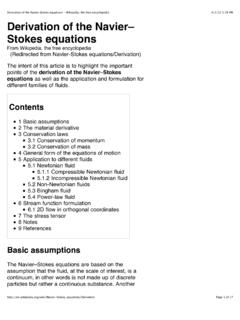
Derivation of the Navier–Stokes equations - Wikipedia, the ...
www.math.ucdavis.edu(Redirected from Navier-Stokes equations/Derivation) The intent of this article is to highlight the important points of the derivation of the Navier–Stokes equations as well as the application and formulation for different families of fluids. Contents 1 Basic assumptions 2 The material derivative 3 Conservation laws 3.1 Conservation of momentum