
section 7 - ACC
Section 7: equipment for moving and handling people 7.2 Types of equipment Table 7.1 shows the main types of equipment used for moving people, and examples of common uses. Some types of equipment are known by several names, as shown. Detailed descriptions of each type of equipment are provided later in this section.
Download section 7 - ACC

Information
Domain:
Source:
Link to this page:
Documents from same domain

Low Level Laser Therapy (LLLT) for Musculoskeletal Pain
www.acc.co.nzLow level laser therapy (LLLT) has been developed as a technology for pain management for decades. In response to a funding request, the Evidence Based

Guidelines for using computers - ACC
www.acc.co.nz6 Guidelines for using computers – preventing and managing discomfort, pain and injury WHaT Is a coMPuTer WorKsTaTIon? We define ‘a computer’ as the combination of computer hardware, display screen, keyboard and/or mouse or other input device.
Hearing Aid Battery Order Form - ACC
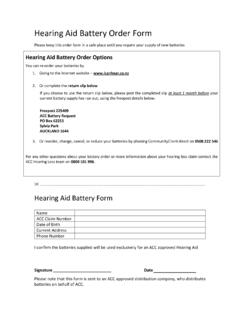
www.acc.co.nzHearing Aid Battery Order Form Please keep this order form in a safe place until you require your supply of new batteries Hearing Aid Battery Order Options

Concussion Service
www.acc.co.nzConcussion is the most common type of Traumatic Brain Injury (TBI) and refers to mild to moderate TBIs (MTBI). MTBI is a technical term used more commonly in general medical contexts. However, the term ‘concussion’ is still commonly used in sports medicine and is used here to describe this service.

Caring for your child after their head injury - ACC
www.acc.co.nzCaring for your child after their head injury Warning signs You should seek medical help (either go to the hospital or call 111 for an ambulance) if your child has any of the following warning signs in the first 24 hours after the injury: • Is hard to wake …

Mental Injury Assessments for ACC
www.acc.co.nzexplain the development or severity of any presenting symptoms (e.g., attachment issues often result in personality difficulties). • Whether the extent and severity of the difficulties experienced is greater or lesser than you would expect given the nature of the events reported and to what extent other non-event

Dissociative Identity Disorder diagnostic guide - ACC
www.acc.co.nzdiagnostic guide This summary aims to assist you to diagnose adult Dissociative Identity Disorder (DID; see Appendix 1 for definition) in your mental health assessment of ACC clients. The summary sets out the difficulties in DID diagnosis, and outlines best practice diagnostic criteria. This summary is adapted from the International

Training for Independence Services Operational Guidelines
www.acc.co.nzo proactively identifying potential issues and resolving them. • ensuring the education, assessment and therapy provided is appropriate to the diagnosis • providing ACC with a copy of the Client’s agreed rehabilitation/service plan • taking all practical actions to ensure the Client attends, participates and

Accredited Employers Programme - ACC - Home
www.acc.co.nzorganisational health and safety management will be reviewed. 2. Evidence that the effectiveness of health and safety management has been reviewed in the last 12 months. 3. Procedure/s to review health and safety management that occurs after: • a notifiable event • changes in work procedures • changes in health and safety policies and ...

Treatment Injury Claim Lodgement Guide - ACC
www.acc.co.nzInjury Claim appropriately. Use this guide to: • identify what you need to discuss with your patient before lodging a claim, including making sure they have given their consent • help you decide whether to lodge a Treatment Injury Claim • confirm the key information you need to send to ACC to help a timely decision.
Related documents
Material Safety Data Sheet
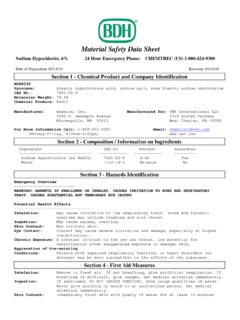
webs.anokaramsey.eduSection 7 - Handling and Storage Keep in a tightly closed container, stored in a cool, dry, ventilated area. Protect against physical damage. Isolate from incompatible substances. Containers of this material may be hazardous when empty since they retain product residues (vapors, liquid); observe all warnings and precautions listed for the product.

Basic Elements of Equipment Cleaning and Sanitizing in ...
edis.ifas.ufl.eduBasic Elements of Equipment Cleaning and Sanitizing in Food Processing and Handling Operations 2 understanding of the nature of the different types of food soil and the chemistry of its removal. Cleaning Methods Equipment can be categorized with regard to cleaning method as follows: • Mechanical Cleaning. Often referred to as clean-in-place ...
A quick guide to health and safety in ports - HSE
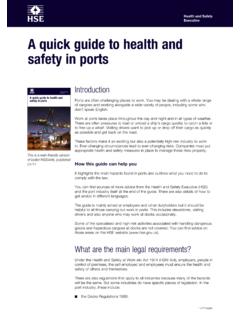
www.hse.gov.uk4 of 11 pages Health and Safety Executive A quick guide to health and safety in ports Movement of vehicles and other plant on the dockside. Trailer coupling and uncoupling on the dockside and on the ship. Vehicle/pedestrian access, eg ro-ro bridges and vessel ramps. Reversing vehicles on ro-ro decks. Movement of vehicles in container storage areas and lorry parks.

The Ergonomics of Manual Material Handling - MHI
www.mhi.orgThe Ergonomics of Manual Material Handling A. Factors That Affect Pushing and Pulling Figure 3 captures the essence of a pushing task – the person pushing must overcome the forces that resist motion. To generate and apply force to the equipment, she must have adequate
CARGO-HANDLING EQUIPMENT ON BOARD AND IN PORT
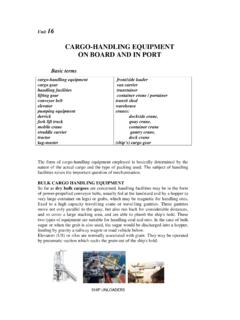
www.pfri.uniri.hrBULK CARGO HANDLING EQUIPMENT So far as dry bulk cargoes are concerned, handling facilities may be in the form of power-propelled conveyor belts, usually fed at the landward end by a hopper (a very large container on legs) or grabs, which may be magnetic for handling ores, fixed to a high capacity travel1ing crane or travel1ing gantries.

Material Handling – Loading and Unloading
www.ucop.eduMaterial Handling – Loading and ... 1 NEVER attempt to operate a forklift or other powered industrial equipment until trained and authorized to do so 2 Prior to loading and unloading trucks and trailers, complete the following whether the truck/trailer is at a dock