
SEISMIC LOAD ANALYSIS - Memphis
•Selection of method of analysis ... Irregularity (1a) exists if stiffness of any story is less than 70% of the stiffness of the story above or less than 80% of the average stiffness of the three stories above. ... Normalized Displacement Normalized Shear Design Elastic Expected.
Download SEISMIC LOAD ANALYSIS - Memphis

Information
Domain:
Source:
Link to this page:
Documents from same domain
Chapter 11 SEISMIC DESIGN CRITERIA - Civil …
www.ce.memphis.eduP1: JsY ASCE003-11.tex ASCE003/SIE-v1.cls September 29, 2005 17:5 Chapter 11 SEISMIC DESIGN CRITERIA 11.1 GENERAL 11.1.1 Purpose. Chapter 11 presents criteria for the design and
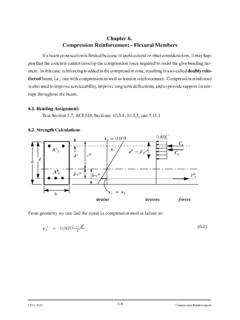
Chapter 6. Compression Reinforcement - Flexural …
www.ce.memphis.eduCIVL 4135 118 Compression Reinforcement Chapter 6. Compression Reinforcement - Flexural Members Ifabeamcrosssectionislimitedbecauseofarchitecturalorotherconsiderations,itmayhap-

Review of Engineering Fundamentals - University …
www.ce.memphis.eduReview of Engineering Fundamentals CIVL 4197. Course Format ... FE Chemical 853 77% FE Civil 4,874 70% FE Electrical & Computer 1,217 …

ASCE Requirements for Citations f13 - Civil …
www.ce.memphis.eduASCE Requirements for Citations Books Feld, J. and Carper, K. (1997). Construction Failure, 2nd Ed., Wiley, New York. Book references must include author, book title, publisher, and the publisher’s

2 - Aggregate Gradation and Sampling - Civil …
www.ce.memphis.eduCIVL 3137 3 Gradation Analysis percent coarser or percent retained percent finer or percent passing

BEAM DESIGN - University of Memphis
www.ce.memphis.edu6 2. SHEAR DESIGN IN FLAT PLATES AND FLAT SLABS When two-way slabs are supported directly by columns, as in flat slabs and flat plates, or when slabs carry concentrated loads, as in footings, shear near the columns is of critical

Topic 14 - Foundation Design - Civil Engineering
www.ce.memphis.eduInstructional Materials Complementing FEMA 451, Design Examples Foundation Design 14-7 Reinforced Concrete Footings: Basic Design Criteria (concentrically loaded) d/2 …
Curing Concrete, Chapter 12 - The University of …
www.ce.memphis.edu221 Chapter 12 Curing Concrete 3. Methods that accelerate strength gain by supplying heat and additional moisture to the concrete. This is usually accomplished with live steam, heating coils,

AAA CE4135 ver2 - Civil Engineering
www.ce.memphis.eduCIVL 4135 Chapter 1. Introduction • 2 A problem unique to the design of reinforced concrete structures is the need to detail each member throughout.

Aggregates for Concrete - Department of Civil …
www.ce.memphis.eduT 27). The range of particle sizes in aggregate is illustrated in Fig. 5-4. The aggregate particle size is determined by using wire-mesh sieves with square openings.
Related documents
Chapter 4 - Matrix Stiffness Method
colincaprani.comThe matrix stiffness method is the basis of almost all commercial structural analysis programs. It is a specific case of the more general finite element method, and was in ... Using the basic relationship that force is equal to stiffness times displacement, we can determine the force at node 1 as: ( ) 1 Fk = net displacement at 1. Thus: ( ) 1 1 ...

Chapter 2 – Introduction to the Stiffness (Displacement ...
www.ce.memphis.eduThe Stiffness (Displacement) Method 1.Select Element Type-Consider the linear spring shown below. The spring is of length L and is subjected to a nodal tensile force, T directed along the x-axis. f1x 2x f Note: Assumed sign conventions The Stiffness (Displacement) Method 2.Select a Displacement Function-A displacement function u(x) is assumed ...
Beam Stiffness - Memphis
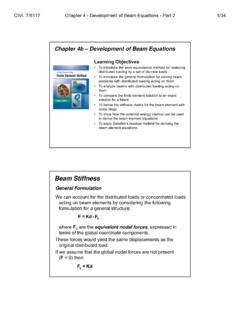
www.ce.memphis.eduBeam Stiffness Comparison of FE Solution to Exact Solution Values of displacement and slope at other locations along the beam for the FE are obtained by using the assumed cubic displacement function. 32 3 22 3322 11 vx x xLv xL xL() 2 3 LL The value of the displacement at the midlengthv(x = 50 in) is: v x in in( 50 ) 0.0278

Force Method for Analysis of Indeterminate Structures
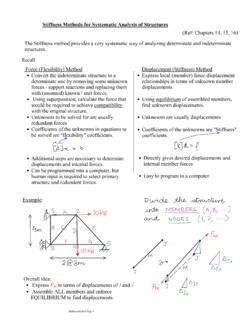
engineering.purdue.eduDisplacement (Stiffness) Method Express local (member) force -displacement relationships in terms of unknown member displacements. • Using equilibrium of assembled members, find unknown displacements. • • Unknowns are usually displacements Coefficients of the unknowns are "Stiffness" coefficients. • Convert the indeterminate structure to a
Stiffness Methods for Systematic Analysis of Structures
engineering.purdue.eduStiffness Methods for Systematic Analysis of Structures (Ref: Chapters 14, 15, 16) The Stiffness method provides a very systematic way of analyzing determinate and indeterminate structures. Displacement (Stiffness) Method Express local (member) force -displacement relationships in terms of unknown member displacements. •

Introduction to Stiffness Analysis
web.engr.uky.eduStiffness Analysis 2 displacements. The number of unknowns in the stiffness method of analysis is known as the degree of kinematic indeterminacy, which refers to the number of node/joint displacements that are unknown and are needed to describe the displaced shape of the structure. One major advantageof the stiffness method of analysis is that

Direct Analysis Method Handout - AISC
www.aisc.orgReduce all stiffness that contributes to stability 2nd-order analysis – include both P- and P- K=1 for member design Serviceability checks use unreduced stiffness 27 DIRECT ANALYSIS METHOD APPLICATION Accurately model frame behavior Factor loads (even for ASD) Consider initial imperfections (apply notional loads)
BEAM ANALYSIS USING THE STIFFNESS METHOD
www.erbakan.edu.trStiffness Matrix! General Procedures! Internal Hinges! Temperature Effects! Force & Displacement Transformation! Skew Roller Support BEAM ANALYSIS USING THE STIFFNESS METHOD. 2 Slope ΠDeflection Equations