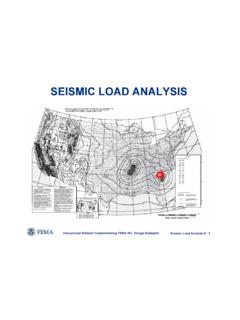
SEISMIC LOAD ANALYSIS - Memphis
5a, 5b) Strength (Weak Story) Irregularity Vertical Structural Irregularities Irregularity (5a) exists if the lateral strength of any story is less than 80% of the strength of the story above. An extreme irregularity (5b) exists If the lateral strength of any story is less than 65% of the strength of the story above. Irregularities 5a and 5b ...
Download SEISMIC LOAD ANALYSIS - Memphis

Information
Domain:
Source:
Link to this page:
Documents from same domain
Chapter 11 SEISMIC DESIGN CRITERIA - Civil …
www.ce.memphis.eduP1: JsY ASCE003-11.tex ASCE003/SIE-v1.cls September 29, 2005 17:5 Chapter 11 SEISMIC DESIGN CRITERIA 11.1 GENERAL 11.1.1 Purpose. Chapter 11 presents criteria for the design and
Chapter 6. Compression Reinforcement - Flexural …
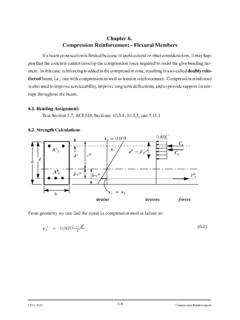
www.ce.memphis.eduCIVL 4135 118 Compression Reinforcement Chapter 6. Compression Reinforcement - Flexural Members Ifabeamcrosssectionislimitedbecauseofarchitecturalorotherconsiderations,itmayhap-

Review of Engineering Fundamentals - University …
www.ce.memphis.eduReview of Engineering Fundamentals CIVL 4197. Course Format ... FE Chemical 853 77% FE Civil 4,874 70% FE Electrical & Computer 1,217 …

ASCE Requirements for Citations f13 - Civil …
www.ce.memphis.eduASCE Requirements for Citations Books Feld, J. and Carper, K. (1997). Construction Failure, 2nd Ed., Wiley, New York. Book references must include author, book title, publisher, and the publisher’s

2 - Aggregate Gradation and Sampling - Civil …
www.ce.memphis.eduCIVL 3137 3 Gradation Analysis percent coarser or percent retained percent finer or percent passing
BEAM DESIGN - University of Memphis
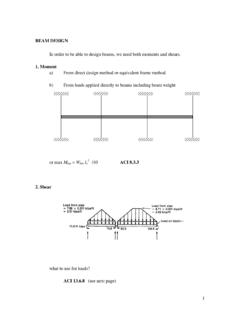
www.ce.memphis.edu6 2. SHEAR DESIGN IN FLAT PLATES AND FLAT SLABS When two-way slabs are supported directly by columns, as in flat slabs and flat plates, or when slabs carry concentrated loads, as in footings, shear near the columns is of critical

Topic 14 - Foundation Design - Civil Engineering
www.ce.memphis.eduInstructional Materials Complementing FEMA 451, Design Examples Foundation Design 14-7 Reinforced Concrete Footings: Basic Design Criteria (concentrically loaded) d/2 …
Curing Concrete, Chapter 12 - The University of …
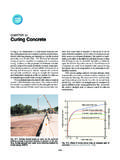
www.ce.memphis.edu221 Chapter 12 Curing Concrete 3. Methods that accelerate strength gain by supplying heat and additional moisture to the concrete. This is usually accomplished with live steam, heating coils,
AAA CE4135 ver2 - Civil Engineering
www.ce.memphis.eduCIVL 4135 Chapter 1. Introduction • 2 A problem unique to the design of reinforced concrete structures is the need to detail each member throughout.
Aggregates for Concrete - Department of Civil …
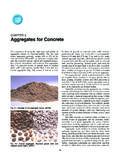
www.ce.memphis.eduT 27). The range of particle sizes in aggregate is illustrated in Fig. 5-4. The aggregate particle size is determined by using wire-mesh sieves with square openings.
Related documents
Chapter 2 Design for Shear - Engineering
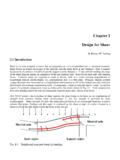
by.genie.uottawa.ca2.2 Shear strength of beams Equation (11-3) of ACI 318-05, Section 11.3.1.1 permits the shear strength Vc of a beam without shear reinforcement to be taken as the product of an index limit stress of 2√fc’ times a nominal area bwd. With fc’ expressed in lb/in 2 units and beam dimensions in inches, nominal shear strength V c = 2√fc’bwd ...

Calculating Anchor Bolt Pullout Strength - zaab.org
robot.zaab.orgcalled its Shear Strength. A conservative value for concrete shear strength is 800 psi. To determine the force required to pullout the bolt separating it at the epoxy to concrete bond, use the following calculation: Force = D x x L x 800 psi Where: F = Bolt Pullout Force in lbs. D = Grout Hole Diameter in inches L = Length in inches of the ...

The strength and dilatancy of sands
www-civ.eng.cam.ac.ukshear deformation can continue in the absence of a volume change. The point of peak strength, P, is usually associ- ated with the maximum rate of dilation defined as ( - d&,/de Jmax where E, is the volumetric strain and ai is the major principal strain (both defined positive in compression).
Aerospace Threaded Fastener Strength in Combined Shear …
ntrs.nasa.govtensile strength or minimum double shear strength in either a standard part or procurement speci-fication. These values are usually derived by multiplying the thread tensile stress area by the design allowable ultimate tensile stress of the fastener material or by …
8. STRENGTH OF SOILS AND ROCKS - University of Melbourne
people.eng.unimelb.edu.aushear stress is the shear strength of the soil for the particular value of the normal force N or normal stress (N/A) applied to the soil, where A is the cross sectional area of the soil sample. Fig. 8.8 shows that a dense sand has a greater shear strength than a loose sand and this strength is reached at a smaller value of the displacement.
Bending: Design for Strength, Stiffness and Stress ...
sites.esm.psu.eduDesign for Strength Once the loading scenarios are determined, we can draw shear and moment load diagrams for a beam under each scenario. For example, if we know the load for a beam, but its location is uncer-tain, then for one scenario we would locate the load to achieve a maximum moment; for the other we would locate it to achieve maximum shear.
USING THE POINT LOAD TEST TO DETERMINE THE UNIAXIAL ...
www.cdc.govstrength, direct shear strength, long term creep, roof bolt anchorage capacity, slake durability, ultrasonic velocity, swelling strain and Atterberg limits. The diametral point load (DPL) was not initiated until 1996, which resulted from an interest in utilizing of …
Defining Yield Stress and Failure Stress (Strength)
www.failurecriteria.comstrength are widely codified and quoted. Modulus E is straightforward but the terms yield stress and strength have a somewhat ambiguous history of use. In fact, there has not even been agreement on the proper designations for these properties. The terms yield point, proportional limit, yield strength have been used for the first property.