
SELECTIVE AND DIFFERENTIAL MEDIA
as glucose-salts, as well as rich, chemically complex media such as brain heart infusion agar and tryptic soy broth. However, these general growth media may permit the growth unwanted microorganisms from clinical or environmental samples that are not relevant to the purpose of the microbiological examination.
Download SELECTIVE AND DIFFERENTIAL MEDIA

Information
Domain:
Source:
Link to this page:
Documents from same domain

Biology of Fungi, Lecture 3: Fungal Structure and …
crcooper01.people.ysu.eduBiology of Fungi Lecture 3: Fungal Structure and Function Page 2 of 5 Fungal Cell Wall u Functions Q Structural barrier Q Determines pattern of cell …

GELATIN HYDROLYSIS TEST
crcooper01.people.ysu.edu2) Using aseptic technique and a microbiology needle, inoculate the respective tube with the appropriate bacterium by stabbing the medium three-fourths of the way to the bottom of the tube. 3) Incubate all tubes for 1 to 7 days at 37°C. 4) Periodically throughout the incubation period, remove the tubes from the incubator and

BASIC CULTURE TECHNIQUE STREAK PLATE
crcooper01.people.ysu.edu3) Using aseptic technique, sterilize a microbiological loop using either the gas burner or the Bacti-Cinerator (see the exercise entitled Basic Microbiology Technique: Aseptic Transfer). 4) While holding the loop between the thumb and forefinger, grasp the mixed bacterial culture in …

DETERMINATION OF MICROBIAL NUMBERS
crcooper01.people.ysu.eduDetermination of Microbial Numbers, Page 4 of 20 given volume. Discerning between live and dead cells requires that the cells be stained in a specific manner. The chamber portion of the hemocytometer incorporates a special counting grid (Fig. 3). This grid has specific dimensions in length and width, typically 3 mm x 3 mm, with each grid divided
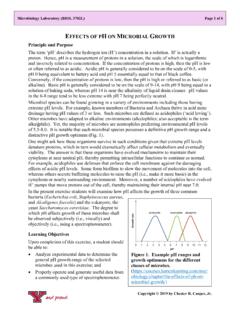
EFFECTS OF PH ON MICROBIAL GROWTH
crcooper01.people.ysu.edu• Sabouraud dextrose agar culture (3-5 days old) of Saccharomyces kudriavzevii (ATCC 2601; formerly designated as Saccharomyces cerevisiae) [abbreviated as S. kudriavzevii] Materials • Sterile saline (5 ml) in standard test tube • Sterile bulb transfer pipettes • TSB (3 ml) in 13 x 100 mm tubes • TSB, pH 3.0, (3 ml) in 13 x 100 mm tubes
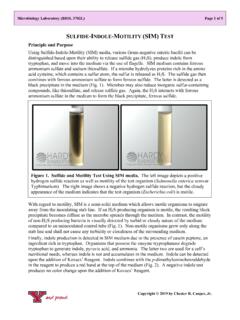
SULFIDE-INDOLE-MOTILITY (SIM) TEST
crcooper01.people.ysu.eduFinally, indole production is detected in SIM medium due to the presence of casein peptone, an ingredient rich in tryptophan. Organisms that possess the enzyme tryptophanase degrade tryptophan to generate indole, pyruvic acid, and ammonia. The latter two are used for a cell’s nutritional needs, whereas indole is not and accumulates in the medium.

CARBOHYDRATE FERMENTATION TEST - Youngstown State …
crcooper01.people.ysu.eduMicrobiology Laboratory (BIOL 3702L) Page 1 of 6 CARBOHYDRATE FERMENTATION TEST Principle and Purpose Microorganisms need to generate energy in order to grow, divide, and survive. In any given environment, different sugars (i.e., carbohydrates) may be available. Microbes must possess the
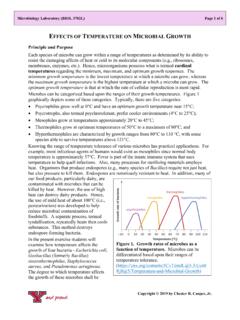
EFFECTS OF TEMPERATURE ON MICROBIAL GROWTH
crcooper01.people.ysu.eduaureus, and Pseudomonas aeruginosa. The degree to which temperature affects the growth of these microbes shall be Figure 1. Growth rates of microbes as a function of temperature. Microbes can be differentiated based upon their ranges of temperature tolerance.
Related documents
Handy One-Page LID Summary - ThyCa
www.thyca.orgHandy One-Page LID Summary—Tear-Out Copy ©2020 ThyCa: Thyroid Cancer Survivors’ Association, Inc. SM www.thyca.org For the detailed Free Low-Iodine Cookbook with hundreds of delicious recipes, visit www.thyca.org. Key Points This is a Low-Iodine Diet (“LID”), not a “No-Iodine Diet” or an “Iodine-Free Diet.” The American Thyroid
Microbiological Best Laboratory Practices, USP <1117 ...
microbiologynetwork.comwith R2A agar, but many facilities use TSA (Trypticase Soy Agar) or HPCA (Heterotrophic Plate Count Agar) for this purpose. The recommendation is provided that the choice of media should be consistent, appropriate and justified. An entire section is devoted to the question of media storage and the effects this might have on the media quality.
Sensory evaluation - Jones & Bartlett Learning
samples.jbpub.comimpulses that travel to the brain via the optic nerve. 5 Perception by the visual system of light of wavelengths 400–500 nanometers (nm; blue), 500–600 nm (green and yellow), and 600–800 nm (red) is commonly expressed in terms
Blood Agar Plates and Hemolysis Protocols
asm.org"Blood Agar" is not a consistently defined medium. The term "blood agar" generally refers to an enriched base medium to which defibrinated mammalian blood has been added. In the US "blood agar" is usually prepared from Tryptic Soy Agar or Columbia Agar base with 5% Sheep blood. Rabbit or horse blood may be

LOW-IODINE DIET BEFORE IODINE SCAN
endocrine.ucsf.edusalted nuts, soy sauce, BBQ or hot sauces, ketchup. 3. Asian foods containing a lot of salt (soy sauce, hot sauces, preserved eggs, seaweed). 4. No soy sauce. 5. Ocean fish, cod, shrimp, other shellfish, seaweed, kelp, agar. 6. White bread and rolls (made with iodate dough conditioners). Wheat or rye bread is generally OK (check label). Rice is ...

Agars Bacto Agar • Agar, Grade A • Agar, Granulated Agar ...
legacy.bd.comAgar, Technical • Agar, Noble • Agarose • Agar, Select Intended Use Bacto™ Agar is a solidifying agent in which extraneous matter, pigmented portions and salts have been reduced to a minimum. Bacto Agar is used in preparing microbiological culture media. Agar, Grade A is a high-grade agar, specially processed for microbiological purposes.

Tryptic Soy Agar - BD
legacy.bd.comBD Tryptic Soy Agar is used in a variety of industrial microbiology procedures, e.g., in microbial limit testing and in water and food microbiology.1-3,6,7 Unsupplemented Tryptic Soy Agar is used for cultivation of many less fastidious bacteria, e.g., Enterobacteriaceae, nonfermenting Gram negative rods (Pseudomonas and many others),
ANNEX Preparation of Media and Reagents
www.cdc.govA. Blood agar plate (BAP): trypticase soy agar (TSA) + 5% sheep blood . A BAP is used as a general blood agar medium. It is used for growth and testing of N. meningitidis and S. pneumoniae. The plate should appear a bright red color. If the plates appear dark red, they are either old or the blood was likely added when the agar was too hot. If ...
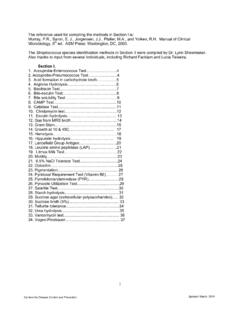
Streptococcus Laboratory General Methods
www.cdc.govInoculate a trypticase soy 5% sheep blood agar plate by streaking a heavy inoculum onto one-fourth of the plate and streak the remaining portion for isolated colonies. Place a vancomycin disk on the heaviest part of the inoculum, and put the plate into a candle extinction jar or a CO. 2.