
Shoulder: Rotator Cuff Isometric Program – Standing
X08252 (Rev. 11/2019) ©AAHC \OT Shoulder/Scapula Shoulder: Rotator Cuff Isometric Program – Standing. Isometric exercises are muscle tightening exercises performed with no joint movement. Their action is to increase circulation for healing and strengthening muscles with minimal joint irritation.
Download Shoulder: Rotator Cuff Isometric Program – Standing

Information
Domain:
Source:
Link to this page:
Documents from same domain

Lower Extremity Strengthening Exercises in Supine
ahc.aurorahealthcare.orgLower Extremity Strengthening Exercises in Supine, Page 2 X19572bc (Rev. 04/10) ©AHC Lower Extremity The information presented is intended for general information and educational purposes.

Relaxation Exercises - Aurora Health Care
ahc.aurorahealthcare.orgX26017 (07/06) ©AHC Breathing/Relaxation Relaxation Exercises The information presented is intended for general information and educational purposes. It is not intended to replace the advice of your health care provider. Contact your health care provider if you believe you have a health problem.

Hip: Straight Leg Raise – Supine 4-Way - Aurora Health Care
ahc.aurorahealthcare.orgHip: Straight Leg Raise – Supine 4-Way Straight leg raise – flexion 1. Lie on your back. 2. Bend uninvolved knee and put foot on floor. 3. Slowly tighten the thigh muscle of the involved leg, performing a quad set. 4. Flex foot of involved leg toward nose. 5. Slowly lift entire leg 12 to 18 inches off floor.
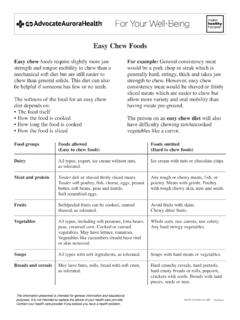
Easy Chew Foods - Aurora Health Care
ahc.aurorahealthcare.orgEasy Chew Foods. Easy chew foods require slightly more jaw strength and tongue mobility to chew than a mechanical soft diet but are still easier to chew than general solids. This diet can also be helpful if someone has few or no teeth. The softness of the food for an easy chew

“D (Rh) Type” and “D Variant” Antigen
ahc.aurorahealthcare.org“D (Rh) Type” and “D Variant” Antigen What is the D antigen? D antigen is a protein with many parts, found on the surface of red blood cells. The D antigen is also known as the “Rh factor” and it tells us your blood type. People are either D (Rh) negative or D (Rh) positive. If your blood type is D negative, your red

Vestibular Rehabilitation Exercises – Level 1
ahc.aurorahealthcare.orgVestibular Rehabilitation Exercises – Level 1, page 3 X20521 (Rev. 12/2019) ©AAHC Vertigo/Vestibular. The information presented is intended for general information and educational purposes. It is not intended to replace the advice of your health care provider. Contact your health care provider if you believe you have a health problem. 6.
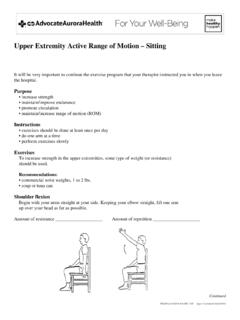
Upper Extremity Active Range of Motion – Sitting
ahc.aurorahealthcare.orgTo increase strength in the upper extremities, some type of weight (or resistance) should be used. Recommendations: • commercial wrist weights, 1 to 2 lbs. • soup or tuna can . Shoulder flexion Begin with your arms straight at your side. Keeping your elbow straight, lift one arm . up over your head as far as possible.
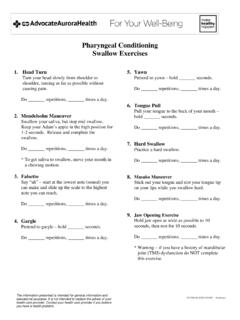
Pharyngeal Conditioning Swallow Exercises
ahc.aurorahealthcare.orgSwallow your saliva, but stop mid swallow. Keep your Adam’s apple in the high position for 1-2 seconds. Release and complete the swallow. Do _____ repetitions, _____ times a day. * To get saliva to swallow, move your mouth in a chewing motion. 3. Falsetto 8. Say “ah” – start at the lowest note (sound) you

Cervical Range of Motion and Isometrics Home Exercise …
ahc.aurorahealthcare.org3. Neck Flexion. Slowly bend your head forward, return to the starting position. Hold . Perform . seconds. Repeat times per day. times. 4. Neck Sidebending. Slowly tilt your head toward one shoulder, then slowly repeat . to the opposite side while keeping your face straight ahead. Hold . Perform . seconds. Repeat times per day. times. 5. Neck ...

Shaker Exercise - Aurora Health Care
ahc.aurorahealthcare.org1. Lie flat on your back. 2. Lift your head and look at your toes (lift head only, do not raise shoulders). 3. Hold this position (the goal is 60 seconds). 4. Relax, lower head and rest one minute. *Perform steps 1 to 4 three times. 5. Lift head up and lower head quickly 30 times (head only, do not raise shoulders). Tips
Related documents
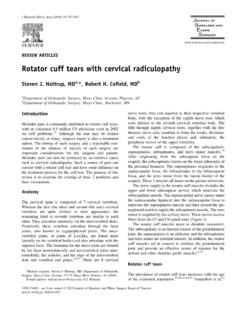
Rotator cuff tears with cervical radiculopathy
www.rearmyourself.comShoulder pain is commonly attributed to rotator cuff tears, with an estimated 4.5 million US physician visits in 2002 for cuff problems.51 Although the tear may be treated conservatively at times, surgical repair is also a treatment option. The timing of such surgery and a reasonable esti-mation of the chances of success of such surgery are

Small Rotator Cuff Repair Protocol - Fowler Kennedy
fowlerkennedy.comthe rotator cuff repair.13 Remove for showering and range of motion exercises Minimize postoperative pain and inflammation Controlled passive shoulder motion (under therapist supervision and within pain …
LARGE ROTATOR CUFF REPAIR PROTOCOL
www.fowlerkennedy.comthe rotator cuff repair.13 Remove for showering and range of motion exercises Minimize postoperative pain and inflammation Controlled passive shoulder motion (under therapist supervision and within pain …
Shoulder Orthopedic Tests - OrthoSurgery
www.orthosurgery.grRotator Cuff Instability • Clinical Signs and Symptoms – Severe anterior lateral shoulder pain – Pain when sleeping on the affected side – Stiffness – “Catching” of the shoulder during use – Pain on active and passive range of motion – Localized tenderness – Unable to abduct shoulder

Rotator Cuff Repair Protocol - Boston Shoulder Institute
bostonshoulderinstitute.comArthroscopic Rotator Cuff Repair Protocol: The intent of this protocol is to provide the clinician with a guideline of the post-operative rehabilitation course of a patient that has undergone an arthroscopic assisted/mini-open rotator cuff repair. It is no means intended to …

Shoulder Tendonitis
sportmed.comThis leads to pain and loss of shoulder strength and motion. • Impingement tendinitis. When the space is narrowed between the rotator cuff and the coracoacromial arch, the humerus can “pinch” the rotator cuff tendon into the arch. This can happen when the cuff is weak, the bursa is swollen or if there is a bone spur present. Tendinitis ...

Rotator Cuff Repair - Twin Cities Orthopedics
tcomn.comSub-maximal rotator cuff isometrics (no pain). ! Advance prone series to include T’s. ! Add rows with weights or bands. ! Supine chest-flys providing both strength and active anterior shoulder stretch. ! Supine (adding weight as tolerated) progressing to standing PNF patterns. ! Seated active ER at 90/90. ! Biceps and triceps PRE.
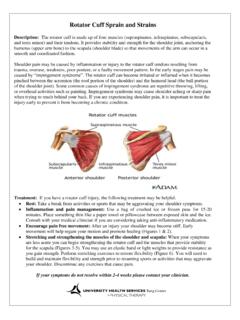
Rotator Cuff Sprain and Strains
uhs.berkeley.eduShoulder pain may be caused by inflammation or injury to the rotator cuff tendons resulting from trauma, overuse, weakness, poor posture, or a faulty movement pattern. In the early stages pain may be caused by “impingement syndrome”. The rotator cuff can become irritated or inflamed when it becomes
Arthroscopic Rotator Cuff Repair Frequently Asked Questions
www.brighamandwomens.orgThis protocol is designed for the patient following arthroscopic rotator cuff repair. Those patients who have good rotator cuff tissue integrity, a one to two tendon repair, with a tear 3 centimeters or less will typically be progressed on the quicker end of these time frames. Those patients with poor rotator cuff tissue integrity, tear of 2

Rehabilitation Protocol for Rotator Cuff Repair-Small to ...
www.massgeneral.orgMar 11, 2019 · The American Society of Shoulder and Elbow Therapists’ consensus statement on rehabilitation following arthroscopic rotator cuff repair. J Shoulder Elbow Surg. 2016. 25, p 521-535. Van der Meijden, O.A., Westgard, P., Chandler, Z., et al. Rehabilitation after arthroscopic rotator cuff repair: current concepts review and evidence-based guidelines.