Solar System Math - NASA
¥ There are asteroids orbiting the Sun in a region between the inner and outer planets. ¥ Asteroids are rock and metallic objects that orbit the Sun, but are too small to be considered planets. *In August 2006, Pluto was reclassified as a Òdwarf planet.Ó
Download Solar System Math - NASA

Information
Domain:
Source:
Link to this page:
Documents from same domain
Q: What do you do on the International Space …
www.nasa.govQ: What do you do on the International Space Station (ISS)? A: Astronauts and cosmonauts on the space station stay busy.There’s lots of work to operate the many science experiments on board.
NEPA RECORD OF ENVIRONMENTAL …
www.nasa.govDec 13, 2012 · JSC Form 1119 (Revised January 25, 2011)(MS Word October 2010) NEPA RECORD OF ENVIRONMENTAL CONSIDERATION (REC) Complete this form if you answered “yes” or “unknown” on any JF 1138 entries and if
Use of XSLT to transform the output of multiple …
www.nasa.govNASA IV&V International Workshop 2014 1 Use of XSLT to transform the output of multiple Static Code Analysis tools into a consistent analysis spreadsheet format
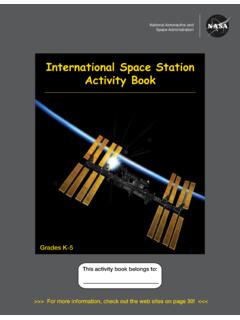
International Space Station Activity Book
www.nasa.govNational Aeronautics and Space Administration . Grades K-5 . This activity book belongs to: International Space Station Activity Book >>> For more information, check out the web sites on page 30!
Gravity, Who Needs It
www.nasa.govGravity, Who Needs It? ... six months on the space station versus three years on a Mars mission? No. ... human, being more isolated ...
Glide Slope Ratio
www.nasa.govGlide Slope Ratio The Glide Slope Ratio is a number that indicates how well your designed shoebox glider flies through the air in terms of its forward distance vs. its drop in altitude. Glide Ratio = Horizontal Distance divided by the Change in Altitude.
Modeling, SiMulation, inforMation technology & …
www.nasa.govTA11-1 exeCuTive Summary Figure 1 is an initial draft strategic roadmap for the Modeling, Simulation, Information Technol-ogy and Processing Technology Area.
NASA Technology Roadmaps
www.nasa.gov2015 NASA Technology Roadmaps TA 11: Modeling, Simulation, Information Technology, and Processing TA 11- 2 July 2015 Foreword NASA is leading the way with a balanced program of space exploration, aeronautics, and science research.
A Journey to Inspire, Innovate, and Discover
www.nasa.govReport of the President’s Commission on 2 Implementation of United States Space Exploration Policy Transmittal Letter June 4, 2004 The Honorable George W. Bush
National Aeronautics and Space Administration Headquarters
www.nasa.govGEMS is a Category 3 project (less than $250M) in Phase B, and was requesting transition from Formulation to Implementation (Phase C) where the official Agency baseline is established and external commitments are made
Related documents
Solar System Scale Model - Stanford University
solar-center.stanford.eduAsteroids dust 540 - 945 m Dust to 950 km 2-3.5 AU 300-525 million km Jupiter 250 mm 1.4 km 140,000 km 5.2 AU 780 million km Saturn Rings 210 mm 450 mm 2.6 km -- 116,000 km ~280,000 km. 1. 9.6 AU 1500 million km Uranus 91 mm 5.2 km 51,000 km 19 AU 2900 million km Neptune 89 mm 8.1 km 50,000 km 30 AU 4500 million km ...
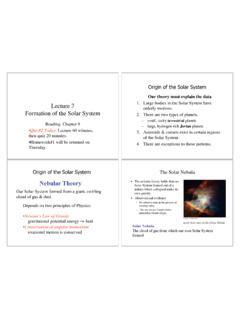
Nebular Theory Solar System formed out of a
www.as.utexas.edu3.Asteroids & comets exist in certain regions of the Solar System 4.There are exceptions to these patterns. Origin of the Solar System Nebular Theory Depends on two principles of Physics: ¥NewtonÕs Law of Gravity gravitaional potential energy ! heat ¥Conservation of angular momentum rotational motion is conserved
Earth Science Regents Review #2 - MR. FERRO'S PHYSICS
ferrophysics.weebly.coma) Our solar system (sun, planets, asteroids, comets, meteors) formed 4.6 billion years ago when a cloud of gas and dust was pulled together due to gravity. b) Terrestrial planets (inner four) are rocky and small. Jovian planets (outer four) are gaseous …

The Planetary and Lunar Ephemerides DE430 and DE431
ipnpr.jpl.nasa.govThe set of 343 asteroids is identical to the set used in DE421. The set represents 90 percent of the total mass of the main belt and contains the asteroids with the most significant ef-fects on the orbit of Mars in terms of perturbation amplitude and frequency [7]. For DE421,
An Overview of SPICE - NASA
naif.jpl.nasa.govasteroids and spacecraft • Size, shape and orientation of planets, satellites, comets and asteroids • Orientation of a spacecraft and its various moving structures • Instrument field-of-view location on a planet’s surface or atmosphere Overview of SPICE
and Coordinate Systems - NASA
naif.jpl.nasa.gov•Dwarf planets*, asteroids and comets spin in the right hand sense about their “positive pole.” –What the IAU now calls the “positive pole” is still referred to as the “north pole” in SPICE documentation. –The “positive pole” may point above or below the – • –

Earth Timeline - NASA
nightsky.jpl.nasa.govHow often do asteroids hit Earth? In the beginning of Earth's history, asteroids were constantly hitting the Earth. This was called the Heavy Bombardment Phase and ended 3.8 billion years ago, allowing a more stable environment for life to form. In Earth's recent history, there are fewer impacts, but they do still happen.

Space Technology Grand Challenges - NASA
www.nasa.govasteroids that pass within 45 million kilometers of the Earth’s orbit. Some near earth objects are potentially large enough to be hazardous to the Earth in the event of a direct collision. Although impact with large objects is rare, the history of Earth indicates that such events do occur. A better understanding of the likelihood