Example: biology
Earth Timeline - NASA
How often do asteroids hit Earth? In the beginning of Earth's history, asteroids were constantly hitting the Earth. This was called the Heavy Bombardment Phase and ended 3.8 billion years ago, allowing a more stable environment for life to form. In Earth's recent history, there are fewer impacts, but they do still happen.
Tags:
Information
Domain:
Source:
Link to this page:
Documents from same domain
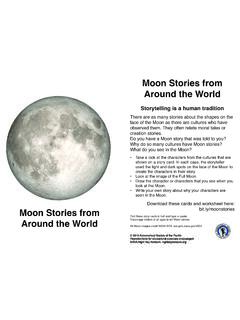
Moon Stories from Around the World - Night Sky Network
nightsky.jpl.nasa.govNASA Night Sky Network nightskynetwork.org Moon Stories from Around the World Storytelling is a human tradition There are as many stories about the shapes on the face of the Moon as there are cultures who have observed them. They often relate moral tales or creation stories.
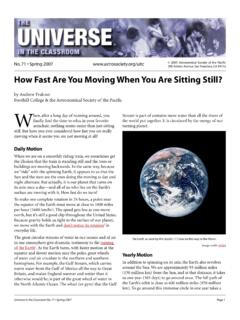
How Fast Are You Moving When You Are Sitting Still?
nightsky.jpl.nasa.govThe Earth as seen by the Apollo 17 Crew on the way to the Moon. Universe in the Classroom No. 71 • Spring 2007 Page 2 speed of 66,000 miles per hour (107 million km/hr)3. At ... astronomers were not sure how to answer this question. We could measure the motion of the Milky Way relative to a neighbor galaxy, but this galaxy is also
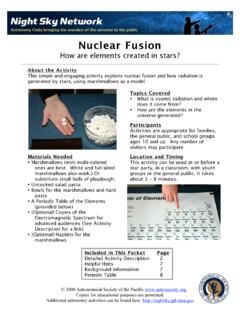
Nuclear Fusion - NASA
nightsky.jpl.nasa.govThis simple and engaging activity explains nuclear fusion and how radiation is generated by stars, using marshmallows as a model. ... For more information about exposure to radioactivity and its effects on the body, search the Internet for “radiation sickness”. ... Space Agency (ESA) orbiting observatory, designed to observe high- ...

Magnification vs. Resolution - Night Sky Network
nightsky.jpl.nasa.gov1. As you increase magnification (by using different eyepieces), the amount of sky you are looking at will generally get smaller - you are looking a smaller amount of the object you are viewing. The amount of light the telescope is gathering does not change. The resolution of the telescope does not change. The area of sky the scope

Does the Moon Rotate? - NASA
nightsky.jpl.nasa.govhours of sunset or within two hours after sunrise. To Say: People sometimes wonder if the Moon rotates. To us on Earth, the Moon always has the same face pointed toward us. So the Moon might not seem to rotate. But to someone on the Moon, it certainly does – the Moon experiences
Related documents

The Planetary and Lunar Ephemerides DE430 and DE431
ipnpr.jpl.nasa.govThe set of 343 asteroids is identical to the set used in DE421. The set represents 90 percent of the total mass of the main belt and contains the asteroids with the most significant ef-fects on the orbit of Mars in terms of perturbation amplitude and frequency [7]. For DE421,
An Overview of SPICE - NASA
naif.jpl.nasa.govasteroids and spacecraft • Size, shape and orientation of planets, satellites, comets and asteroids • Orientation of a spacecraft and its various moving structures • Instrument field-of-view location on a planet’s surface or atmosphere Overview of SPICE
Solar System Math - NASA
www.nasa.gov¥ There are asteroids orbiting the Sun in a region between the inner and outer planets. ¥ Asteroids are rock and metallic objects that orbit the Sun, but are too small to be considered planets. *In August 2006, Pluto was reclassified as a Òdwarf planet.Ó
Solar System Scale Model - Stanford University
solar-center.stanford.eduAsteroids dust 540 - 945 m Dust to 950 km 2-3.5 AU 300-525 million km Jupiter 250 mm 1.4 km 140,000 km 5.2 AU 780 million km Saturn Rings 210 mm 450 mm 2.6 km -- 116,000 km ~280,000 km. 1. 9.6 AU 1500 million km Uranus 91 mm 5.2 km 51,000 km 19 AU 2900 million km Neptune 89 mm 8.1 km 50,000 km 30 AU 4500 million km ...
Nebular Theory Solar System formed out of a
www.as.utexas.edu3.Asteroids & comets exist in certain regions of the Solar System 4.There are exceptions to these patterns. Origin of the Solar System Nebular Theory Depends on two principles of Physics: ¥NewtonÕs Law of Gravity gravitaional potential energy ! heat ¥Conservation of angular momentum rotational motion is conserved
Earth Science Regents Review #2 - MR. FERRO'S PHYSICS
ferrophysics.weebly.coma) Our solar system (sun, planets, asteroids, comets, meteors) formed 4.6 billion years ago when a cloud of gas and dust was pulled together due to gravity. b) Terrestrial planets (inner four) are rocky and small. Jovian planets (outer four) are gaseous …
and Coordinate Systems - NASA
naif.jpl.nasa.gov•Dwarf planets*, asteroids and comets spin in the right hand sense about their “positive pole.” –What the IAU now calls the “positive pole” is still referred to as the “north pole” in SPICE documentation. –The “positive pole” may point above or below the – • –

Space Technology Grand Challenges - NASA
www.nasa.govasteroids that pass within 45 million kilometers of the Earth’s orbit. Some near earth objects are potentially large enough to be hazardous to the Earth in the event of a direct collision. Although impact with large objects is rare, the history of Earth indicates that such events do occur. A better understanding of the likelihood