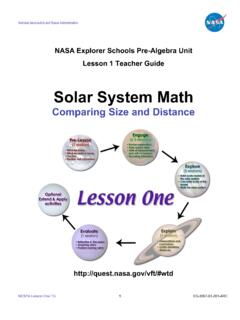
Solar System Math - NASA
[Optional] Math Review: Converting Units Teacher Resource (TG pp.10-16)! [Optional] Math Review: Converting Units Student Practice (SW p.3) This activity is a good way to find out where students are in terms of their basic knowledge of the solar system before beginning the lesson. First, discuss with students the basic properties of our solar ...
Download Solar System Math - NASA

Information
Domain:
Source:
Link to this page:
Documents from same domain
Q: What do you do on the International Space …
www.nasa.govQ: What do you do on the International Space Station (ISS)? A: Astronauts and cosmonauts on the space station stay busy.There’s lots of work to operate the many science experiments on board.
NEPA RECORD OF ENVIRONMENTAL …
www.nasa.govDec 13, 2012 · JSC Form 1119 (Revised January 25, 2011)(MS Word October 2010) NEPA RECORD OF ENVIRONMENTAL CONSIDERATION (REC) Complete this form if you answered “yes” or “unknown” on any JF 1138 entries and if
Use of XSLT to transform the output of multiple …
www.nasa.govNASA IV&V International Workshop 2014 1 Use of XSLT to transform the output of multiple Static Code Analysis tools into a consistent analysis spreadsheet format
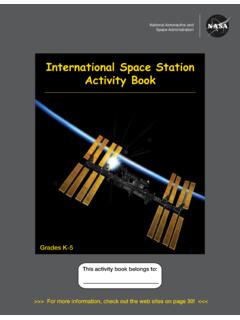
International Space Station Activity Book
www.nasa.govNational Aeronautics and Space Administration . Grades K-5 . This activity book belongs to: International Space Station Activity Book >>> For more information, check out the web sites on page 30!
Gravity, Who Needs It
www.nasa.govGravity, Who Needs It? ... six months on the space station versus three years on a Mars mission? No. ... human, being more isolated ...
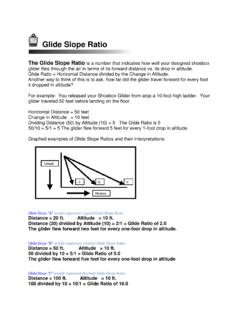
Glide Slope Ratio
www.nasa.govGlide Slope Ratio The Glide Slope Ratio is a number that indicates how well your designed shoebox glider flies through the air in terms of its forward distance vs. its drop in altitude. Glide Ratio = Horizontal Distance divided by the Change in Altitude.
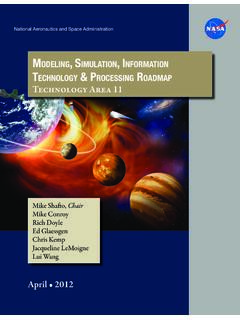
Modeling, SiMulation, inforMation technology & …
www.nasa.govTA11-1 exeCuTive Summary Figure 1 is an initial draft strategic roadmap for the Modeling, Simulation, Information Technol-ogy and Processing Technology Area.
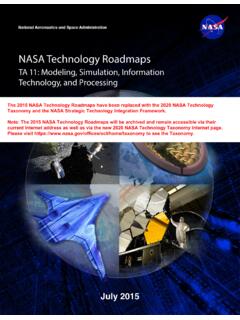
NASA Technology Roadmaps
www.nasa.gov2015 NASA Technology Roadmaps TA 11: Modeling, Simulation, Information Technology, and Processing TA 11- 2 July 2015 Foreword NASA is leading the way with a balanced program of space exploration, aeronautics, and science research.
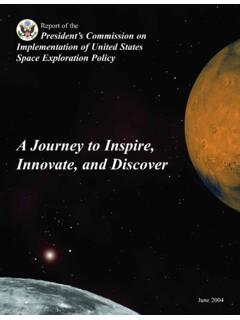
A Journey to Inspire, Innovate, and Discover
www.nasa.govReport of the President’s Commission on 2 Implementation of United States Space Exploration Policy Transmittal Letter June 4, 2004 The Honorable George W. Bush
National Aeronautics and Space Administration Headquarters
www.nasa.govGEMS is a Category 3 project (less than $250M) in Phase B, and was requesting transition from Formulation to Implementation (Phase C) where the official Agency baseline is established and external commitments are made
Related documents
SAMPLE SYLLABUS SAMPLE SYLLABUS TEMPLATE
apps.ccc.edu: This 8-week Adult Basic Education Math course is designed to reinforce addition, subtraction, and estimation competencies, simple decimals and fractions are also introduced during the course. Mathematical lessons reflect real-life situations and usage in which sound knowledge of vocabulary, critical thinking, and mathematical concepts are needed.
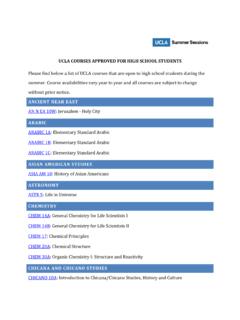
UCLA COURSES APPROVED FOR HIGH SCHOOL STUDENTS
summer.ucla.eduEPS SCI 9: Solar System and Planets EPS SCI 15: Blue Planet: Introduction to Oceanography ECONOMICS ECON 1: Principles of Economics ECON 2: Principles of Economics ... MATH 1: Precalculus MATH 31A: Differential and Integral Calculus MATH 32A: Calculus of Several Variables MATH 33A: Linear Algebra and Applications
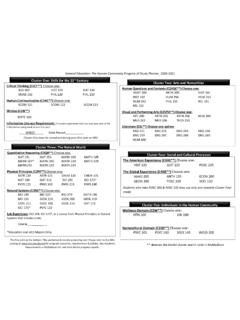
Cluster One: Skills for the 21st - James Madison University
www.jmu.eduMATH 229: Introduction to Applied Statistics Using R MATH 231: Calculus with Functions I MATH 233: A Modeling Approach to Calculus MATH 235: Calculus Physical Principles _ ASTR 120: The Solar System ASTR 121: Stars, Galaxies, and Cosmology CHEM 120: Concepts of Chemistry CHEM 131: General Chemistry (lab co-requisite)

Solar system worksheet - K5 Learning
www.k5learning.comTitle: Solar system worksheet Author: K5 Learning Subject: Grade 2 Science - Solar system Keywords: science, worksheet, grade 2, Solar system Created Date
SIXTH GRADE WEATHER - msnucleus.org
www.msnucleus.orgSolar radiation refers to the number of hours of bright sunshine per day. Both solar and terrestrial are measurable by total radiation receivers. Visibility. This is defined as the maximum distance an object can be distinguished against the background sky. Observations of current temperatures, humidity, wind, pressure, and highest and
5 Grade Curriculum Space Systems: Stars and the S ar System
www.ou.edu-PRELIMINARY MATH BACKGROUND: Students may need to review place values since this lesson uses numbers in the hundred thousands. There are ... asked to think about where the next closest star after the sun would be on the model to see the huge gap after the solar system.

The Solar System - Start with a Book
www.startwithabook.org2 Introduction Our solar system is the Sun and everything that travels around it. Traveling around the Sun are eight official planets, at least five dwarf planets, nearly 200 moons (or natural satellites of the planets), and a large number of comets and asteroids. Supplies • Tape measure • Rolls of toilet paper