Example: quiz answers
SIXTH GRADE WEATHER - msnucleus.org
Solar radiation refers to the number of hours of bright sunshine per day. Both solar and terrestrial are measurable by total radiation receivers. Visibility. This is defined as the maximum distance an object can be distinguished against the background sky. Observations of current temperatures, humidity, wind, pressure, and highest and
Tags:
Information
Domain:
Source:
Link to this page:
Documents from same domain

THIRD GRADE HUMAN BIOLOGY - msnucleus.org
www.msnucleus.orgTHIRD GRADE HUMAN BIOLOGY 2 WEEKS LESSON PLANS AND ACTIVITIES. Math/Science Nucleus ©1990,2000 2 ... Discussing human body systems. VOCABULARY: circulatory digestive endocrine muscle nervous renal respiratory sensory skeleton ... The respiratory system has lungs, diaphragm, and esophagus. However, the heart is also part of the respiratory as ...

SIXTH GRADE - msnucleus.org
www.msnucleus.orgSIXTH GRADE 1 WEEK LESSON PLANS AND ... POST: Comparing the different components of the Universe. SOLAR SYSTEM WEEK 2. PRE: Exploring the structure of our Sun. LAB: Calculating the weight of objects on different planets. POST: Exploring astronomical themes in songs. EARTH WEEK 3. PRE: Comparing the motion of the Sun, Earth, and Moon. LAB ...

FOURTH GRADE UNIVERSE - msnucleus.org
www.msnucleus.orgOVERVIEW OF FOURTH GRADE UNIVERSE WEEK 1. PRE: Comparing astrology and astronomy. ... Exploring the Earth/Moon system. POST: Comparing the landscapes of the Earth and Moon. GEOGRAPHY ... As the Earth moves around the Sun, the Sun comes between the Earth and each

FOURTH GRADE WEATHER - msnucleus.org
www.msnucleus.orgA weather map is a graphical representation of how the meteorologist may interpret the information they receive. The weather map is a way to chart all the data points to easily see if there are patterns emerging from the weather patterns. PROCEDURE: 1. Refer back to last week's lab on how air moves. Discuss pressure systems.
THIRD GRADE - msnucleus.org
www.msnucleus.orgVenus, Earth and Mars and the gas planets of Jupiter, Saturn, Uranus, and Neptune. Pluto is considered a terrestrial planet, but not an inner planet. Moons, or natural satellites, are bodies that revolve around a …
SECOND GRADE VOLCANOES - msnucleus.org
www.msnucleus.orgthe picture on their worksheet. Have them color their pictures. Ask them to use their ... power and the mystery of a volcanic event is truly an earthy phenomena. Students ... Next, have the students place a little baking soda in the flask, and then pour in an appropriate amount of vinegar.
SECOND GRADE WEATHER - k-12 Science Curriculum ngss ...
www.msnucleus.orgOVERVIEW OF SECOND GRADE WATER WEEK 1. PRE: Exploring the properties of water. LAB: Experimenting with different soap mixtures. POST: Analyzing the water cycle. OCEANS WEEK 2. PRE: Interpreting how water is recycled. LAB: Distinguishing polluted, dirty, and clean water. POST: Comparing solvents and solutes. ATMOSPHERE WEEK 3. PRE ...
SIXTH GRADE MINERALS - msnucleus.org
www.msnucleus.orgPOST: Comparing an ore with a mineral. ROCKS WEEK 4. PRE: Discovering how rocks are formed by plate tectonics. LAB: Distinguishing where rocks are located within the rock cycle. POST: Writing a creative essay on rocks. WEEK 5. PRE: Discussing decorative uses of rocks. LAB: Distinguishing between adhesives and cements.
Related documents
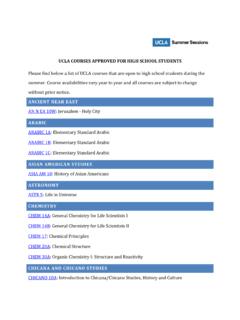
UCLA COURSES APPROVED FOR HIGH SCHOOL STUDENTS
summer.ucla.eduEPS SCI 9: Solar System and Planets EPS SCI 15: Blue Planet: Introduction to Oceanography ECONOMICS ECON 1: Principles of Economics ECON 2: Principles of Economics ... MATH 1: Precalculus MATH 31A: Differential and Integral Calculus MATH 32A: Calculus of Several Variables MATH 33A: Linear Algebra and Applications
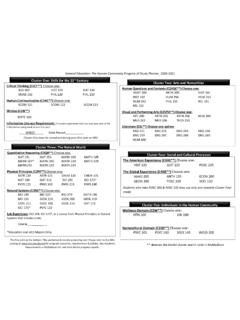
Cluster One: Skills for the 21st - James Madison University
www.jmu.eduMATH 229: Introduction to Applied Statistics Using R MATH 231: Calculus with Functions I MATH 233: A Modeling Approach to Calculus MATH 235: Calculus Physical Principles _ ASTR 120: The Solar System ASTR 121: Stars, Galaxies, and Cosmology CHEM 120: Concepts of Chemistry CHEM 131: General Chemistry (lab co-requisite)
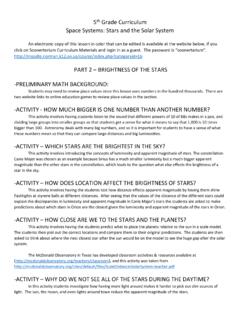
5 Grade Curriculum Space Systems: Stars and the S ar System
www.ou.edu-PRELIMINARY MATH BACKGROUND: Students may need to review place values since this lesson uses numbers in the hundred thousands. There are ... asked to think about where the next closest star after the sun would be on the model to see the huge gap after the solar system.
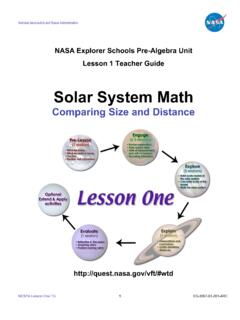
Solar System Math - NASA
www.nasa.gov[Optional] Math Review: Converting Units Teacher Resource (TG pp.10-16)! [Optional] Math Review: Converting Units Student Practice (SW p.3) This activity is a good way to find out where students are in terms of their basic knowledge of the solar system before beginning the lesson. First, discuss with students the basic properties of our solar ...

The Solar System - Start with a Book
www.startwithabook.org2 Introduction Our solar system is the Sun and everything that travels around it. Traveling around the Sun are eight official planets, at least five dwarf planets, nearly 200 moons (or natural satellites of the planets), and a large number of comets and asteroids. Supplies • Tape measure • Rolls of toilet paper

Solar system worksheet - K5 Learning
www.k5learning.comTitle: Solar system worksheet Author: K5 Learning Subject: Grade 2 Science - Solar system Keywords: science, worksheet, grade 2, Solar system Created Date
SAMPLE SYLLABUS SAMPLE SYLLABUS TEMPLATE
apps.ccc.edu: This 8-week Adult Basic Education Math course is designed to reinforce addition, subtraction, and estimation competencies, simple decimals and fractions are also introduced during the course. Mathematical lessons reflect real-life situations and usage in which sound knowledge of vocabulary, critical thinking, and mathematical concepts are needed.