Example: barber
SIXTH GRADE - msnucleus.org
SIXTH GRADE 1 WEEK LESSON PLANS AND ... POST: Comparing the different components of the Universe. SOLAR SYSTEM WEEK 2. PRE: Exploring the structure of our Sun. LAB: Calculating the weight of objects on different planets. POST: Exploring astronomical themes in songs. EARTH WEEK 3. PRE: Comparing the motion of the Sun, Earth, and Moon. LAB ...
Tags:
Information
Domain:
Source:
Link to this page:
Documents from same domain

FOURTH GRADE UNIVERSE - msnucleus.org
www.msnucleus.orgOVERVIEW OF FOURTH GRADE UNIVERSE WEEK 1. PRE: Comparing astrology and astronomy. ... Exploring the Earth/Moon system. POST: Comparing the landscapes of the Earth and Moon. GEOGRAPHY ... As the Earth moves around the Sun, the Sun comes between the Earth and each
THIRD GRADE - msnucleus.org
www.msnucleus.orgVenus, Earth and Mars and the gas planets of Jupiter, Saturn, Uranus, and Neptune. Pluto is considered a terrestrial planet, but not an inner planet. Moons, or natural satellites, are bodies that revolve around a …
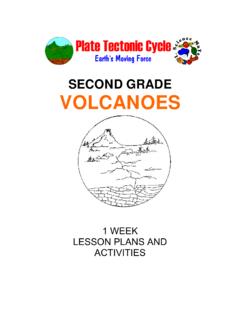
SECOND GRADE VOLCANOES - msnucleus.org
www.msnucleus.orgthe picture on their worksheet. Have them color their pictures. Ask them to use their ... power and the mystery of a volcanic event is truly an earthy phenomena. Students ... Next, have the students place a little baking soda in the flask, and then pour in an appropriate amount of vinegar.
SECOND GRADE WEATHER - k-12 Science Curriculum ngss ...
www.msnucleus.orgOVERVIEW OF SECOND GRADE WATER WEEK 1. PRE: Exploring the properties of water. LAB: Experimenting with different soap mixtures. POST: Analyzing the water cycle. OCEANS WEEK 2. PRE: Interpreting how water is recycled. LAB: Distinguishing polluted, dirty, and clean water. POST: Comparing solvents and solutes. ATMOSPHERE WEEK 3. PRE ...

THIRD GRADE HUMAN BIOLOGY - msnucleus.org
www.msnucleus.orgTHIRD GRADE HUMAN BIOLOGY 2 WEEKS LESSON PLANS AND ACTIVITIES. Math/Science Nucleus ©1990,2000 2 ... Discussing human body systems. VOCABULARY: circulatory digestive endocrine muscle nervous renal respiratory sensory skeleton ... The respiratory system has lungs, diaphragm, and esophagus. However, the heart is also part of the respiratory as ...
SIXTH GRADE MINERALS - msnucleus.org
www.msnucleus.orgPOST: Comparing an ore with a mineral. ROCKS WEEK 4. PRE: Discovering how rocks are formed by plate tectonics. LAB: Distinguishing where rocks are located within the rock cycle. POST: Writing a creative essay on rocks. WEEK 5. PRE: Discussing decorative uses of rocks. LAB: Distinguishing between adhesives and cements.

FOURTH GRADE WEATHER - msnucleus.org
www.msnucleus.orgA weather map is a graphical representation of how the meteorologist may interpret the information they receive. The weather map is a way to chart all the data points to easily see if there are patterns emerging from the weather patterns. PROCEDURE: 1. Refer back to last week's lab on how air moves. Discuss pressure systems.
SIXTH GRADE WEATHER - msnucleus.org
www.msnucleus.orgSolar radiation refers to the number of hours of bright sunshine per day. Both solar and terrestrial are measurable by total radiation receivers. Visibility. This is defined as the maximum distance an object can be distinguished against the background sky. Observations of current temperatures, humidity, wind, pressure, and highest and
Related documents

Chapter 23: The Sun-Earth-Moon System
mrnortonatsaswinsted.weebly.comChapter 23: The Sun-Earth-Moon System Section 3: Exploring Earth’s Moon Section 1: Earth Section 2: The Moon – Earth’s Satellite. Chapter 23: The Sun-Earth-Moon System Section 1: Earth Grade 6 Earth Science Mr. Norton . Section 1: Earth Section Objectives

STEM Curriculum Map Specifics Grade 5 Prepared by ...
people.umass.eduExploring Earth www.windows2univers e.org Earth ! www.usgs.gov The Water Cycle, Water Cycle for Schools www.geography4kids. com Biosphere, Hydrosphere, ... Exploring Earth, Sun and Moon; Earth’s Rotation and Revolution, What’s Up in Space? Stars; Gravity, Force and Work Science Video Vocabulary: Gravity

th Exploring the Sun - abc.net.au
www.abc.net.auExploring the Sun 1. Discuss the Exploring the Sun story with another student. ... 3. How many days does it take for the Earth to orbit the Sun? 4. What happens at the core of the Earth? 5. What ...

M E SSE N Exploring Solar Systems Across the Universe
messenger.jhuapl.eduThe sun, the earth, and the rest of the solar system formed from a nebular cloud of dust and gas 4.6 billion years ago. The early earth was very different from the planet we live on today.

22 Lesson Section 3 Exploring Earth’s Moon - Glencoe
ww.glencoe.com64 The Sun-Earth-Moon System Copyright © Glencoe/McGraw-Hill, a division of the McGraw-Hill Companies, Inc. Schedule Block Schedule: 1.5 sessions ( denotes ...

Exploring World Cultural Geography
continentalacademy.netWelcome to your Continental Academy course “Exploring Worl d Cultural Geography”. It is made up of 8 indivi dual lessons, as listed in the Table of ... to orbit around the earth. [a] Sun [b] Moon [c] Earth [d] Mars . Exploring World Cultural Geography 9 ... Exploring World Cultural Geography 10 Earth. Parallels circle the globe from east to ...

Exploring Science
d3r1z7wkgqhj9d.cloudfront.netExploring Science is designed to be used with your 4 or 5 year old student. ... Unit 6: Exploring the Earth Unit 7: Exploring Chemistry Unit 8: Exploring Sound ... Sun is a giant light source for the Earth. When something blocks out the Sun’s light, a shadow is also

Exploring Earth, Sun, and - Amazon S3
s3.amazonaws.comPage 2 Exploring Earth, Sun, and Moon VisualLearningCompany1-800-453-8481 The purchase of this video program entitles the user the right to reproduce or duplicate, in whole or in part, this teacher’s guide and the black line master handouts

Planetary Magnetism Teacher's Guide - |LASP|CU-Boulder
lasp.colorado.eduo Earth’s protection from the Sun’s harmful effects: Earth’s atmosphere shields the surface from high-energy radiation from the Sun, and the magnetosphere shields it from most of the charged particles.

Earth and Space - paterson.k12.nj.us
paterson.k12.nj.usThe sun, which is also a star, is much, much closer to the Earth than any other star in the universe. Once students understand these concepts, they should explore the effect of distance on the apparent brightness of the sun in relation to
Related search queries
Chapter 23: The Sun-Earth-Moon System, Exploring Earth, Earth, Exploring Earth, Sun and, Exploring, Exploring Solar Systems Across the Universe, Exploring World Cultural Geography, Exploring Worl d Cultural Geography, Exploring Science, Exploring Earth, Sun, and, Amazon S3, Planetary Magnetism Teacher's Guide